

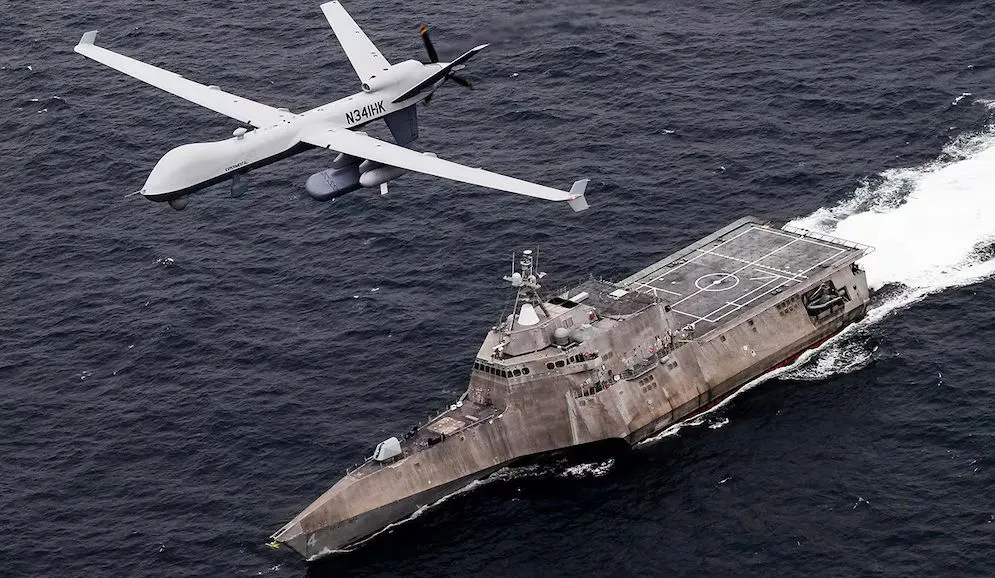
Two of America’s leading defense contractors are locked in a high-stakes contest to supply Norway with advanced maritime surveillance drones designed for Arctic operations. As Oslo prepares to expand its unmanned aerial capabilities under its 2025–2036 Defense Pledge, Northrop Grumman and General Atomics have emerged as frontrunners in a project that may shape the future of NATO’s northern flank security.
The drones will be deployed at Norway’s Andøya Air Station, strategically located 300 kilometers above the Arctic Circle. In early 2024, the Norwegian Ministry of Defense issued a request for information to U.S.-based manufacturers, signaling the start of a competitive procurement process.
General Atomics has put forward its MQ-9B SeaGuardian, a medium-altitude, long-endurance (MALE) drone with a proven record in maritime patrol missions. Northrop Grumman, on the other hand, is offering the high-altitude MQ-4C Triton—an advanced platform already integrated with the U.S. Navy’s surveillance architecture.
Despite the early stage of the project, tensions are rising. Northrop Grumman’s vice president of global surveillance, Jane Bishop, recently published a critical assessment of the MQ-9B, questioning its survivability and performance ceiling compared to the Triton. Her commentary highlighted operational losses of MALE drones in conflict zones and claimed Norway would need “four times as many” SeaGuardians to match the capability of a single Triton-class aircraft.
General Atomics has refrained from public rebuttal, but the company’s drone remains a cost-effective and widely exported option with demonstrated integration with NATO forces.
For Norway, the decision will hinge not only on performance but also on interoperability. Both contenders tout compatibility with the Royal Norwegian Air Force’s growing fleet of P-8A Poseidon maritime patrol aircraft. These U.S.-built aircraft, of which Norway has acquired five since 2022, are already replacing the aging P-3 Orions and DA-20 Falcons.
The final scope of the procurement remains undefined, with Brigadier General Jarle Nergård of the Norwegian Defense Materiel Agency (NDMA) confirming that the project is still in the concept phase. “We are defining requirements and evaluating operational needs. No flight tests or final decisions have been made,” he said.
Meanwhile, Norway continues to expand its role in maritime innovation. The government recently committed $620 million to a UK-led initiative aimed at building unmanned surface vessels for Ukraine, using Norwegian firm Kongsberg’s technologies.
With Arctic geopolitics growing more complex, Norway’s choice of drone platform could have implications beyond its borders—impacting regional security, NATO force integration, and the evolving landscape of unmanned warfare.
