

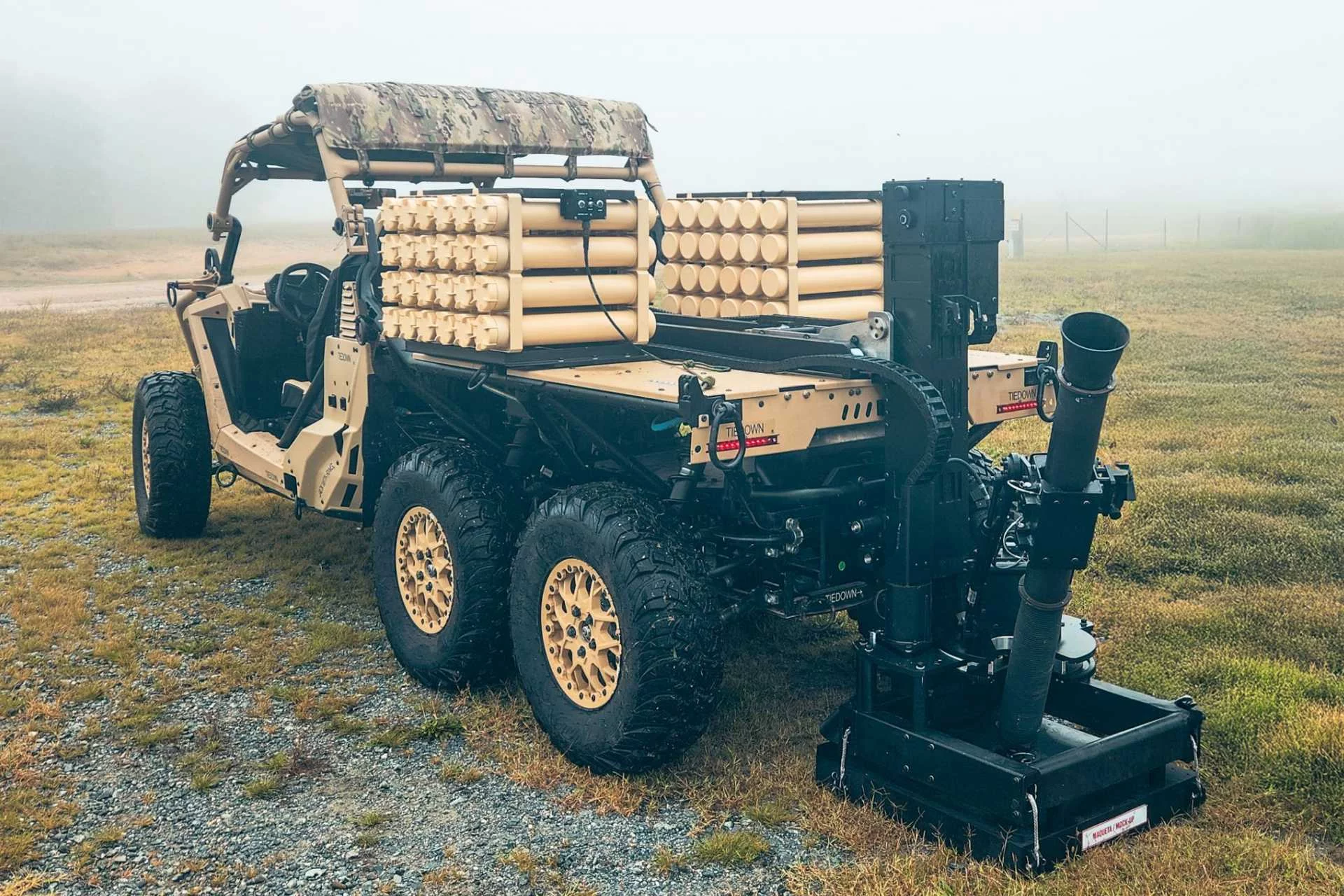
At Marine Corps Base Quantico, the U.S. Marine Corps showcased the Scorpion Light mobile mortar system—also known as the Alakran—during a live-fire demonstration at the Marine Gunners Symposium. The event, organized with Global Military Products and Polaris Government and Defense, highlighted the system’s ability to execute “shoot and scoot” tactics within minutes.
Mounted on the Polaris MRZR Alpha 6×6, the Scorpion Light fired 18 rounds of 81 mm ammunition, engaging multiple targets while rapidly relocating. Marine observers noted the system’s capacity to strike quickly and minimize exposure to enemy counter-battery fire, a feature particularly relevant to dispersed operations and special forces missions.
Originally developed in Spain by NTGS (now Milanion NTGS), the Scorpion was designed in the mid-2010s to simplify mortar operations that traditionally required larger crews and lengthy setup. Its innovative non-seating baseplate allows mortars to be fired from hard surfaces without digging, drastically reducing deployment time. Compatible with light tactical vehicles worldwide—from Toyota Land Cruisers to URO VAMTACs—the system has been adopted by several countries, including Saudi Arabia, Ukraine, and France.
In its U.S. configuration, the Scorpion benefits from the MRZR Alpha 6×6’s expanded cargo bed, capable of carrying up to 48 mortar rounds while maintaining air transportability. The platform’s short wheelbase and third axle improve stability on mud and uneven terrain, while 90% parts commonality with the standard MRZR Alpha streamlines logistics.
The Scorpion Light system integrates a fully digital fire control system, enabling ballistic calculations, target programming of up to 1,000 coordinates, and automatic re-aiming within seconds. It supports both 81 mm and 120 mm mortars, with ranges up to 8.2 km. Two operators are sufficient to run the system thanks to automation, compared to traditional mortars requiring three to seven personnel.
Combat use has already been recorded in Ukraine, where special forces such as the Kraken unit have employed the system to fire and redeploy before detection. Its barrel-cooling technology in the “S” variant allows rates of fire up to 16 rounds per minute without overheating.
Meanwhile, the Polaris MRZR Alpha 6×6 itself continues to evolve as a versatile expeditionary platform. With a multi-fuel turbocharged diesel engine, 362 km operational range, and transportability via aircraft like the C-130, CH-47, and V-22 Osprey, it provides Marines with a lightweight yet adaptable vehicle capable of carrying not only mortars but also loitering munition launchers.
This demonstration reflects the Corps’ ongoing push for mobile, survivable firepower that can rapidly integrate into future expeditionary and special operations concepts.
