

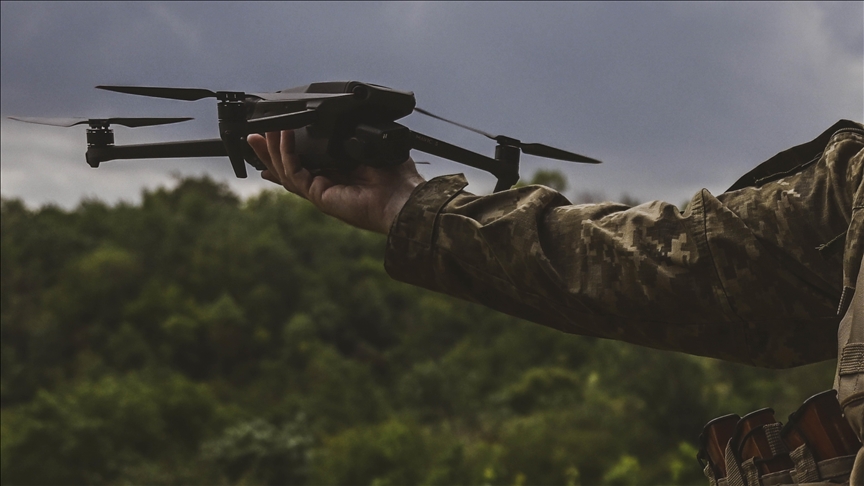
According to BBC on August 19, 2025, Ukrainian President Volodymyr Zelensky announced in Washington that the United States intends to purchase Ukrainian-made drones, providing crucial funding for domestic production. Speaking after meetings with US President Donald Trump and European leaders at the White House, Zelensky described the deal as part of Ukraine’s ongoing negotiations for security guarantees. He emphasized that domestic companies would gain resources to expand production once exports begin, highlighting the strategic importance of drones in the ongoing conflict with Russia. The announcement coincided with broader discussions on US weapons, European financing, and new industrial partnerships.
Small quadcopters adapted to carry munitions deliver near-real-time reconnaissance and precision support to Ukrainian troops, while fixed-wing drones such as the Leleka-100, PD-2, Shark, and Raybird-3 provide deep surveillance and feed into digital fire-control networks.
Zelensky explained that the drone sales to the US were part of a larger framework, including a $90 billion US weapons package for systems Ukraine does not manufacture, such as aircraft and advanced air defense. Reports suggest Ukraine proposed $100 billion in US arms purchases funded by European partners, alongside a $50 billion joint drone production deal with Washington. Final details of security guarantees, including the structure of weapons commitments, are expected within a week to ten days. The framework focuses on three priorities: supporting Ukraine’s armed forces, acquiring foreign-made weapons, and securing domestic drone production. Trump clarified that the US role would emphasize sales rather than free transfers, while European leaders stressed the need for a ceasefire before advancing negotiations with Russia.
These meetings followed Trump’s Alaska summit with Putin, which did not produce a ceasefire. Trump mentioned a 40-minute call with Putin after the Zelensky talks, discussing a bilateral meeting between Russian and Ukrainian leaders followed by a trilateral meeting including the US. Macron noted Putin’s willingness to negotiate, though no venue or date was set. German Chancellor Merz stressed that another meeting would be impossible without a ceasefire, while NATO Secretary General Rutte highlighted coordination led by British PM Starmer and Macron involving around 30 countries, including Japan and Australia. Zelensky prioritized long-term guarantees and defense financing rather than an immediate ceasefire.
Documents reviewed by the Financial Times showed Ukraine refused territorial concessions, rejected partial withdrawal from Donetsk and Luhansk, and demanded compensation for wartime damage, potentially from $300 billion in frozen Russian assets. Zelensky confirmed negotiations included a $90 billion weapons deal and a $50 billion drone production agreement.
Ukraine’s domestic drone industry has expanded significantly since 2022. From limited pre-war manufacturers, over 500 firms were active by 2025, producing systems from small quadcopters to long-range strike drones. Government initiatives like the “Army of Drones” program, tax exemptions, and Brave1 incubator grants facilitated rapid growth. In 2024, contracts were signed for 1.6 million drones valued at ₴114 billion; by early 2025, monthly deliveries reached 200,000 units. Zelensky also announced plans to produce 30,000 long-range drones in 2025, positioning Ukraine as a leading producer and ensuring export-driven industry sustainability.
Operationally, drones are central to Ukraine’s strategy. Small quadcopters support infantry with reconnaissance and improvised strikes, while Leleka-100, PD-2, and Shark perform long-range surveillance and artillery spotting. The US supplied over 700 Switchblade loitering munitions and 1,800 Phoenix Ghost drones, while Poland delivered Warmate systems. FPV racing drones were converted into low-cost attack platforms, and long-range UJ-22, Bober, and Antonov Lyuty drones targeted Russian infrastructure.
Foreign partnerships boosted production capacity. Turkey’s Baykar delivered 50 TB2 drones and invested $100 million in co-production facilities. The US co-developed Phoenix Ghost drones, while European allies and Poland supplied reconnaissance and heavy-lift systems.
Ukraine also countered extensive Russian drone use, including Shahed-136, Lancet, and Orlan UAVs. Layered defenses combining kinetic systems, electronic warfare, and innovative measures were implemented, while GPS-hardened Shaheds forced continuous adaptation.
The US decision to purchase Ukrainian drones is significant. For Ukraine, it secures production revenue and integrates its manufacturers into allied procurement. For the US, it provides access to battle-tested systems and addresses technological gaps. Combined with weapons purchases and security guarantees, the agreement strengthens Ukraine’s long-term defense capabilities.
