

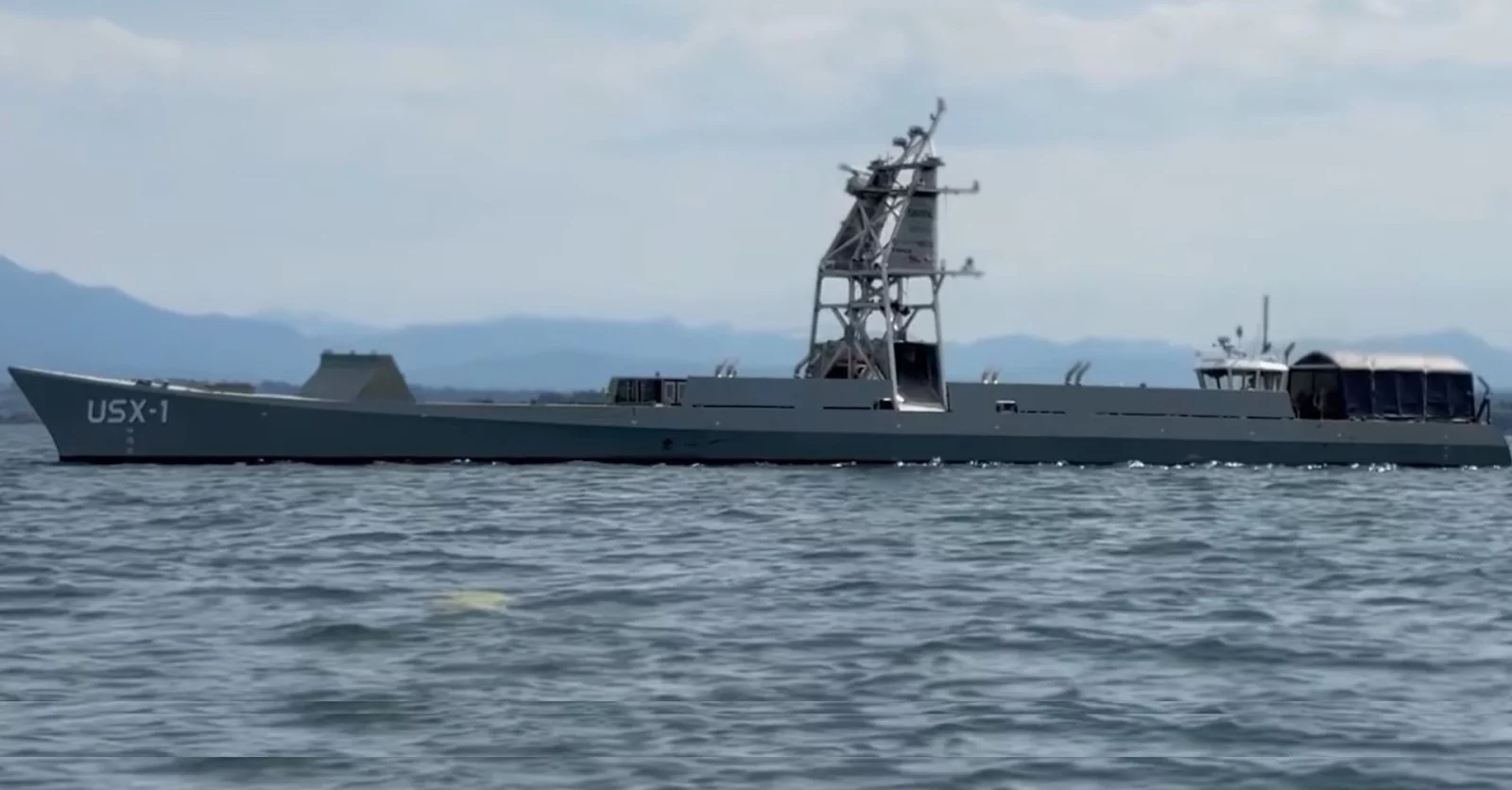
The USX-1 Defiant, developed by the Defense Advanced Research Projects Agency (DARPA) in collaboration with Serco and Nichols Brothers, marks a significant milestone in the evolution of unmanned surface warfare.
At 55 meters in length and 240 tons displacement, the Defiant represents the first medium-class unmanned surface vessel (USV) purpose-built to operate without a crew. The vessel has successfully completed early sea trials, including autonomous refueling, high-speed maneuvers, and self-docking operations — proving its readiness for operational integration into the US Navy’s Distributed Maritime Operations (DMO) framework.
Distributed Maritime Power Through Persistent Presence
Defiant’s core mission is to deliver persistent maritime surveillance and extend the Navy’s operational endurance in high-risk or contested waters.
Operating under EMCON (emissions control) conditions, the vessel can remain undetected by enemy sensors while monitoring choke points, gray-zone activity, and irregular maritime traffic. Designed for one-year operational endurance, Defiant can remain on station for extended periods, distorting an adversary’s perception of time, presence, and response windows — a key advantage in modern naval strategy.
Industrial and Logistical Efficiency: Simplified Design, Faster Turnaround
Beyond its operational role, the USX-1 Defiant introduces a new model of industrial efficiency. Without life-support systems or crew spaces, internal volume is fully dedicated to sensors, power generation, and cooling systems.
The simplified hull allows for rapid maintenance and redeployment in smaller commercial shipyards instead of major naval facilities. This reduces logistical burden, increases fleet readiness, and enables the Navy to rotate ships faster between missions while freeing up critical dock space for larger combatants.
Expanding the Sensor Web: Smarter, Modular, Connected
The Defiant’s sensor mast architecture currently integrates advanced navigation and surface-search radar systems from JRC and Simrad, but its modular framework allows for scalable upgrades — from electronic support measures (ESM) to enhanced data links and additional maritime ISR payloads.
The goal is not to replicate the combat capability of a destroyer, but to achieve a cost-effective balance of coverage, endurance, and adaptability. This ensures continuous maritime awareness even when crewed assets such as P-8A Poseidon, MQ-4C Triton, or FFG-62 Constellation-class frigates rotate out of operational zones.
Power in Numbers: The Future of a Crewless Fleet
A single unmanned surface vessel cannot shift naval balance — but a networked fleet of Defiant-class USVs can.
Deployed along critical littorals or choke points, a cluster of Defiants can impose significant surveillance and targeting costs on any adversary. Each hull may act as a sensor node, decoy, relay, or electronic warfare platform, creating uncertainty and forcing adversaries to monitor multiple potential threats simultaneously.
The Navy’s goal is scale and persistence, not singular power projection — a model where availability and distributed presence define combat advantage.
A Steady Multiplier for the Future Fleet
The USX-1 Defiant embodies DARPA’s long-term vision for a sustainable, resilient, and scalable unmanned naval force.
By combining autonomy, endurance, and low-maintenance design, Defiant is poised to become a force multiplier that extends the Navy’s sensor reach, reduces risk to personnel, and enhances flexibility in distributed operations.
Not a silver bullet — but a persistent asset that reshapes how the US Navy maintains maritime dominance in an era of constant surveillance and strategic competition.
