

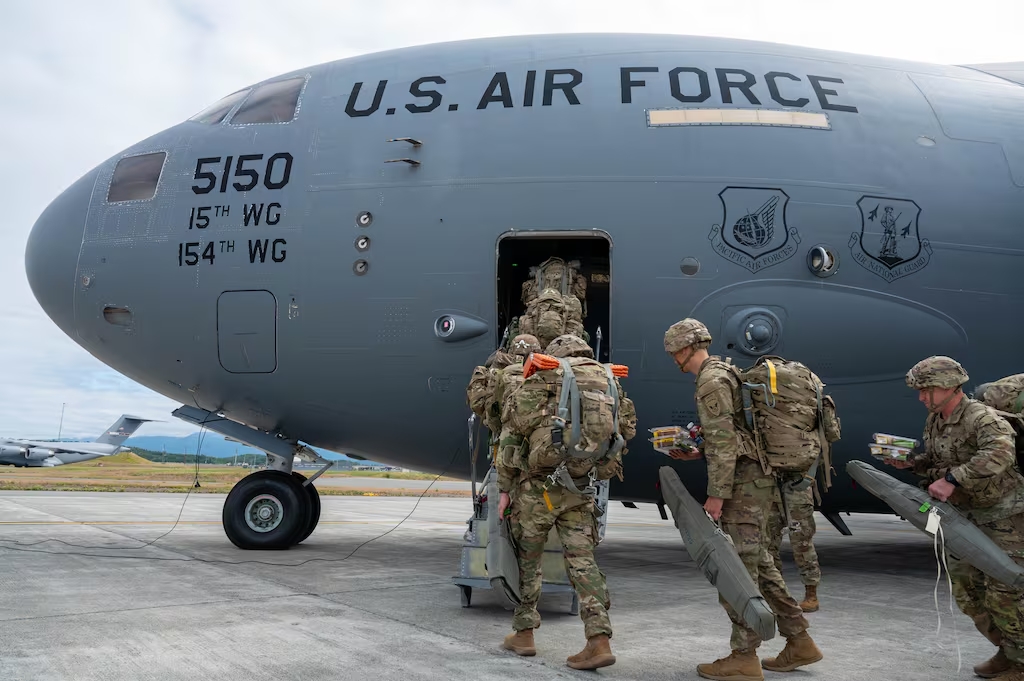
U.S. Army paratroopers made a bold arrival in Australia during Exercise Talisman Sabre 2025, jumping into the night sky after a nonstop 14.5-hour flight from Alaska. The operation marked the start of an extensive joint exercise designed to test long-range rapid deployment and combat readiness.
Col. Brian Weightman, commander of the 2nd Infantry Brigade Combat Team (Airborne), 11th Airborne Division, led the first jump, landing precisely on target. While a 10% casualty rate is considered acceptable in such operations, only three minor injuries occurred — one due to a midair entanglement.
Following the 6,800-mile flight, the “Three Geronimo” battalion marched over 30 miles to secure an urban objective near Townsville. “To execute with speed and intensity sends a strong message to any potential adversary,” Weightman noted.
Transported by six C-17A Globemasters from both U.S. and Australian air forces, over 320 American and a dozen German paratroopers participated. French troops joined upon arrival. Heavy equipment like HMMWVs was also airdropped.
Weightman highlighted advanced communication capabilities that allowed real-time voice, video, and data exchanges during the flight — enhancing battlefield awareness.
He emphasized the strategic reach of airborne infantry: “We can deploy a ready and connected battalion anywhere in the world.” Refuting concerns about airborne forces’ relevance, he added, “If I were the enemy, I’d be worried about what we just did.”
The 11th Airborne Division is uniquely capable of operating in both Arctic and tropical environments. As the Indo-Pacific faces rising tensions, Weightman stressed the focus on interoperability with allies, not specific adversaries. “If we can move and unite power at scale, we can meet any challenge.”
Talisman Sabre 2025 gathered more than 40,000 troops from 19 nations, emphasizing coordination, readiness, and global partnership.
