

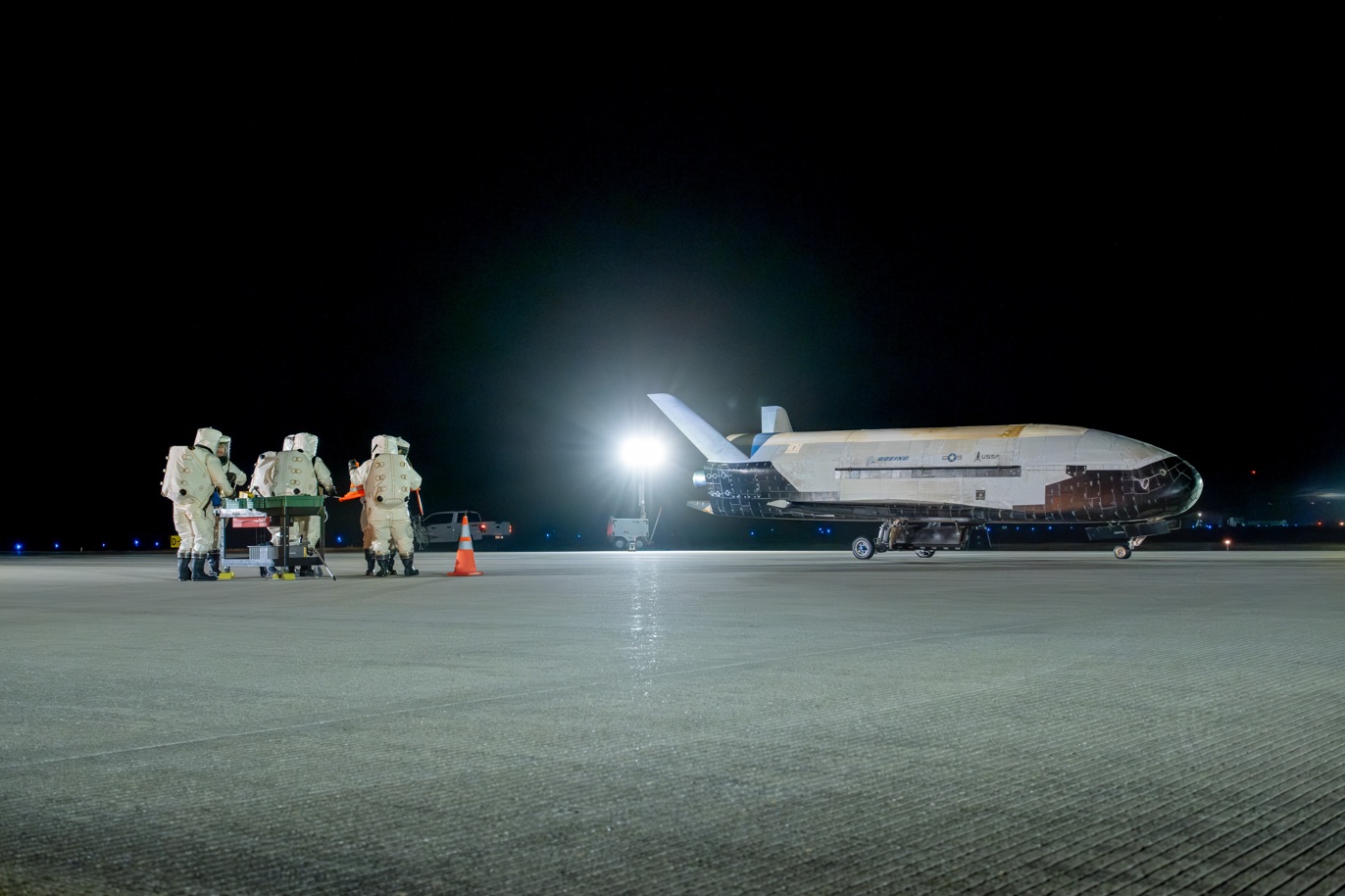
OTV-8 will test advanced laser communication systems between satellites and a quantum inertial sensor.
The US Space Force (USSF) and the Air Force Rapid Capabilities Office are preparing to launch the eighth mission of the X-37B Orbital Test Vehicle (OTV-8).
Scheduled for August 21, 2025, the mission will see the Boeing-built X-37B launched from Kennedy Space Center aboard a SpaceX Falcon 9 rocket under the designation USSF-36.
The mission will involve various tests and experimental operations. Technologies to be tested include advanced laser communication systems between satellites and a quantum inertial sensor.
The laser communication demonstrations, involving “proliferated commercial satellite networks in Low Earth Orbit,” aim to enhance the security and resilience of US space communications.
According to USSF, laser communications increase data transmission speeds due to shorter infrared wavelengths.
The quantum inertial sensor trial will enable precise navigation in space without relying on traditional GPS by detecting atomic movements.
This technology is critically important for maintaining navigation capabilities in areas where GPS signals are weak or disrupted, thereby strengthening the defense capabilities of US space assets.
OTV-8 will also carry a service module to increase its experimental payload capacity, providing additional opportunities for mission partners such as the Air Force Research Laboratory and the Defense Innovation Unit.
The insights gained from these experiments will play a vital role in shaping the USSF’s future space architectures.
This announcement comes just six months after the successful completion of the OTV-7 mission.
These experiments are part of a broader USSF initiative to enhance the resilience and versatility of American orbital resources, ensuring the protection and stability of space.
US Space Force Space Operations Commander General Chance Saltzman said, “OTV-8’s laser communications demonstration will mark an important step in our ability to leverage proliferated space networks as part of diversified and redundant space architectures. In doing so, it will strengthen the resilience, reliability, adaptability, and data transmission speeds of our satellite communications architecture.”
