

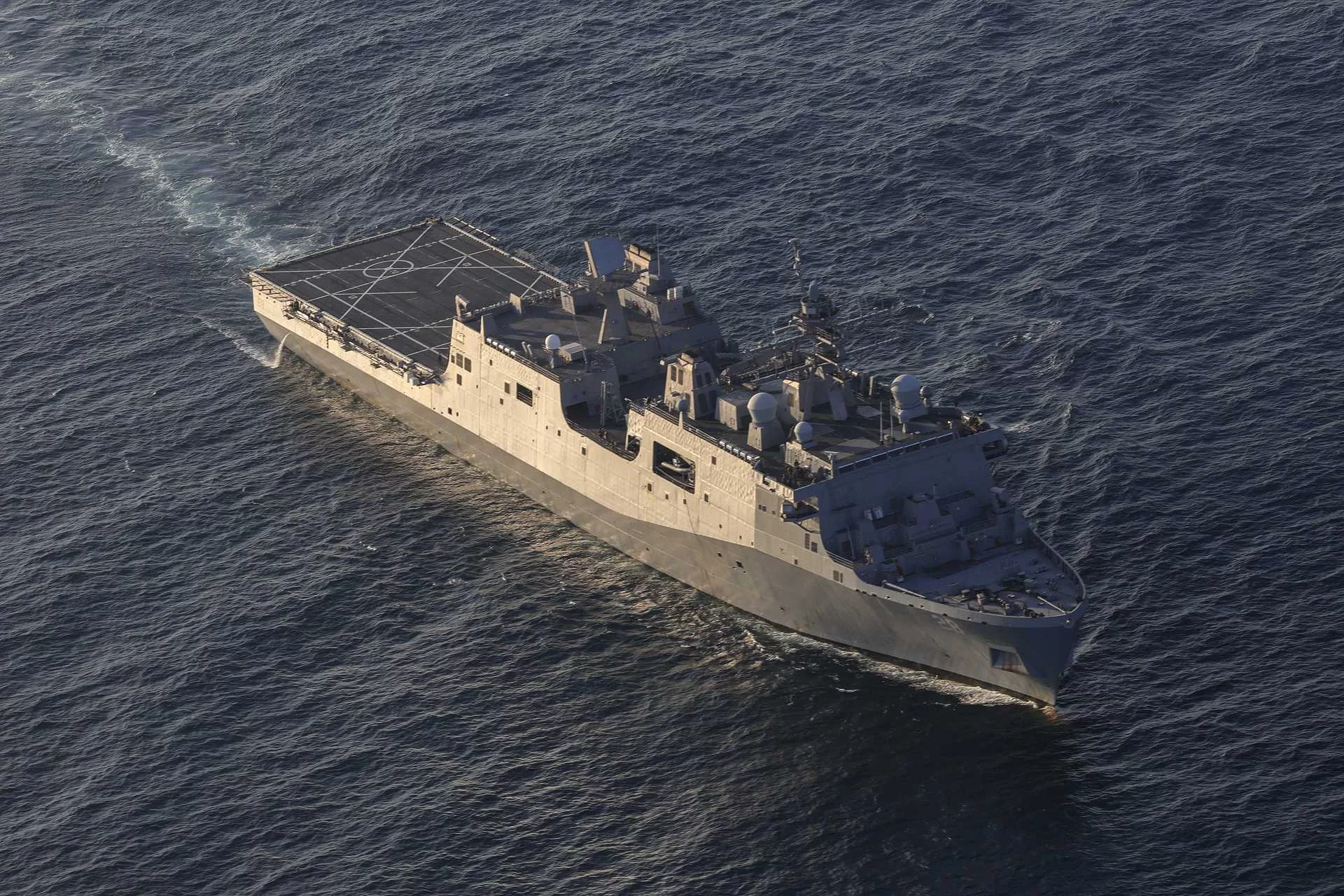
The USS Fort Lauderdale (LPD-28), a San Antonio-class amphibious transport dock, has returned to the Caribbean following a brief logistics stop at Naval Station Mayport, Florida. Open-source tracking indicates the ship’s redeployment is part of Washington’s continued maritime posture near Venezuela—supporting counter-narcotics operations and reinforcing U.S. influence in the region’s contested sea lanes.
Amphibious Versatility for Regional Operations
Designed for expeditionary warfare, USS Fort Lauderdale can deploy landing craft, helicopters, and MV-22 Ospreys, enabling rapid troop movement, special operations, and humanitarian response. Its ability to project force without reliance on fixed ports makes it invaluable for maritime interdiction against elusive trafficking networks dispersed across island chains.
The ship’s aviation assets, including MV-22s and UH-1Y Venoms, support intelligence, surveillance, and reconnaissance (ISR) missions, as well as coordination with Coast Guard and DEA aircraft. This flexibility allows Fort Lauderdale to act as a sea-based operations hub for joint interdiction and security cooperation.
Command, Control, and Coalition Integration
Beyond transport duties, Fort Lauderdale functions as an advanced command-and-control node. Equipped with secure communications and real-time ISR fusion, it enhances multi-agency coordination under Joint Interagency Task Force South (JIATF-South). The vessel facilitates integrated missions involving the U.S. Navy, Coast Guard, DEA, and partner nations targeting smuggling routes originating in Venezuela, Colombia, and Central America.
Adaptation to “Gray Zone” Operations
The ship’s renewed deployment aligns with an 18-month surge in amphibious operations across the Caribbean. Pentagon planners describe these missions as part of “gray zone maneuver”—a hybrid framework combining deterrence, humanitarian engagement, and law enforcement cooperation. Through this approach, the U.S. Navy maintains strategic presence without direct escalation.
Analysis: A Signal of Renewed Power Projection
Fort Lauderdale’s presence off Venezuela’s maritime approaches signals more than a routine patrol—it marks a recalibration of U.S. naval power in the Western Hemisphere. As cartel networks adopt new technologies such as narco-submersibles and encrypted communications, the Navy’s use of amphibious platforms reflects a shift toward sustained, flexible maritime governance and persistent regional engagement.
