

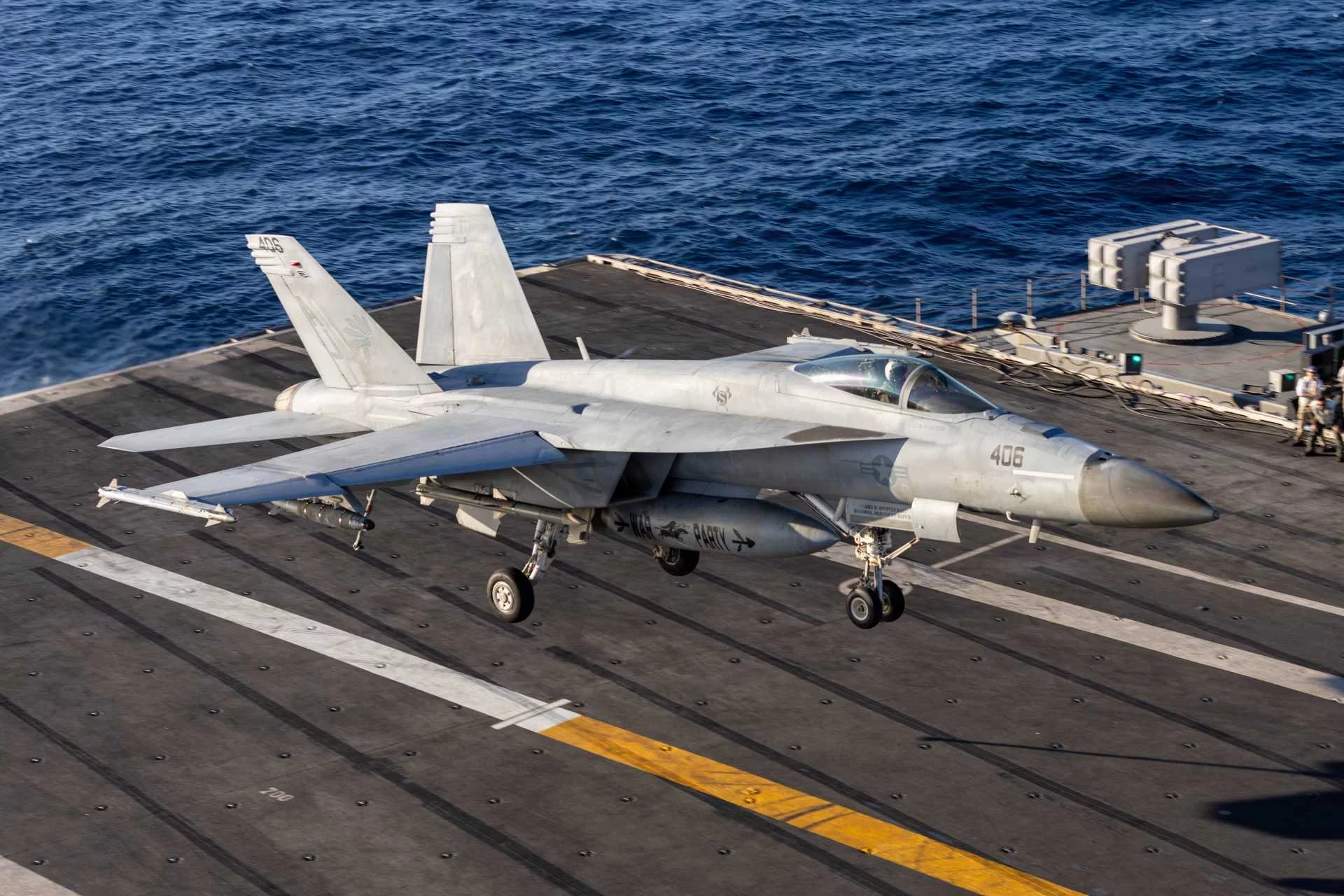
The U.S. Navy’s flagship carrier USS Gerald R. Ford has intensified its flight operations in the Caribbean Sea, signaling Washington’s stronger push against illicit maritime activity and growing regional tensions with Venezuela.
Newly released Department of Defense imagery confirms that the Ford Strike Group has been conducting continuous flight operations across the Caribbean throughout November 2025. Officials say the deployment reflects U.S. Southern Command’s expanded readiness posture and its focus on disrupting trafficking routes that stretch across the Western Hemisphere.
Targeting Drug and Arms Trafficking Networks
Although the Pentagon has not disclosed the full mission profile, defense sources familiar with the region note that the current operational tempo is aimed at dismantling narcotics and weapons trafficking networks that rely on strategic Caribbean corridors. Ford’s presence also serves as a direct show of force as relations with Venezuela remain strained.
Super Hornet and Hawkeye Operations Captured
Photos shared by the Department of Defense show F/A-18E/F Super Hornets and E-2D Advanced Hawkeyes performing launch and recovery cycles on Ford’s flight deck, underscoring the carrier’s ability to sustain high sortie rates and maintain peak readiness.
A Multi-Domain Force Securing Regional Waters
The Ford Strike Group, supported by three Arleigh Burke-class destroyers, brings a fully networked, multi-domain response capability to the Caribbean. This includes air dominance, maritime strike, rapid interdiction, and persistent surveillance—especially against high-speed “go-fast” boats and semi-submersibles ferrying narcotics toward the U.S. mainland.
Prepared for Escalation Against Venezuela
If tensions escalate with Venezuela, Ford’s Carrier Air Wing Eight provides robust strike and surveillance capabilities. The air wing includes 44 F/A-18E/F Super Hornets, EA-18G Growlers, E-2D airborne early-warning aircraft, and MH-60R/S helicopters—enabling long-range strikes and electronic warfare support.
Enhanced Sortie Generation With EMALS & AAG
The USS Gerald R. Ford’s EMALS launch system and Advanced Arresting Gear allow for faster, more efficient flight operations than previous carrier classes. This capability gives the U.S. Navy the ability to maintain air and sea superiority around Venezuela for extended durations without land-based support.
Joint Drills With Regional Partners
During the deployment, the Ford Strike Group conducted multinational drills with naval forces from Colombia, the Dominican Republic, and Trinidad and Tobago. Exercises focused on maritime interdiction, joint boarding procedures, and integrated air-sea responses to trafficking vessels.
A New Era in Carrier Employment
Analysts describe the Ford’s Caribbean deployment as a strategic shift in U.S. carrier operations—moving from traditional global missions to confronting non-state maritime threats near U.S. borders. While the Navy has not revealed how long Ford will remain in the region, experts believe the mission may be extended depending on trafficking activity and regional security dynamics.
