

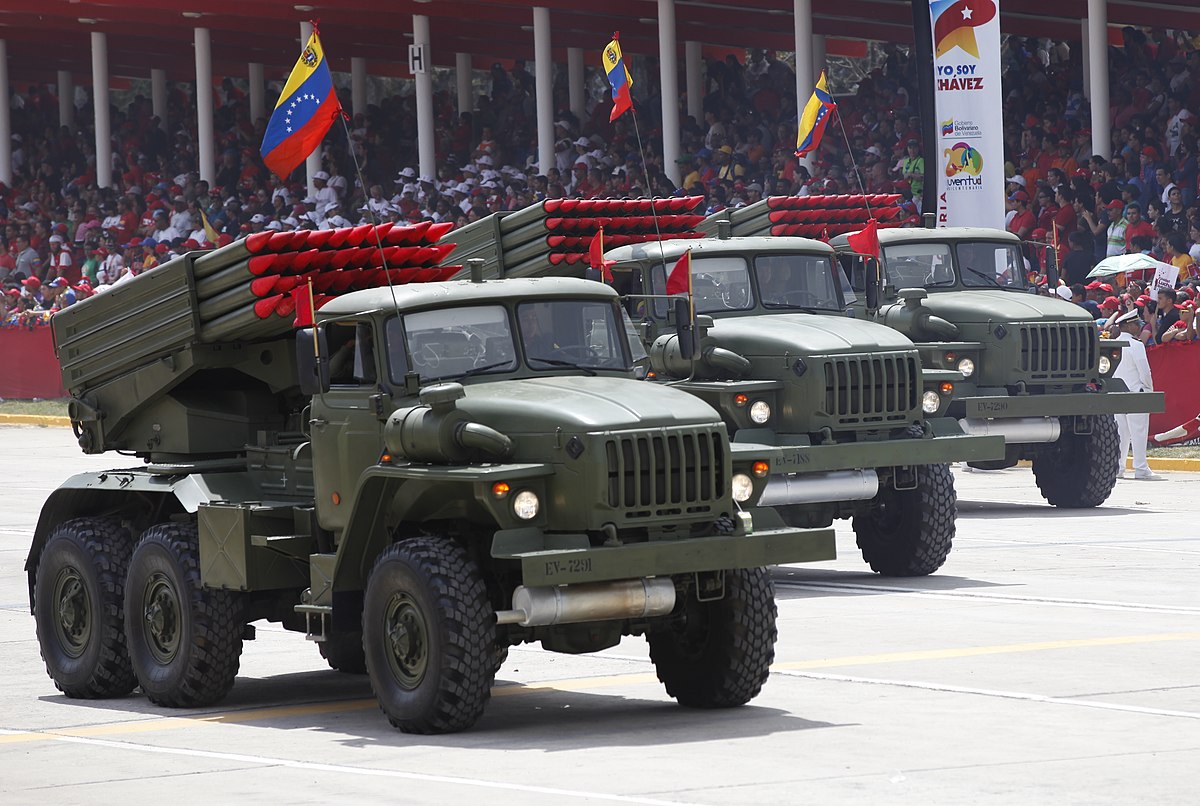
Venezuela has positioned a BM-21 Grad multiple rocket launcher directly on the shoreline in Lechería, Anzoátegui, facing the Caribbean Sea at a moment when one of the largest U.S. naval formations in decades is patrolling just offshore. The move sharply increases the risk that a crisis could escalate from sea to populated coastal areas with little warning.
Images posted to social media on 29 November 2025 show a Venezuelan BM-21 MLRS placed on the beach at coordinates 10.202477, -64.696459. The deployment comes as U.S. carrier strike groups, destroyers, cruisers and F-35 squadrons operate near Venezuela’s maritime borders. The presence of heavy artillery on a public, tourist coastline underscores how quickly the standoff is transitioning into a scenario where miscalculation could trigger immediate kinetic consequences.
BM-21 Grad: A Soviet-Era Rocket System Reimagined for Coastal Defense
The 122 mm, 40-tube BM-21 Grad—first fielded in 1963—can unleash a powerful barrage over 20–50 km, depending on rocket type. Venezuela purchased 24 units from Russia between 2008 and 2011. Traditionally an inland battlefield system, the Grad’s seaside deployment signals Caracas’s intent to adapt it for coastal denial, rapid reaction against amphibious or special operations forces, and disruption of landing zones or port facilities.
A Dangerous Mix: Heavy Rockets in a Civilian Zone
Deploying such an unguided, area-effect weapon in a populated beach environment creates two major concerns:
- High vulnerability — the launcher is openly exposed to air strikes, naval gunfire or drones.
- High collateral damage risk — the Grad relies on saturation fire, posing significant danger to civilians if used near urban zones like Lechería.
Analysts note that Venezuela may be activating pre-planned coastal fire zones mapped years earlier as part of Russian-assisted modernization programs.
Part of a Broader Russian-Backed Defense Posture
The Grad is only one component of a larger Russian-origin arsenal that includes:
- BM-30 Smerch long-range MLRS
- 2S19 Msta-S and 2S23 Nona-SVK artillery
- Bal-E coastal defense missile systems
- S-300VM and Buk-M2E air defense systems
This network, built over nearly two decades, forms the backbone of Caracas’s anti-access strategy.
Strategic Timing: U.S. Naval Buildup in the Region
The U.S. deployment off Venezuela’s coast—described as the largest in Latin America since the early 2000s—has been framed officially as a counter-narcotics mission. However, regional observers see it as a pressure maneuver directed at the Maduro government.
In response, Venezuela is signaling that it will not rely solely on air-defense missiles but is prepared to contest any ground component of a hypothetical operation, even limited or covert in nature.
Geopolitical Implications and OSINT Transparency
The rapid geolocation of the launcher by OSINT communities highlights a new reality:
Modern military deployments are instantly visible, monitored and politicized.
This transparency allows Caracas to project resolve, but it also exposes assets and reduces operational flexibility.
A Visible Shift Toward Military Posturing
The presence of a BM-21 on a public Caribbean beach is a stark indicator that the Venezuelan crisis has moved beyond rhetoric into concrete preparations. It suggests that any escalation may not begin with precision strikes but with high-volume, unguided rocket fire—a far more unpredictable and dangerous opening to conflict in the Caribbean theater.
