

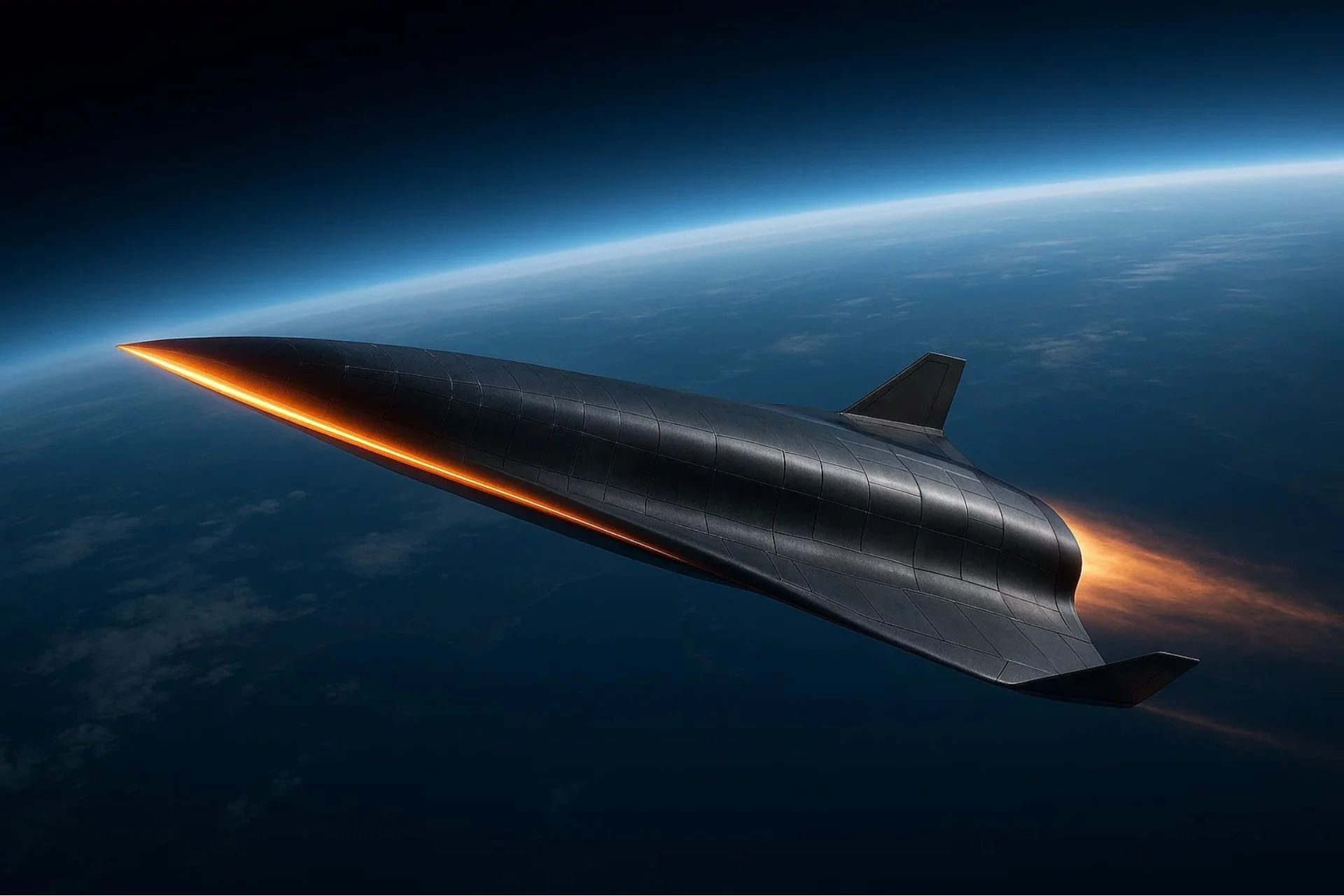
On June 26, 2023, France achieved a landmark moment in hypersonic technology with the successful test flight of its first V-MAX hypersonic glider from Biscarrosse. Developed through cooperation between the French Defence Procurement Agency (DGA), ArianeGroup, and Onera, the test validated key technologies and marked the first European demonstration of controlled hypersonic flight above Mach 5. With this milestone, France joined the ranks of the U.S., Russia, and China as an active player in hypersonics. But this was only the beginning. The next stage, VMAX2, followed by SyLex and the ASN4G nuclear missile program, aims to fully integrate hypersonic systems into France’s defense posture.
Hypersonic gliders are designed to defeat air and missile defense systems by flying at speeds between Mach 5 and Mach 20 with unpredictable, highly maneuverable trajectories. Achieving such performance requires heat-resistant materials, advanced aerodynamics, and robust control systems capable of withstanding extreme conditions. Under ArianeGroup’s leadership, the V-MAX program has already advanced in areas such as thermal protection, high-temperature materials, inertial navigation, and onboard sensors.
VMAX2 now represents the next step—closer to an operational capability. Featuring a redesigned structure and advanced command systems, it will test critical subsystems under realistic conditions while anticipating future interceptor threats. Its purpose is to deepen France’s mastery of hypersonic flight dynamics for future military applications.
Unveiled at the 2025 Paris Air Show, the SyLex project targets speeds of up to Mach 16 (around 20,000 km/h). Initial flight tests are scheduled for 2027, with possible operational deployment around 2030. SyLex highlights France’s determination to establish sovereign hypersonic capabilities without relying on foreign infrastructure.
In parallel, the ASN4G program will replace the current ASMP-A nuclear cruise missile by 2035. Equipped with a ramjet engine, ASN4G will combine hypersonic velocity with a strategic payload, ensuring the credibility of France’s nuclear deterrence in the face of evolving missile defenses.
Meanwhile, global competition is intensifying. Russia already deploys the Avangard and Kinzhal systems, China continues testing the DF-ZF glider, and the U.S. pursues multiple programs but struggles to move beyond prototypes. France, with more limited resources, seeks to remain credible through technological innovation and a reinforced deterrence doctrine.
Ultimately, the progression from V-MAX to VMAX2, then SyLex and ASN4G, reflects France’s step-by-step yet ambitious approach to hypersonics. Each demonstrator expands knowledge, each test paves the way toward capabilities that could shift future military balances. In the race for hypersonic dominance, Paris has made a clear choice: not to remain on the sidelines, but to claim its place among the powers shaping tomorrow’s battlefield.
