

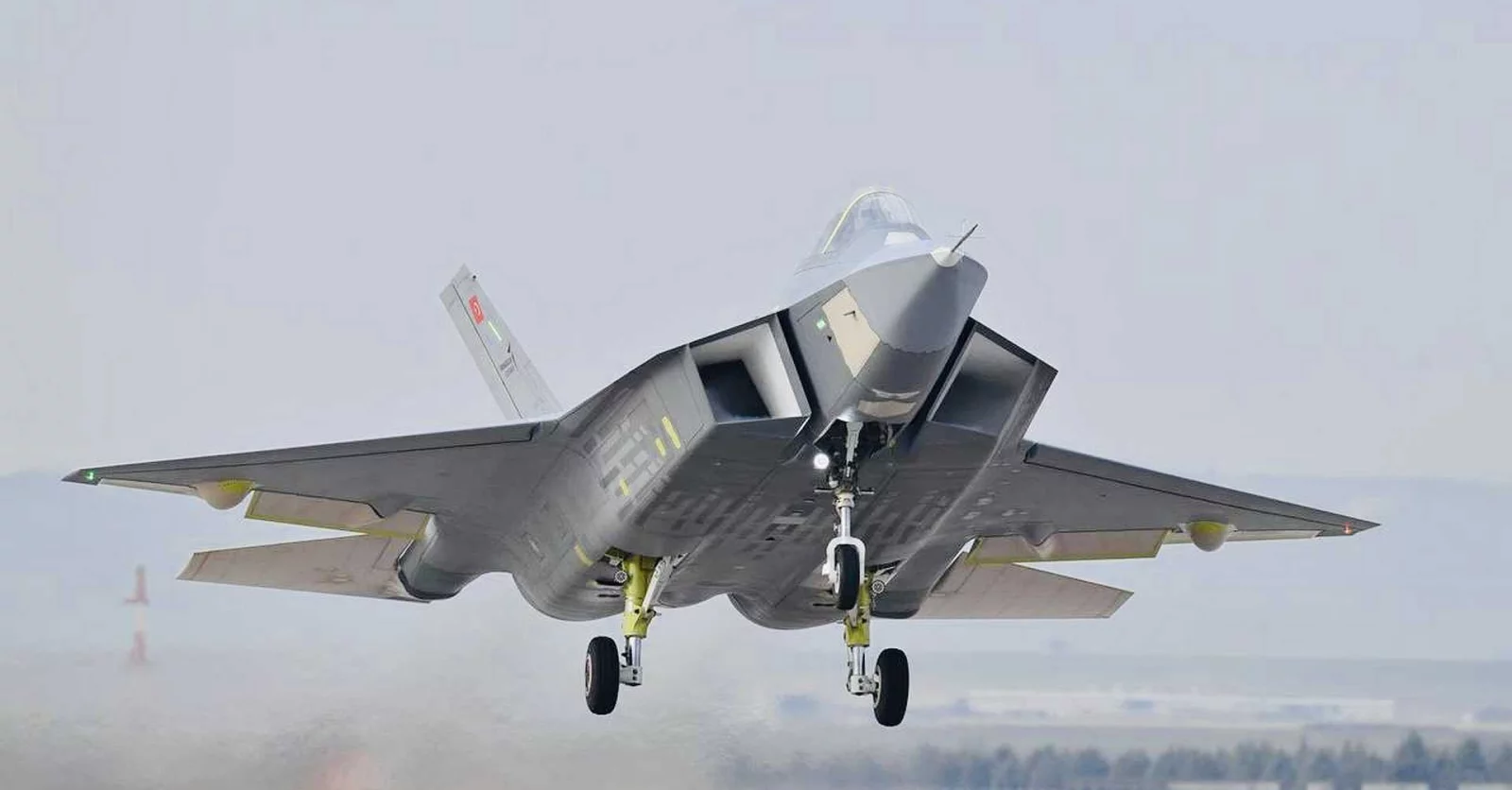
The Presidency of Defense Industries of the Republic of Türkiye (SSB) has officially placed an order for the sixth prototype of the KAAN fifth-generation indigenous fighter jet. This major development once again highlights Türkiye’s determination to integrate a fully domestically developed combat aircraft into its military inventory. Led by Turkish Aerospace Industries (TUSAŞ), the KAAN project is the first entirely homegrown design and production fighter jet in the nation’s history, representing a major leap forward in Türkiye’s defense capabilities.
The KAAN program, originally launched under the name TF-X, began in 2016 as part of a national vision to modernize the Turkish Air Force with an entirely indigenous combat aircraft. Managed by TUSAŞ under the leadership of SSB, the initial phase focused on concept design, computational fluid dynamics (CFD) modeling, and simulation-based performance analysis. The full-scale mock-up of the aircraft was first unveiled at the 2019 Paris Air Show, marking Türkiye’s formal entry into the next-generation fighter development arena. In March 2023, the first prototype began taxi trials, and on February 21, 2024, the KAAN completed its maiden flight successfully — showcasing both the program’s rapid momentum and technical maturity.
By 2025, six different prototypes have been planned or manufactured. Prototype 1 was used for basic flight testing and airframe validation. Prototypes 2 and 3 were assigned to avionics integration and sensor calibration. Prototypes 4 and 5 will undergo high-performance flight testing and weapons integration. The newly ordered Prototype 6 is intended for a broad range of evaluations, including wind tunnel testing, environmental durability, advanced avionics validation, acceleration performance, and runway trials. This strategy reflects a multi-layered testing approach designed to minimize development risks and accelerate the path to mass production.
The KAAN project is progressing through a phased development model. Early production blocks will feature baseline stealth and sensor fusion capabilities, while later blocks — particularly Block 30 and Block 40 — will be powered by a fully indigenous engine. Development of this engine is actively underway and is regarded as a strategic priority for reducing foreign dependency and achieving long-term sustainability in combat aviation.
Technologically, the KAAN has been engineered as a true fifth-generation fighter. It incorporates cutting-edge features such as advanced stealth shaping with internal weapon bays, AESA radar-based sensor fusion, infrared search and track (IRST), electronic warfare capabilities, and AI-assisted battlefield data processing. Its multirole design allows for both beyond-visual-range (BVR) and close-range combat, as well as precision strike missions.
When compared to other modern fighters like France’s Dassault Rafale, the U.S.-made F-35 and F-22, the Eurofighter Typhoon, and Sweden’s Saab Gripen E, KAAN offers a distinct competitive edge. While Rafale and Typhoon are classified as 4.5-generation fighters with limited stealth and external weapons carriage, KAAN embraces a stealth-first design more aligned with the F-35. Its internal weapons bays reduce radar cross-section, and its domestically developed avionics are designed to deliver a sensor fusion experience comparable to fifth-generation standards. Though the Gripen E is praised for its electronic warfare and data link systems, its lack of stealth shaping and internal weapon storage gives KAAN a tactical advantage in high-threat environments.
Designed with modularity in mind, KAAN allows for future upgrades in mission systems, radar, and propulsion. Unlike the F-35, which involves international restrictions and proprietary limitations, KAAN stands out as a fully sovereign combat platform, granting Türkiye full authority over lifecycle upgrades, mission-specific configurations, and export options.
The order of the sixth KAAN prototype underscores Türkiye’s steadfast commitment to becoming a producer of advanced fighter jets. As the KAAN continues to mature, it is set not only to enhance the operational capabilities of the Turkish Air Force but also to emerge as a competitive and independent fifth-generation alternative in the global fighter jet market.
