

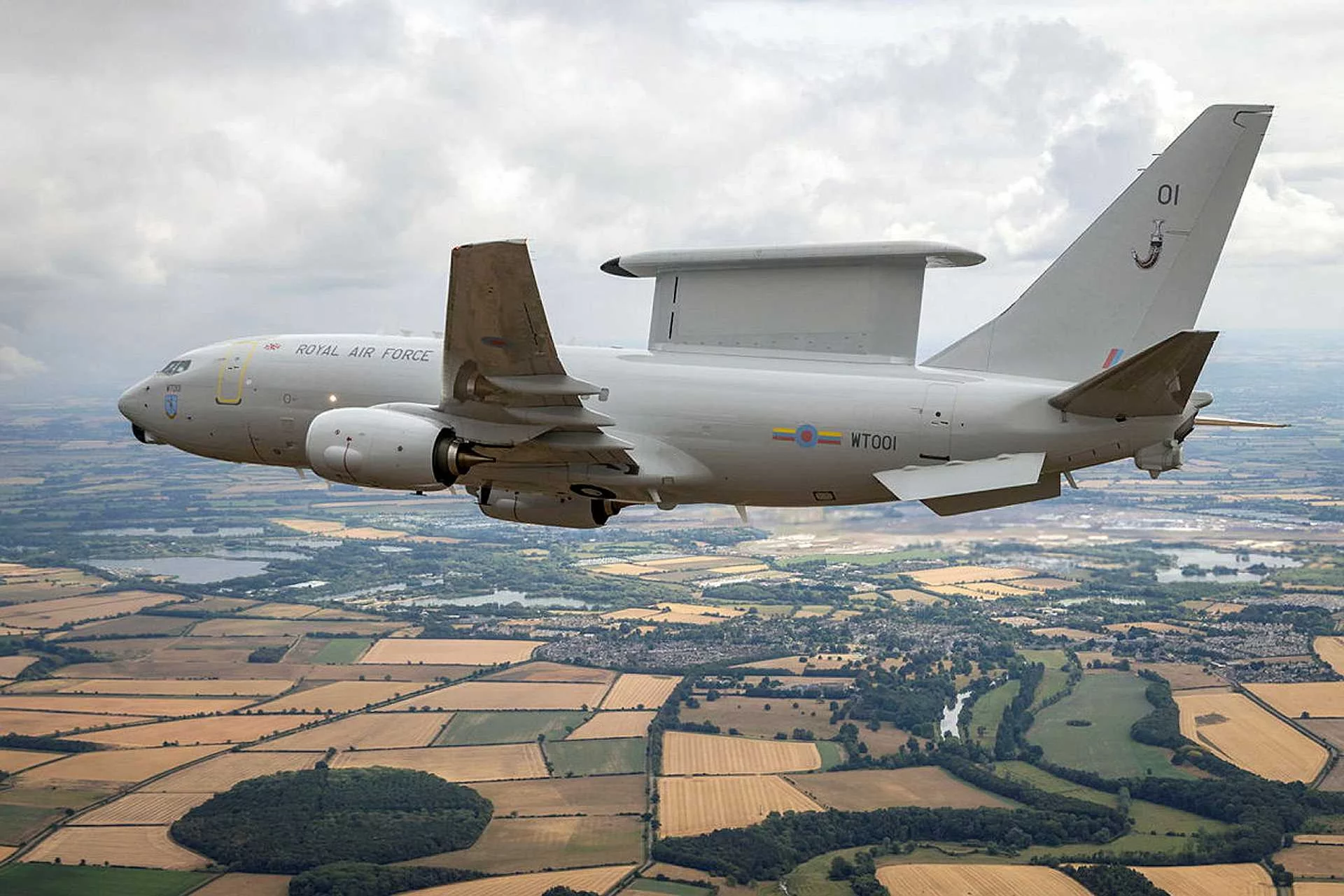
The United Kingdom’s Royal Air Force (RAF) publicly unveiled its next-generation airborne early warning and control (AEW&C) aircraft, the E-7 Wedgetail AEW Mk1, during RIAT 2025 at RAF Fairford. This strategic debut marks a significant advancement in the UK’s air surveillance and battle management capabilities, while also reaffirming its commitment to NATO’s integrated air and missile defense architecture.
In March 2019, the UK Ministry of Defence signed a contract with U.S. aerospace giant Boeing for the procurement of five E-7 Wedgetail AEW Mk1 aircraft. However, following a capability reassessment and budgetary review in 2021, the order was revised to three aircraft. The contract, valued at approximately £1.5 billion, covers aircraft acquisition, mission system integration, ground support infrastructure, and long-term sustainment. The platforms are converted from second-hand Boeing 737-700 commercial airframes and modified for military use at STS Aviation Services in Birmingham, in partnership with Boeing Defence UK.
The first aircraft is expected to achieve Initial Operational Capability (IOC) in 2026, with Full Operational Capability (FOC) projected by 2028. All three aircraft will be operated by No. 8 Squadron at RAF Lossiemouth in Scotland, restoring a sovereign airborne early warning capability that has been absent since the retirement of the E-3D Sentry in 2021.
Though based on the Boeing 737 Next Generation airframe, the Wedgetail’s true strength lies in its advanced mission systems. Its signature component, the Northrop Grumman Multi-role Electronically Scanned Array (MESA) radar, mounted atop the fuselage, provides full 360-degree coverage. This radar can detect and track both aerial and maritime targets at extended ranges, with the ability to identify fighter-sized objects over 370 kilometers away and simultaneously monitor hundreds of contacts in real time.
The Wedgetail serves not only as a high-end sensor platform but also as an airborne command center. Its onboard crew, operating from state-of-the-art consoles, can manage the air battlespace by directing fighter jets, coordinating intercept missions, overseeing naval operations, and supporting ground force movements. The aircraft supports both tactical and strategic-level operations, making it indispensable in joint and coalition scenarios.
For those unfamiliar with the AEW&C concept, the Wedgetail constantly scans the skies, seas, and land to detect potential threats—such as enemy aircraft, cruise missiles, or warships—well before they pose a danger. Once a threat is detected, it can alert friendly forces, guide fighter aircraft to intercept, and ensure all units are operating with the same updated information. This level of real-time coordination is critical in modern warfare, where speed, situational awareness, and secure communication define operational success.
The UK’s three Wedgetail aircraft are being customized to meet national operational requirements. Integration and testing are being conducted domestically at the STS Aviation Services facility in Birmingham. Each platform undergoes rigorous sensor testing, electronic warfare calibration, and mission suite validation. The aircraft are also receiving the distinctive VIII Squadron livery. Co-located with the RAF’s fleet of nine P-8 Poseidon maritime patrol aircraft at RAF Lossiemouth, the Wedgetails benefit from a shared Boeing 737NG platform—streamlining maintenance, logistics, and crew training across both fleets.
Following the retirement of the E-3D Sentry, the UK filled its airborne surveillance gap through reliance on NATO’s E-3A AWACS and U.S. AEW&C assets. With the E-7’s entry into service, the UK will regain autonomous airborne command and control capabilities. Moreover, the Wedgetail’s modular architecture allows future upgrades to address next-generation threats such as hypersonic glide vehicles, stealth UAVs, and integrated air defense systems.
The E-7 program also aligns closely with the RAF’s Future Combat Air System (FCAS) roadmap. The platform is expected to operate alongside both current systems and the sixth-generation Tempest fighter, forming a key enabler of distributed operations and network-centric warfare.
The Wedgetail’s debut at RIAT 2025 not only introduced the aircraft to the public but also highlighted its pivotal role in the UK’s evolving airpower doctrine. As threats across the Euro-Atlantic region continue to evolve, the E-7 Wedgetail ensures the RAF remains at the forefront of modern, integrated, and coalition-capable air operations.
