

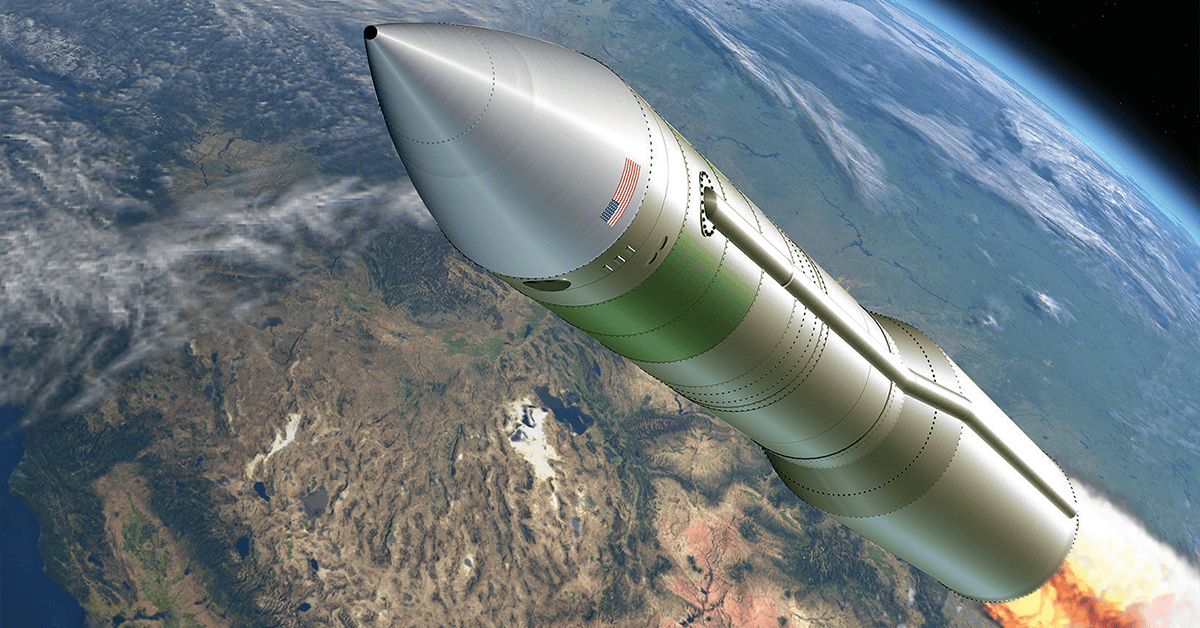
In a significant step forward for the modernization of its nuclear deterrent, the US Air Force (USAF) alongside Northrop Grumman has completed the full-scale qualification test of the stage-two solid rocket motor for the LGM-35A Sentinel intercontinental ballistic missile (ICBM).
The test was carried out by the 717th Test Squadron on July 20, 2025, at the Arnold Engineering Development Complex. This milestone is a critical part of the USAF’s ongoing program to enhance its land-based nuclear deterrence capabilities.
Conducted inside a vacuum chamber designed to simulate high-altitude conditions, the evaluation provided essential performance data, including thrust characteristics and guidance accuracy through the motor’s thrust vector control system.
Brigadier General William Rogers, director of the Air Force Nuclear Weapons Center’s ICBM Systems Directorate and executive officer for the Air Force ICBM program, emphasized the importance of the test: “This milestone demonstrates our disciplined approach to digital engineering and sustained progress on the Sentinel program. Beyond testing hardware, we are validating our models, confirming our development timelines, and ensuring system readiness when called upon.”
The stage-two motor is one of three booster segments that comprise the Sentinel missile’s three-stage propulsion system. This test is among multiple efforts to qualify the stage-two motor design and validate predictive performance models developed within a digital engineering environment.
Data gathered from this test will support ongoing design improvements and reduce technical risks as the program moves closer to production. Following the successful stage-one motor test at Northrop Grumman’s Utah facility in March, this achievement further confirms the alignment between actual test results and digital model forecasts.
Rogers added, “This isn’t merely a motor test. It’s a testament to our confidence—in our engineering, schedule, and, most critically, our capability to deter threats and safeguard the nation.”
The Sentinel program leverages a model-based design approach, allowing engineers to more accurately simulate system behaviors, predict outcomes with greater reliability, and minimize reliance on physical prototypes.
Additional stage-two qualification tests are planned throughout the year by the USAF and Northrop Grumman to evaluate motor components under a range of environmental conditions.
Earlier in May, the USAF successfully conducted a test launch of an unarmed Minuteman III ICBM from Vandenberg Space Force Base, California. The LGM-35A Sentinel is set to replace the Minuteman III missile in due course.
