

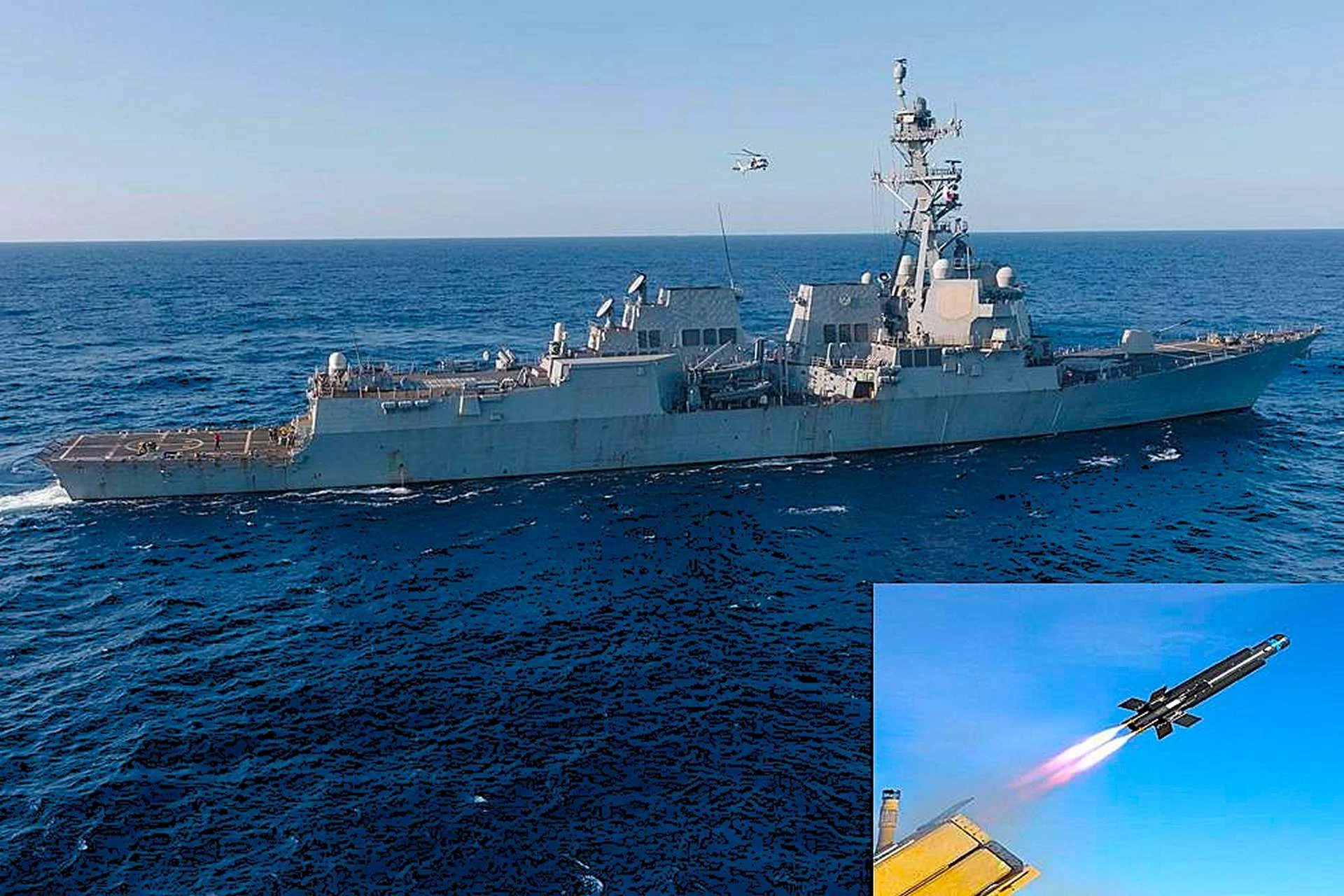
Images released by the U.S. Navy on its DVIDS platform reveal newly installed Coyote counter-drone launchers aboard the Arleigh Burke-class guided-missile destroyer USS Bainbridge (DDG 96). As reported by The War Zone on August 11, 2025, these photos provide the first public confirmation of the system’s operational deployment on a destroyer. Captured during a helicopter, board, search, and seizure drill in the Ionian Sea as part of NATO’s Neptune Strike exercise, the images showcase the system in a real-world maritime environment, signaling the Navy’s growing emphasis on flexible, cost-effective counter-UAS measures.
Assigned to the Gerald R. Ford Carrier Strike Group, USS Bainbridge operates in multi-domain scenarios to protect high-value naval assets. The Coyote interceptors, developed by Raytheon, are installed near the aft Mk 41 Vertical Launch System cells, adding a defensive layer against small, low-flying drones. With loitering and maneuvering capabilities, these interceptors represent a new generation of ship-based counter-UAV systems designed to complement long-range missile defenses.
Previously fielded extensively by the U.S. Army under the Low, Slow, Unmanned Aircraft Integrated Disposal System (LIDS) program, Coyote Block 2 has seen operational use across the Middle East, Africa, and Europe, engaging hostile drones. With an estimated unit cost of $100,000, the system offers a dramatic economic advantage compared to long-range ship-launched interceptors like SM-2 Block IIIC ($2M) and ESSM ($1.65M). Its ability to remain airborne while searching for targets extends defensive coverage, conserving expensive munitions for higher-priority threats.
Strategically, the deployment of Coyotes on Arleigh Burke-class destroyers reflects the Navy’s recognition of unmanned systems as an emerging maritime challenge. Traditional surface-to-air missiles remain essential for larger aerial threats, but they are inefficient against swarms of inexpensive drones. Coyote launchers bridge this gap, enabling persistent counter-drone coverage and supporting modular, cost-conscious fleet defense. While it is unclear whether all Arleigh Burke-class ships will receive Coyotes, similar installations on USS Winston S. Churchill indicate broader evaluation.
This development represents more than a technological upgrade—it signals a doctrinal shift. By adopting loitering interceptor technology, the U.S. Navy is adjusting to a threat environment where reconnaissance, attack, and drone saturation increasingly overlap. USS Bainbridge serves as a tangible example of how layered defense can combine cost-efficiency with operational readiness, potentially shaping future surface combatant armament strategies.
