

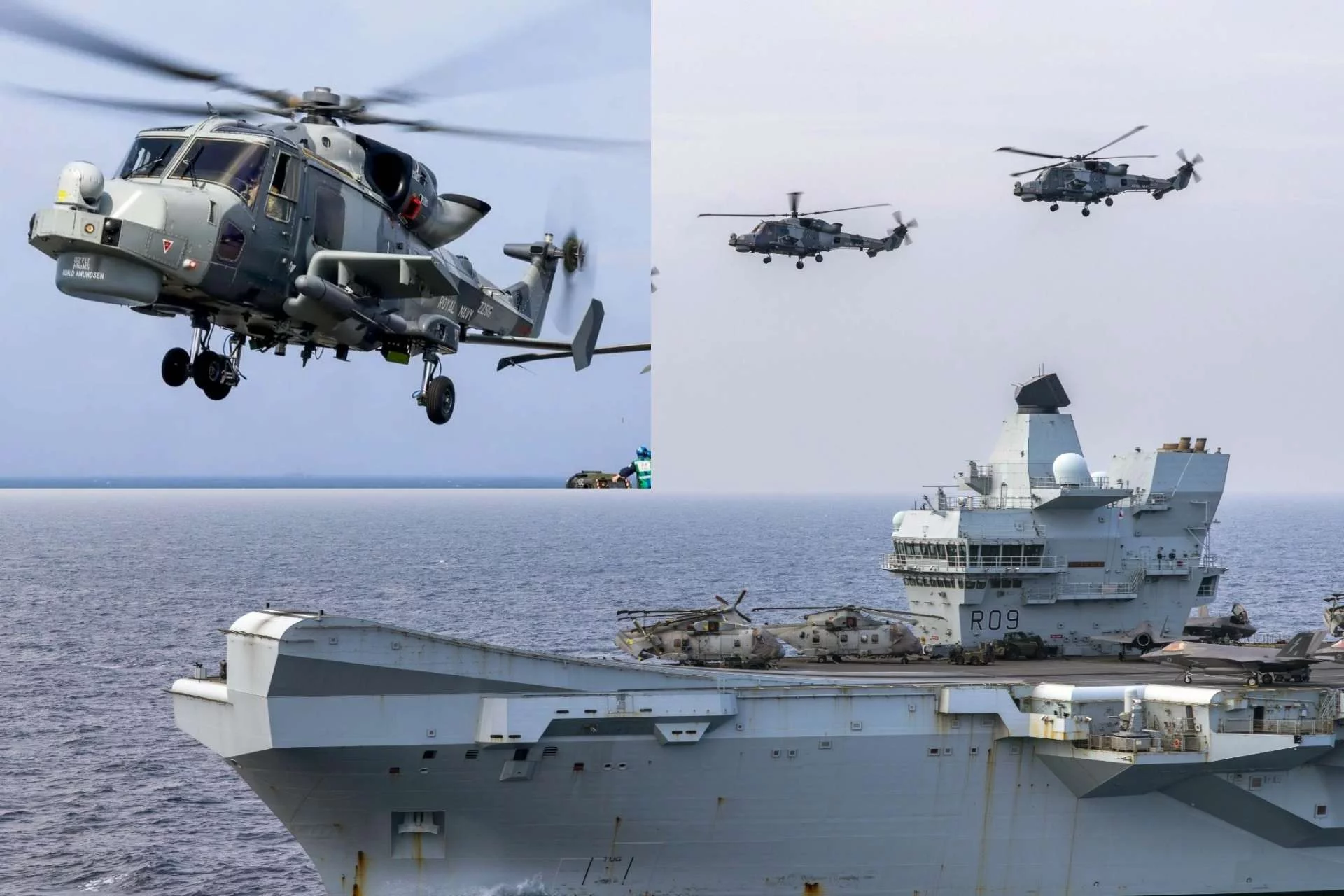
The Royal Navy has declared its Wildcat attack helicopters to have reached Initial Operating Capability (IOC) with the Sea Venom anti‑ship missile. The milestone restores a dedicated helicopter‑launched strike option against surface vessels and coastal targets after several years of transition.
Deployed during the Carrier Strike Group’s extended Indo‑Pacific sortie, four Wildcats from 815 Naval Air Squadron are embarked across HMS Prince of Wales, Type 45 destroyer HMS Dauntless and Norwegian frigate HNoMS Roald Amundsen on Operation Highmast. Each Wildcat can carry four Sea Venoms, enabling multiple discrete engagements in a single sortie or a concentrated salvo against a single high‑value target.
Wildcat retains its Martlet loadout for countering boat swarms and small craft, making the platform highly flexible: commanders can escalate from warning shots and disabling strikes to mission‑kill strikes on larger combatants without immediately calling in fixed‑wing support. Sea Venom — developed by MBDA — combines an imaging infrared seeker with a robust datalink that keeps an operator “in the loop” from launch to impact; live video from missiles can be streamed back to crews for mid‑flight aim adjustments or target reassignment if the tactical picture changes.
With IOC declared, Sea Venom moves from test serials into routine service as a primary counter‑surface weapon for sea denial and escort protection. The capacity to fire, observe and correct shots in real time reduces wasted launches and collateral risk in congested littorals, while a four‑round load compresses an adversary’s defensive decision cycle and enables layered, multi‑axis attacks without massing platforms.
Tactically and strategically, the change is significant: in the North Atlantic and Norwegian Sea it bolsters protection for high‑value units and undersea infrastructure; in the Mediterranean and Red Sea it strengthens deterrence against fast‑moving harassment tactics around chokepoints; and across the Indo‑Pacific it gives allied surface groups added standoff punch against missile‑armed corvettes and fast attack craft.
Bottom line — Wildcats armed with Sea Venom make the Royal Navy’s helicopter force a far more dangerous hunter of naval assets. Task groups gain reach and choice; adversaries face tighter margins and longer odds when operating near a British carrier group.
