

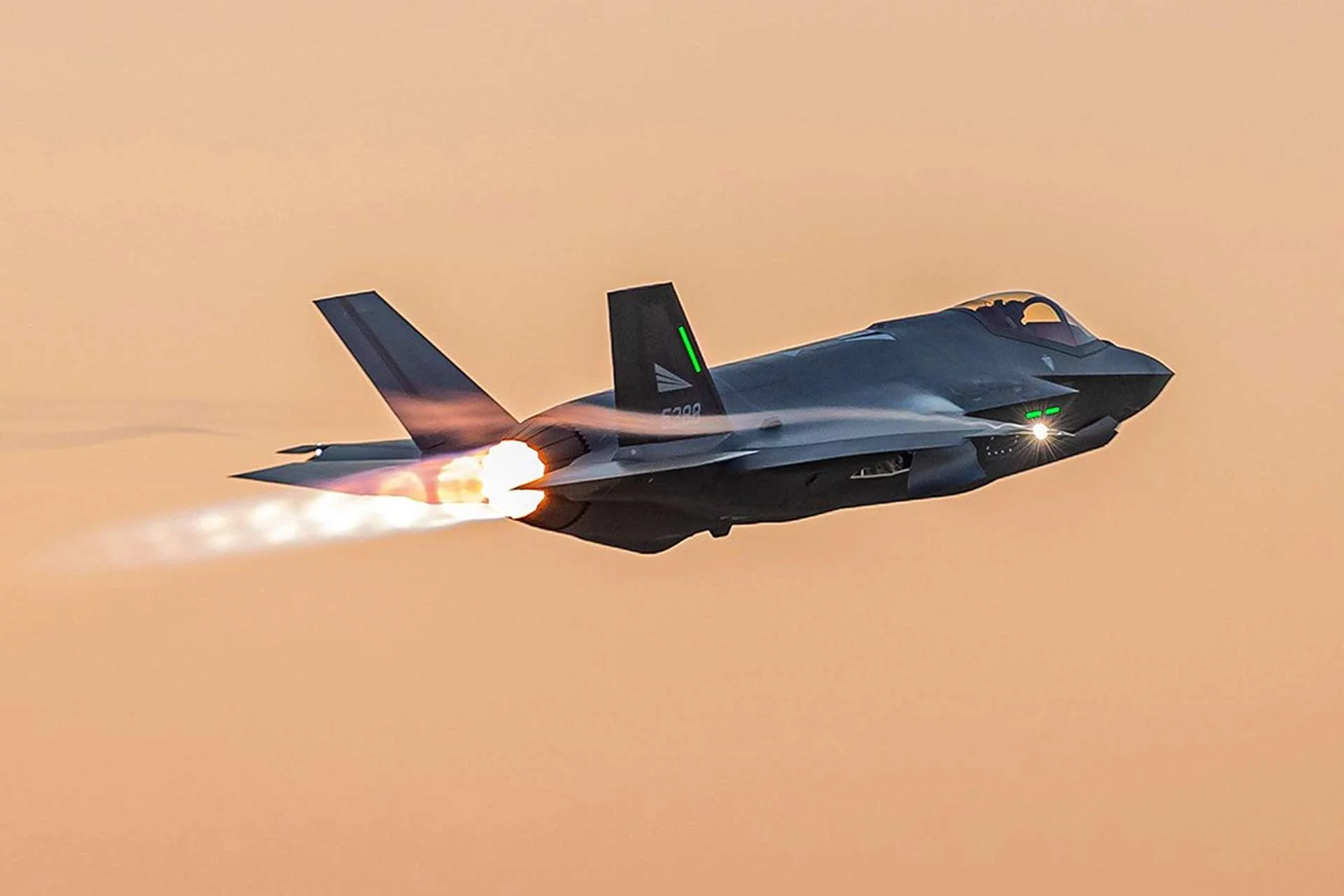
Norwegian F-35 Lightning II jets have been deployed to Poland’s 31st Tactical Air Base (Poznań-Krzesiny) to strengthen NATO air policing on the Alliance’s eastern flank. The deployment aims to deter Russian drone and aircraft incursions and test allied interoperability under heightened regional tensions.
On October 4, 2025, Poland signaled a tighter NATO air posture with this fresh F-35 deployment. Against repeated Russian provocations near NATO borders, the base now hosts Dutch and Norwegian F-35s alongside Polish crews, providing credible interception capability and rapid-response readiness.
The F-35A Lightning II brings stealth, advanced radar, sensor fusion, and secure data links, allowing it to act simultaneously as a sensor, shooter, and networked battlefield node. From Poznań-Krzesiny, the aircraft can quickly detect and engage small, low-signature threats like drones while maintaining the range and speed needed for air policing over Poland’s wide airspace.
Forward-based F-35 operations also streamline data sharing, mission planning, and maintenance across Dutch, Norwegian, and Polish units. A recent incident—when a Dutch F-35 shot down a Russian drone over Poland—demonstrated how forward deployments sharpen deterrence and shorten response times.
Strategically, co-basing advanced fighters with Polish crews turns NATO commitments into daily operational sorties, reducing the time it takes to intercept potential threats and complicating adversary planning.
Militarily, the air package integrates with existing assets, including Polish F-16s for high-volume air policing and German Patriot batteries at Jasionka providing layered air and missile defense. The stealthy F-35 detachments can cue surface-to-air systems or operate independently, while NATO command maintains engagement authority. As additional Norwegian F-35s arrive and Poland accelerates its own F-35 induction, the result is a denser, more resilient eastern-flank air defense posture.
Poland’s message is clear: NATO fighter power will not remain distant while threats evolve. Concentrating Dutch and Norwegian F-35s alongside Polish crews at Poznań-Krzesiny strengthens deterrence, compresses response times, and increases the cost of any airborne provocation over NATO territory.
