

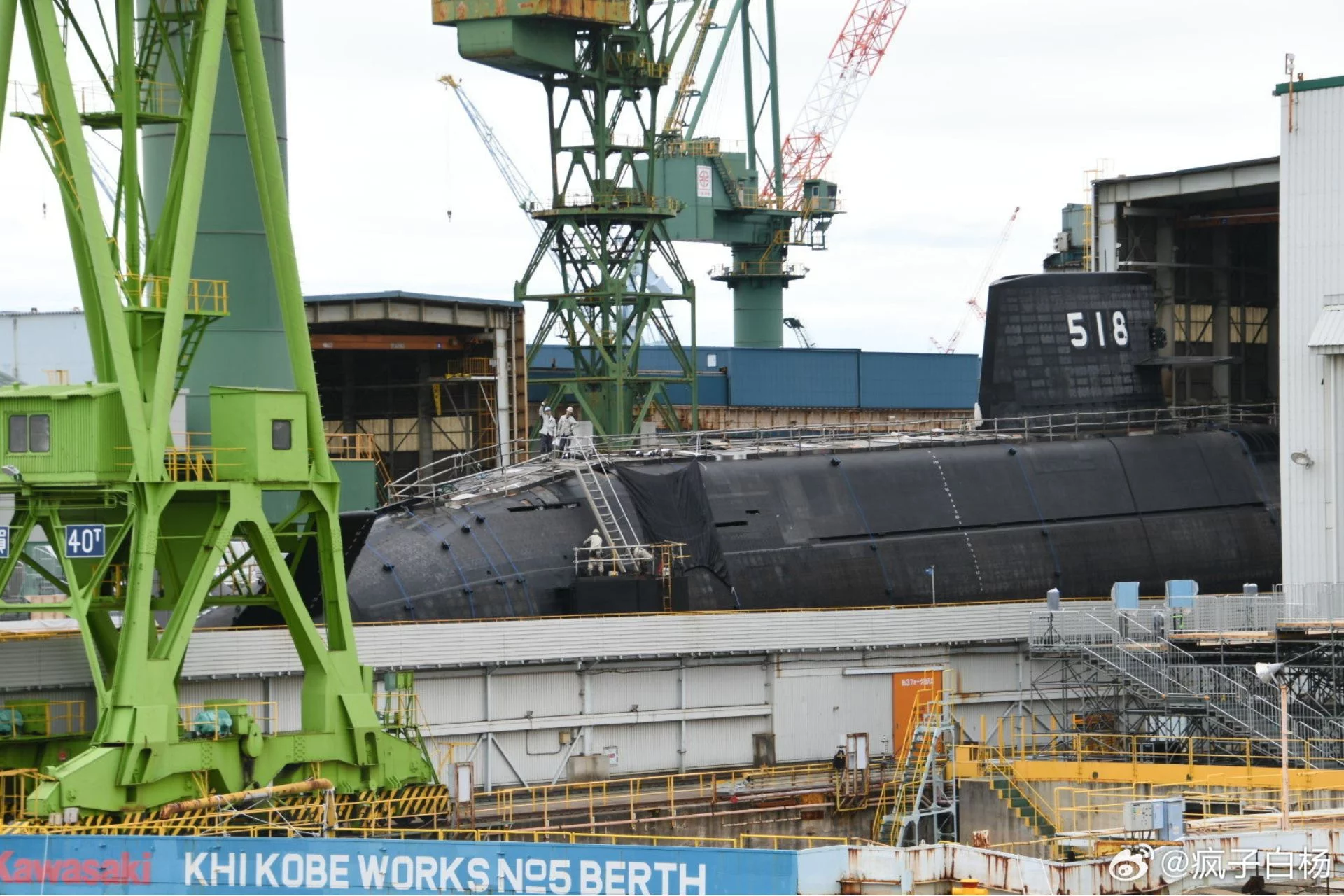
The Japan Maritime Self-Defense Force (JMSDF) is set to launch its next Taigei-class diesel-electric attack submarine on October 14 at Kawasaki Heavy Industries’ Kobe Shipyard. The hull, belonging to the fiscal year 2022 program, is widely expected to be designated SS-518, with its official name to be announced during the ceremony. According to a notice from the Maritime Staff Office, the event is scheduled between 11:50 and 12:05 local time and will be overseen by Vice Admiral Matsumoto Tamotsu — a routine yet notable sign of the consistent production rhythm alternating between Kawasaki and Mitsubishi shipyards.
The Taigei program replaces the traditional air-independent propulsion (AIP) system with high-capacity lithium-ion batteries, allowing longer and faster underwater endurance. This upgrade reduces the need for snorkeling and periscope exposure, offering a tactical advantage in increasingly contested waters marked by growing Chinese and Russian naval activity.
While maintaining the general configuration of the previous Sōryū-class, the Taigei introduces major changes in its energy architecture. The submarine measures roughly 84 meters in length, 9.1 meters in beam, and displaces around 3,000 tonnes surfaced, with a crew of about 60 personnel. It retains a conventional diesel-electric propulsion system, powered by the latest-generation Kawasaki engines for battery recharging. Design priorities focus on acoustic stealth and shorter maintenance cycles.
The sensor and combat suite includes the ZQQ-8 sonar system, ZPS-6H surface search and navigation radar, and an updated combat management system. The optronic mast and electronic warfare suite are integrated through systems like OYX-1 and ZQX-12, which fuse data from sonar, ESM, and surface sensors — improving situational awareness and reducing the vessel’s signature.
In terms of armament, Taigei follows a proven and flexible loadout approach. It is fitted with six 533 mm HU-606 torpedo tubes, capable of launching Type 89 and Type 18 heavyweight torpedoes, as well as UGM-84 Harpoon anti-ship missiles while submerged. Although JMSDF does not disclose loadouts, this versatility supports both blue-water interdiction and chokepoint ambush missions.
What changes with the Taigei-class is operational tempo. Lithium-ion battery capacity allows higher sustained submerged speeds and fewer snorkeling intervals, reducing exposure to enemy detection and increasing responsiveness during shadowing or surveillance missions. Instead of emphasizing static endurance as with AIP, Taigei prioritizes mobility and maneuver flexibility — particularly suited to the First Island Chain geography.
At the force-structure level, Japan’s submarine fleet continues to expand steadily. JS Raigei (SS-516) was commissioned in March 2025, while SS-517 is on track for commissioning next year. The goal of fielding at least eight Taigei-class units remains current, with alternating builds between KHI and MHI supporting a fleet target of about 22 operational submarines. This rotation enables the gradual retirement of Oyashio-class boats while balancing training and maintenance cycles.
The timing of the SS-518 launch coincides with heightened Chinese Navy transits through the Miyako Strait and Russian Pacific Fleet activities. A larger and more advanced Japanese submarine fleet complicates adversary anti-submarine warfare (ASW) operations in the East China Sea and Philippine Sea, strengthening allied posture along the First Island Chain.
While Tokyo’s communication remains cautious, the strategic effect is unmistakable — a cumulative deterrence strategy that raises the cost of coercion and enhances Japan’s and its allies’ operational flexibility in the region.
