

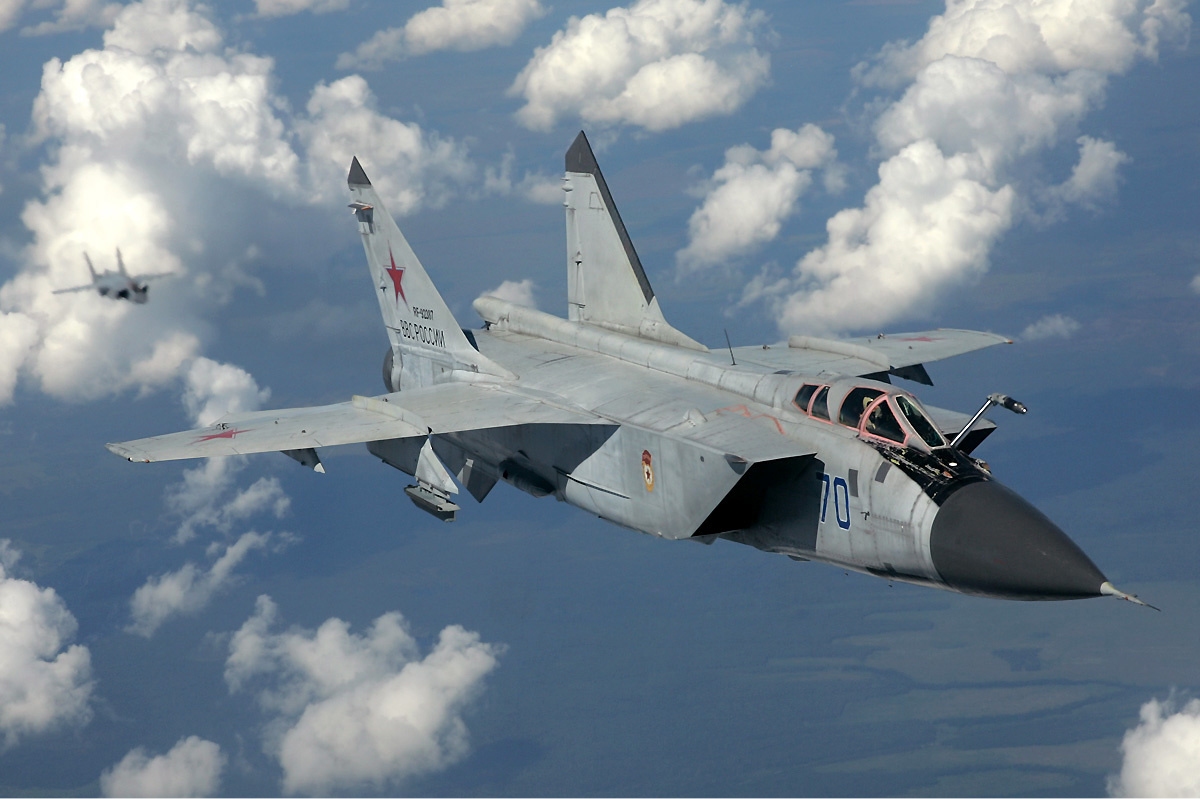
Russia is reportedly altering its employment of MiG-31K aircraft armed with Kinzhal aeroballistic missiles, increasingly relying on aerial refueling to mitigate threats from Ukraine’s expanding long-range strike capabilities and effective air defenses. Open-source intelligence from October 11 suggests that these specialized fighters are being refueled mid-flight by Il-78 tankers, a tactic that allows them to operate from safer bases deep within Russia and maintain longer on-station times before launch. This strategic shift enables Moscow to vary attack azimuths and timing, significantly complicating interception planning for Ukrainian air defense systems like the Patriot.
This tactical evolution is driven by two primary factors. First, successful Ukrainian drone strikes on key Russian airbases, such as Engels-2 in 2022 and Soltsy-2 in 2023, have forced Moscow to reposition its limited fleet of strategic assets away from exposed forward locations. Second, the confirmed interception of Kinzhal missiles by Ukrainian Patriot batteries since May 2023 has shattered their aura of invincibility, creating an operational incentive for Russia to optimize launch parameters—such as speed, altitude, and angle—to increase the chances of penetrating defenses. Air-to-air refueling addresses both challenges by decoupling basing locations from launch points.
The MiG-31K/I “Foxhound” variants serve as high-speed, high-altitude launch platforms for the Kh-47M2 Kinzhal, an air-launched derivative of the Iskander-M ballistic missile. Weighing approximately 4,300 kg and with a reported range of 1,500–2,000 km, the Kinzhal’s effectiveness is heavily dependent on the kinematic energy it possesses at the moment of release. By using Il-78 tankers, the MiG-31s can conserve their internal fuel for the critical high-energy climb and dash just before launching the missile, thereby maximizing its performance.
The strategic ramifications of this integration are significant. Geopolitically, it allows Russia to project power from unpredictable vectors, including the Arctic or Caspian Sea approaches, complicating Ukraine’s early-warning and defensive posture. Militarily, it extends the combat radius of the launch platforms and compresses engagement timelines. However, this strategy introduces a critical vulnerability: a dependence on Russia’s relatively small and valuable fleet of Il-78 tanker aircraft. The survival and careful routing of these tankers are now paramount to the success of Kinzhal missions.
In essence, Russia is trading tanker dependency for enhanced operational flexibility and platform survivability. For Ukraine and its partners, this development underscores the continuous need for mobile, multi-layered air defenses capable of responding to threats from multiple directions. For Russia, it means the Kinzhal, once hailed as a superweapon, must now be employed with greater sophistication to achieve its desired effects on the battlefield.
