

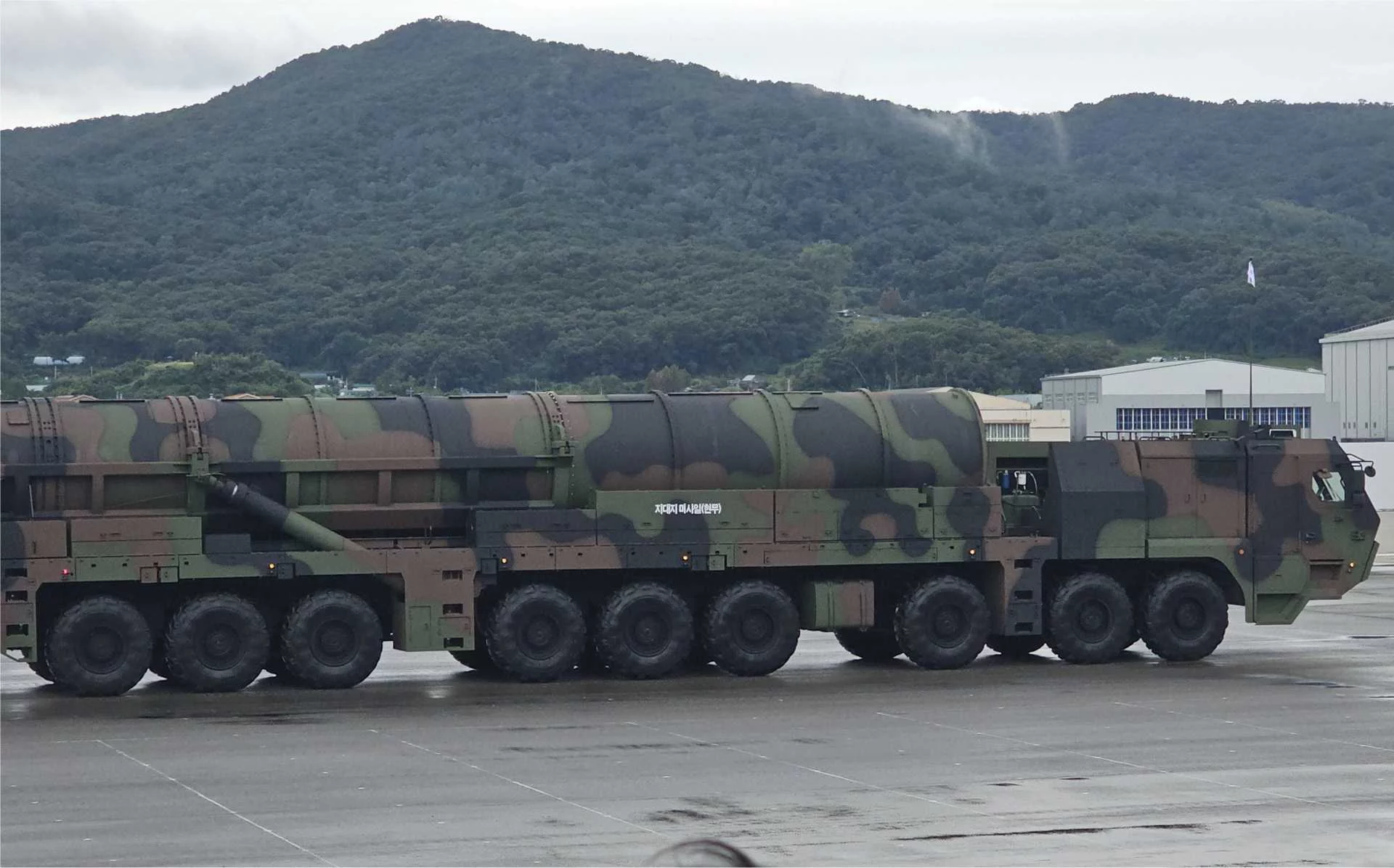
South Korea is preparing to introduce its next-generation Hyunmoo-5 ballistic missile—a short-range system designed for high precision and deep penetration—by the end of 2025. According to Yonhap News, the weapon marks a significant evolution in Seoul’s deterrence strategy.
The Republic of Korea Armed Forces are finalizing preparations for the deployment of the Hyunmoo-5 ballistic missile. Though resembling an intercontinental ballistic missile in size, it has been optimized for conventional missions and is described by defense officials as a “deep-penetration short-range ballistic missile.” Military analysts note that the weapon represents a fundamental shift in South Korea’s defense posture, offering the capability for rapid and devastating strikes against hardened targets across the region.
South Korea’s Most Powerful Ballistic Missile
The Hyunmoo-5 is regarded as the most powerful ballistic missile South Korea has ever developed. It reportedly weighs around 36 tons at launch and carries an 8–9 ton conventional warhead, making it one of the heaviest conventionally armed missiles in existence.
Engineered for deep target penetration, it is said to be capable of destroying underground facilities buried over 100 meters deep. The missile was first displayed publicly during the 2024 South Korea Armed Forces Day parade, mounted on two nine-axle transporter-erector-launchers (TELs) that highlighted its large scale and high mobility.
Strategic Impact Within Short Range
Although some analysts have speculated that the Hyunmoo-5 could reach up to 3,000 kilometers, South Korea’s Ministry of National Defense maintains that it is intended as a short-range operational system. This classification underscores its focus on striking regional deep targets.
Reaching an estimated terminal velocity of Mach 10, the missile is designed to neutralize North Korea’s hardened command centers, missile silos, and WMD infrastructure, even under elevated alert conditions.
A Key Component of South Korea’s “Three-Axis Defense Strategy”
The Hyunmoo-5 serves as a central element of Seoul’s Three-Axis Defense Strategy, which consists of:
- Kill Chain: Preemptive strike capability
- KAMD: Korea Air and Missile Defense
- KMPR: Retaliatory and deterrent operations
Within this framework, Hyunmoo-5 enhances both the preemptive and retaliatory aspects.
Seoul’s broader aim is to reduce dependence on the U.S. extended nuclear deterrent by developing powerful, conventional precision-strike systems with strategic-level impact.
Engineering and Operational Design
The missile reportedly features a two-stage solid-fuel propulsion system, allowing for rapid launch readiness and low logistical burden.
Its massive warhead can be configured either as a single deep-penetration charge or a cluster of precision-guided submunitions designed to destroy multi-compartment bunkers.
Mounted on a mobile TEL platform, the Hyunmoo-5 offers high mobility, concealment, and rapid redeployment — ideal for operations within South Korea’s mountainous terrain.
Regional Security Dynamics Are Shifting
Expected to achieve operational status by late 2025, the Hyunmoo-5 marks the beginning of a new era in conventional deterrence on the Korean Peninsula. The missile stands as South Korea’s direct response to North Korea’s growing nuclear and missile capabilities, serving not as a nuclear countermeasure but as a strategically effective conventional weapon.
In U.S. defense circles, the development has sparked debate over how such a system could blur the line between conventional and strategic weaponry.
Implications for Defense Industry and Technology
The Hyunmoo-5 also demonstrates South Korea’s remarkable progress in indigenous defense technology.
Its development integrates multiple advanced subsystems — missile propulsion, hardened-target penetrators, advanced guidance, and mobile launcher platforms — showcasing the country’s growing industrial and engineering self-sufficiency.
As such, the Hyunmoo-5 is not only a military asset but also a symbol of technological advancement.
With the Hyunmoo-5, South Korea has officially entered a new era of strategic deterrence through conventional weaponry.
This development may shift the regional balance of power in East Asia, but one fact is clear:
Seoul now possesses the capability to deliver precision preemptive strikes when required — ensuring deterrence not just through defense, but through credible, high-impact offensive power.
