

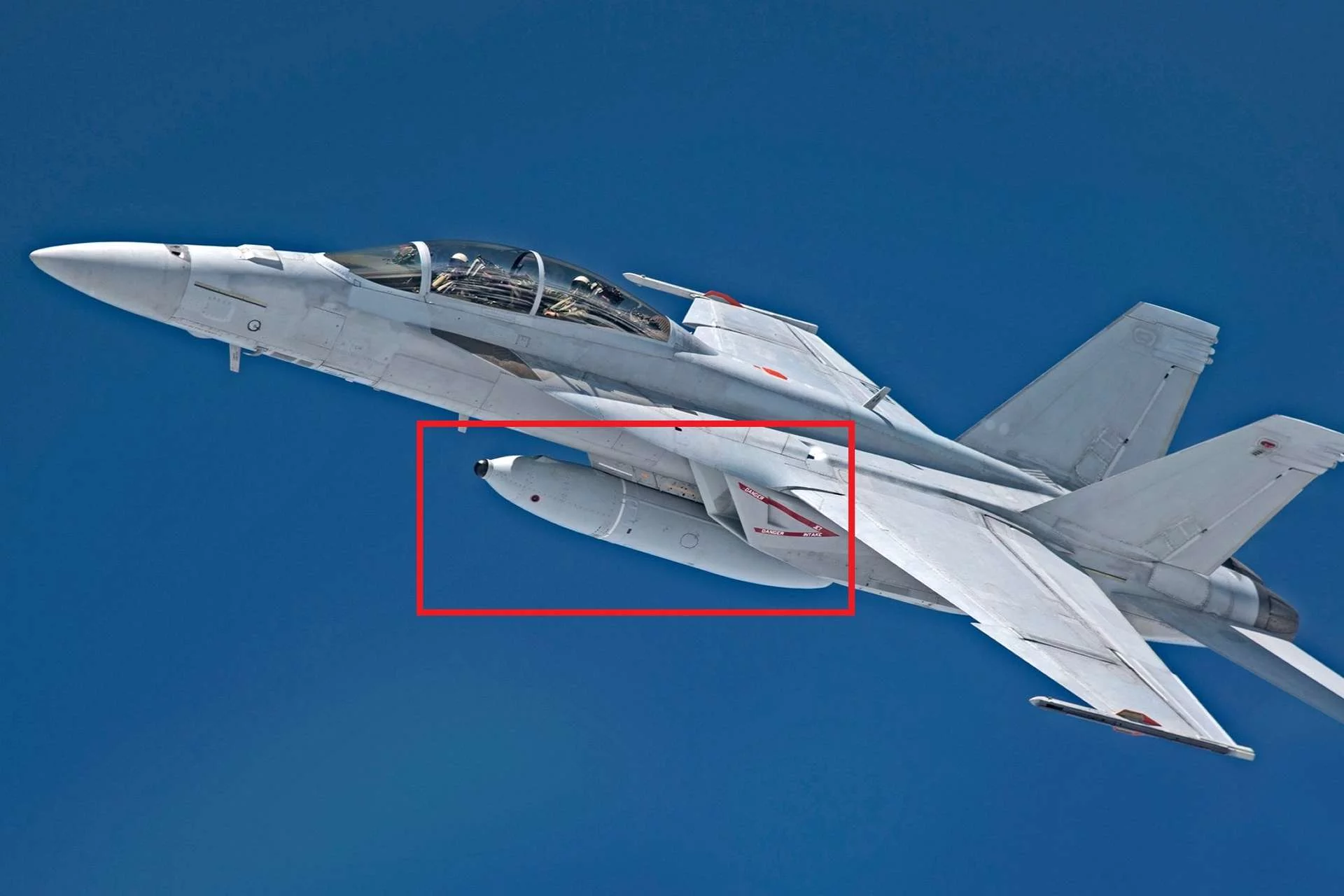
Lockheed Martin has secured a $233 million firm-fixed-price contract to supply IRST21 Block II systems and initial spares to the U.S. Navy and Air National Guard, officially launching the sensor’s transition into full-rate production. The milestone marks a major step in advancing passive, long-range infrared detection capabilities for U.S. airpower.
The Block II upgrade enhances the system’s long-wave infrared search and track (IRST) performance, allowing aircraft to detect and engage low-observable targets at extended ranges without using radar emissions. In an era dominated by radar jamming and stealth threats, this passive sensor provides a crucial “first look, first shot” advantage across contested airspace.
Mounted on the F/A-18E/F Super Hornet’s centerline fuel tank, IRST21 Block II complements the AN/APG-79 AESA radar, maintaining situational awareness even when radar use is restricted. For the F-15 and F-16 fleets, the technology comes in the Legion Pod, offering modular integration and plug-and-play installation without major airframe modifications — effectively bringing sixth-generation sensing to legacy fighters.
The new variant introduces improved range discrimination, faster sensor-to-shooter timelines, and AI-powered tracking algorithms. These advancements deliver beyond-visual-range precision while preserving total passivity, keeping aircraft hidden from enemy sensors.
Strategically, IRST21 Block II strengthens U.S. airpower in radar-denied, GPS-degraded, or electronically contested environments. It enhances detection of stealthy cruise missiles, low-observable aircraft, and high-density raids — threats that conventional radars may struggle to classify or be restricted from tracking. For carrier-based forces, it acts as a silent counter-stealth shield, while Air National Guard units gain a powerful homeland defense tool capable of quietly identifying long-range aerial threats.
Following the U.S. Navy’s Initial Operational Capability (IOC) declaration, the move to full-rate production confirms the system’s maturity, stable pricing, and readiness for broad fleet deployment.
By delivering passive reach, rapid targeting, and enhanced survivability, Lockheed Martin’s IRST21 Block II transforms a specialized sensor into a fleet-wide capability — ensuring U.S. fighters can see first, strike first, and stay undetected in the world’s most contested skies.
