

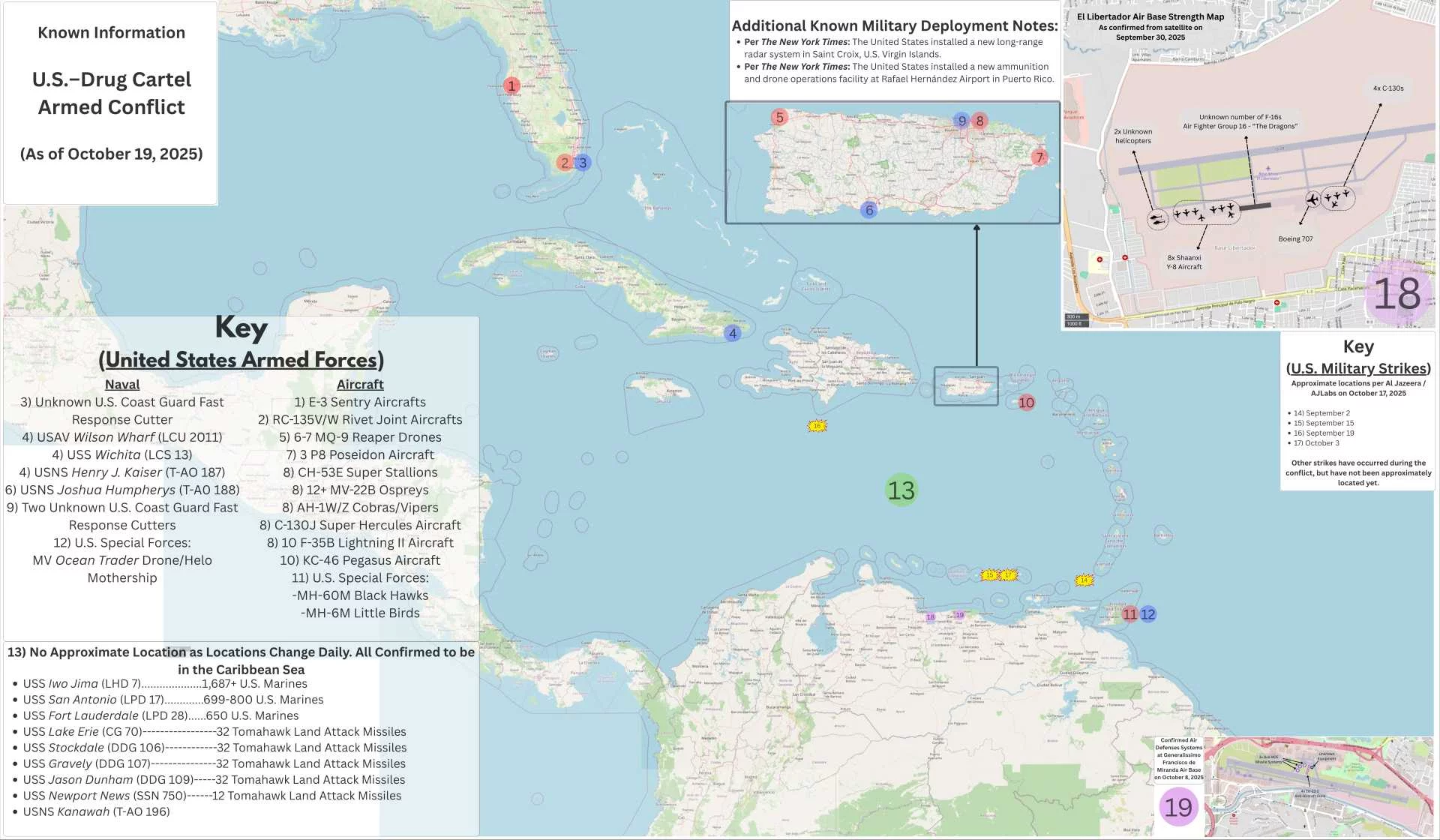
The United States maintains a robust military presence across the Caribbean Sea as part of an ongoing campaign aimed at dismantling Venezuela-linked drug and arms trafficking networks. Pentagon sources describe the operation as one of the largest U.S. deployments in the region in decades.
Since late summer, the Department of Defense has deployed three guided-missile destroyers, an amphibious ready group, and a cruiser to support maritime interdiction and surveillance missions. These naval assets operate alongside Marine Expeditionary Units equipped with vertical-lift aircraft and amphibious assault capabilities.
Embarked aviation elements reportedly include F-35B Lightning II fighters, MQ-9 Reaper drones, and AC-130J Ghostrider gunships, while P-8A Poseidon patrol aircraft and a Virginia-class submarine conduct intelligence and tracking operations against suspected smuggling targets.
The mission seeks to disrupt the financial and logistical lifelines of criminal organizations linked to Venezuela’s security apparatus. However, analysts note that the scale and configuration of U.S. forces indicate readiness for broader “full-spectrum contingency operations,” extending beyond counter-narcotics enforcement.
In response, the Maduro government has condemned the deployment as a “military provocation,” activating coastal defenses and conducting missile drills near Isla Margarita and the Paraguaná Peninsula. Meanwhile, Puerto Rico has become a central logistics and staging hub for U.S. forces, serving as a proving ground for next-generation naval-air integration and distributed maritime operations.
U.S. officials emphasize that the mission is essential for safeguarding regional stability and curbing state-backed criminal networks. Nevertheless, tensions in the Caribbean remain elevated as the operation continues.
