

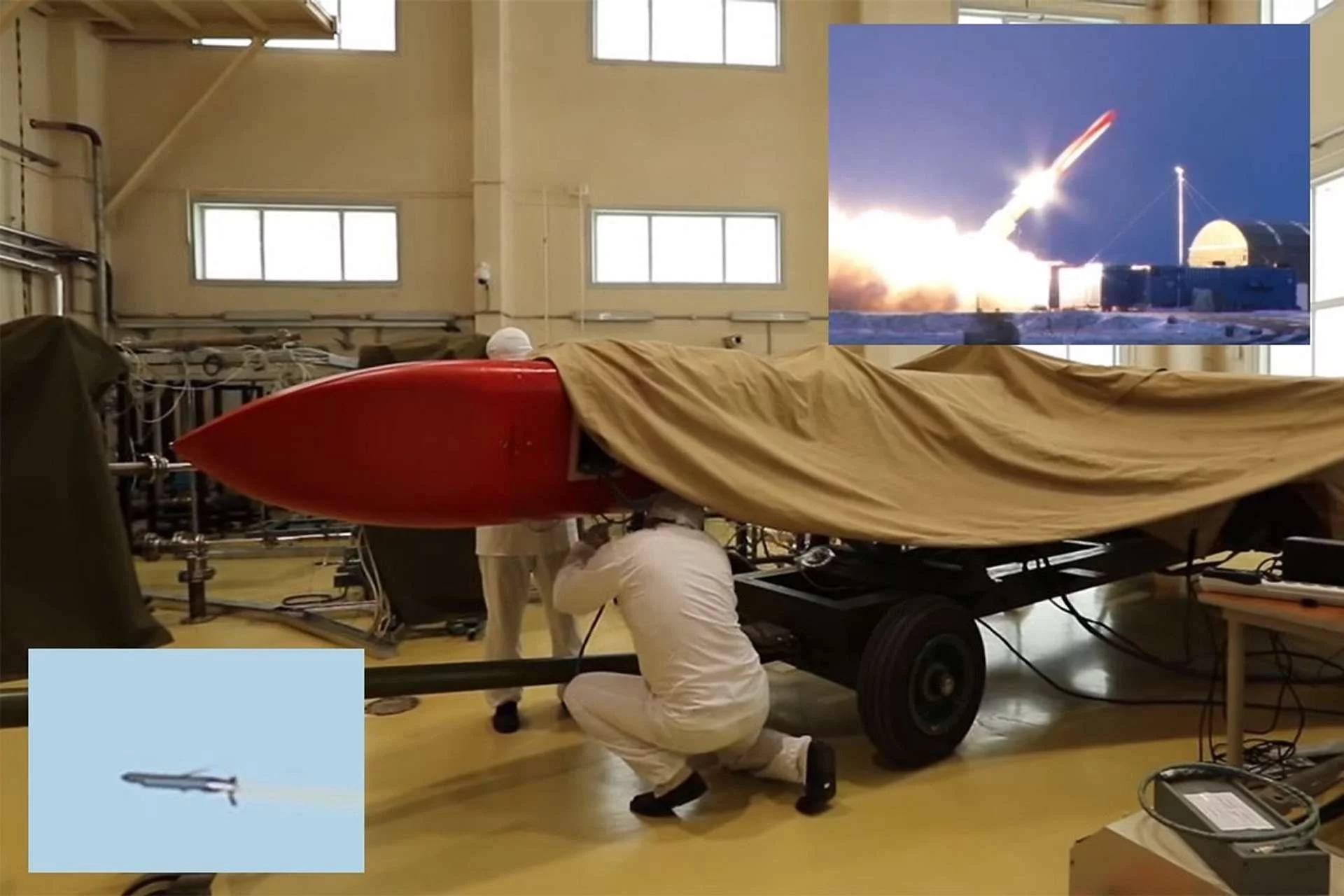
Russia has announced the successful long-range flight test of its 9M730 Burevestnik nuclear-powered cruise missile, which reportedly flew 14,000 kilometers in 15 hours on October 21. The Kremlin presented the test as proof of a new class of intercontinental nuclear-powered systems capable of bypassing Western air and missile defenses, signaling Moscow’s determination to expand its strategic options.
During a televised briefing, President Vladimir Putin confirmed that Burevestnik had completed a “long-endurance, low-altitude” flight, emphasizing that the weapon can penetrate “any missile defense.” The test showcased a propulsion system designed for near-unlimited range and unpredictable routing — a feature that complicates NATO’s early-warning and air-defense networks across the Euro-Atlantic region.
Technical Profile and Strategic Context
Known by its NATO designation SSC-X-9 “Skyfall”, Burevestnik replaces conventional fuel with a nuclear heat source, believed to power a turbojet engine. This theoretically enables months of endurance and virtually global range, allowing terrain-hugging flight paths that reduce radar detection.
The system first appeared publicly in 2018, among six new strategic weapons unveiled by President Putin. Earlier test campaigns raised safety and environmental concerns — including a 2019 explosion linked to related testing that killed several Russian specialists and caused temporary radiation spikes.
Moscow now portrays the missile as nearing operational readiness, while Western experts remain skeptical about its guidance stability, radiation safety, and practical deployment model. Analysts note that while the 14,000-km test demonstrates endurance, it does not prove survivability against advanced layered air defenses.
Comparative and Strategic Implications
In comparison, NATO’s principal land-attack cruise missiles — such as the U.S. Tomahawk Block IV/V and AGM-158B JASSM-ER — are conventionally powered and have operational ranges of around 1,000 miles and 500+ nautical miles, respectively. France’s ASMP-A, the only current NATO nuclear cruise missile, reaches approximately 500–600 km. Against that backdrop, Burevestnik’s claimed “virtually unlimited” range makes it a unique, if controversial, platform.
Strategically, the test comes amid the collapse of arms-control frameworks: the INF Treaty ended in 2019, and New START is set to expire in early 2026 without replacement. A nuclear-powered intercontinental cruise missile falls outside existing treaty categories, complicating verification and risk management regimes. NATO is expected to respond by accelerating integrated air- and missile-defense modernization and long-range fires programs already underway.
President Putin’s declaration that Burevestnik has “no analogues” underscores both ambition and signaling intent. The missile’s test suggests not only technological persistence but also a strategic message: Russia seeks new, non-ballistic options for assured retaliation and extended deterrence.
Whether Burevestnik becomes a deployed weapon or remains a symbolic deterrent, the test reflects a new challenge for Western defense planners — a cruise-missile threat evolving faster than existing air-defense and arms-control architectures were designed to handle.
