

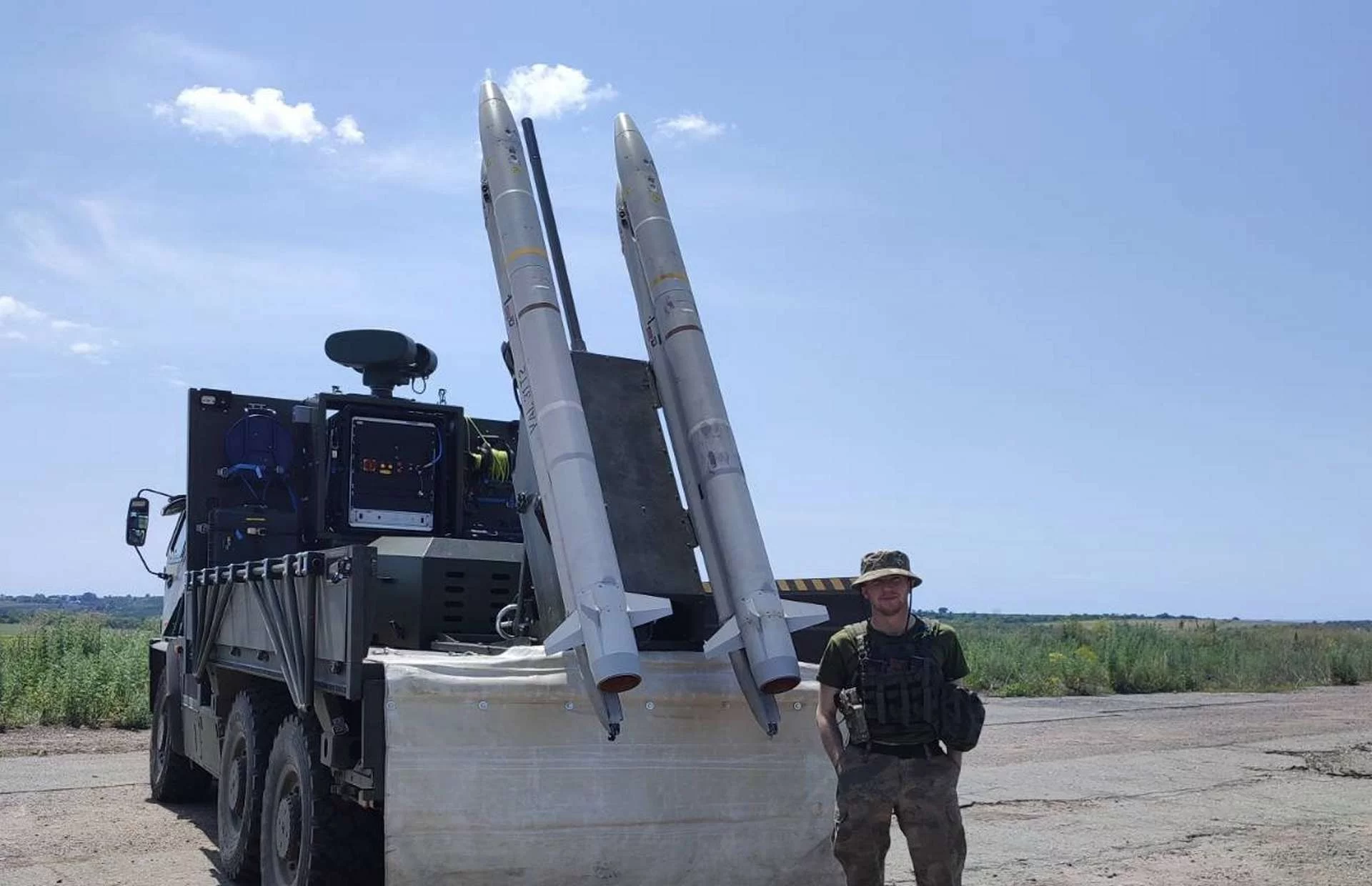
Ukraine’s Air Command West has confirmed that the British-developed Raven short-range air defense system successfully intercepted four Russian cruise missiles and 24 unmanned aerial vehicles, underscoring the growing combat role of allied-engineered systems on Ukraine’s front lines.
According to an official statement released on October 24, the Raven launcher destroyed three Kh-59 and one Kh-101 missiles, alongside over two dozen Russian reconnaissance and strike drones. The system’s crew, led by a commander identified as Artem, recalled its first live intercept in November 2023, followed by a series of successful engagements as the platform’s role expanded beyond counter-drone operations. Ukrainian defense media later verified the figures, confirming Raven’s increasing operational presence across multiple sectors.
Developed by British engineers in record time—just three months—the Raven system adapts the AIM-132 ASRAAM air-to-air missile for surface launch from a truck-mounted platform. Built on the 6×6 Supacat HMT-600 chassis, it features twin launch rails originally sourced from retired RAF aircraft such as the Tornado, Hawk, and Jaguar. The vehicle integrates an electro-optical turret for passive target detection and tracking, enabling rapid, radar-silent engagements. Operators can fire the system remotely from short standoff distances, reducing exposure to enemy retaliation and allowing fast repositioning after launch.
The ASRAAM missile provides Raven with a high-off-boresight infrared seeker, lock-on-after-launch capability, and dual-thrust propulsion, allowing speeds exceeding Mach 3 and an effective range of up to 15 kilometers. Its 10-kilogram blast-fragmentation warhead and proximity fuze offer a lethal solution against low-altitude threats like cruise missiles and drones that exploit terrain masking.
Engagements against the Kh-59 and Kh-101—Russia’s primary subsonic and stealth cruise missiles—illustrate the system’s precision and reaction speed. Successfully intercepting these targets, which are typically designed to evade radar coverage, demonstrates not only Raven’s sensor fusion and missile guidance accuracy but also the Ukrainian crews’ growing proficiency in integrating Western systems into a layered defense architecture.
The Raven provides commanders with a mobile, silent, and survivable SHORAD asset that complements Ukraine’s long- and medium-range defenses such as Patriot, SAMP/T, Buk, and IRIS-T. Units can relocate quickly along probable approach routes, coordinate with local observers, and execute ambush-style launches within seconds. The system’s minimal radar signature and rapid “shoot-and-scoot” capability make it difficult for Russian forces to detect and counterattack.
Strategically, the Raven symbolizes the effectiveness of “FrankenSAM”-type rapid engineering initiatives—projects blending NATO and Ukrainian components into new, field-ready systems. Britain’s contribution of vehicles, missiles, and technical expertise has filled critical gaps in Ukraine’s short-range air defense network, enabling a cost-efficient response to Russia’s saturation drone and cruise missile strikes.
By proving capable of downing advanced cruise missiles, Raven validates the approach of rapid, adaptive weapons integration and strengthens Kyiv’s layered air defense posture. It stands as a clear example of how international collaboration and engineering agility are reshaping modern battlefield dynamics in Ukraine’s favor.
