

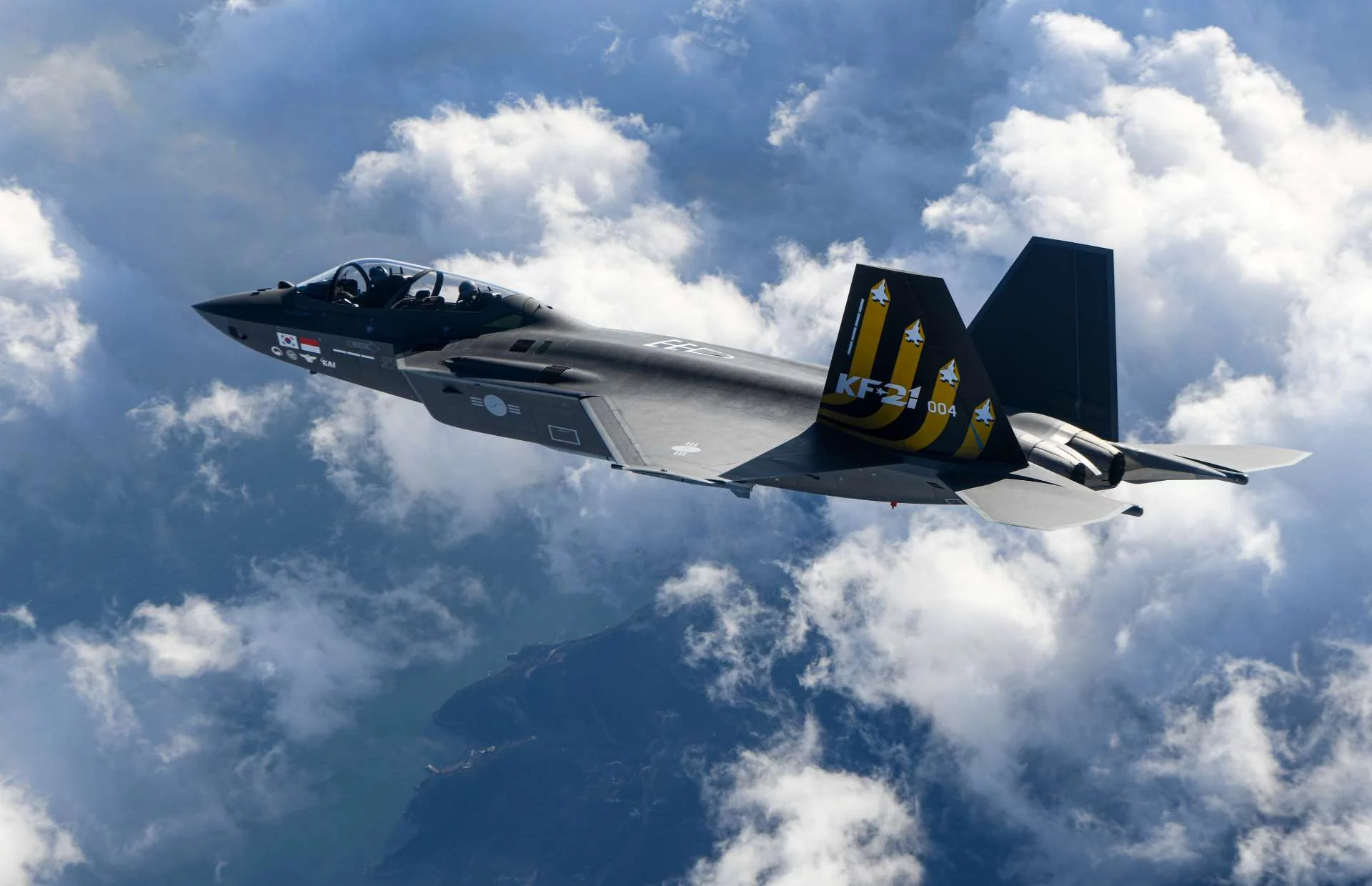
South Korea’s indigenous KF-21 Boramae fighter jet stole the spotlight at Seoul ADEX 2025, impressing a visiting Philippine delegation with a dynamic flight demonstration. Following the event, Korea Aerospace Industries (KAI) confirmed that discussions are underway with Manila over a potential acquisition deal, signaling deeper defense cooperation amid rising tensions in the West Philippine Sea.
According to a South China Morning Post report dated 27 October, KAI highlighted that the Philippines’ recent decision to double its FA-50 fleet reflects momentum toward a stronger industrial partnership. Given the Philippine Air Force’s reliance on FA-50s for air policing, maritime patrol, and light strike missions, the KF-21 naturally emerges as a next-step platform to enhance its combat capabilities.
Powered by twin GE F414 engines, the 4.5-generation KF-21 integrates Hanwha Systems’ AESA radar, infrared search and track (IRST) sensors, and an advanced electronic warfare suite. The Block 1 variant focuses on air-to-air superiority, while Block 2, currently in accelerated development, will introduce precision-guided bombs and domestic cruise missiles, enabling a true multirole “swing-role” profile. Initial deliveries to the Republic of Korea Air Force are expected in 2026.
For Manila, a potential KF-21 purchase would compete with two familiar contenders: the U.S. F-16 Block 70/72 and Sweden’s Gripen. However, the higher cost and longer delivery schedules of these options make the Korean path attractive. The KF-21 also shares logistics and training commonality with existing FA-50 squadrons, reducing transition time and cost.
The aircraft’s twin-engine safety offers a crucial advantage for long-range maritime operations over the West Philippine Sea, where overwater patrols are routine. With Meteor-class missiles guided by AESA and IRST sensors, KF-21 could deliver credible area-denial capability, escort maritime patrol aircraft, and rapidly respond to incursions. As Block 2 brings precision and standoff munitions, the jet could provide sea-control effects complementing coastal defense batteries and FA-50s in day-to-day operations.
With Chinese coast guard and militia activity intensifying near Second Thomas Shoal and other contested areas, Manila faces mounting pressure to bolster deterrence. A modern, survivable multirole fighter like KF-21 enhances that deterrence—shaping behavior at sea, reinforcing coordination with treaty allies, and giving the Philippines more strategic flexibility short of escalation.
