

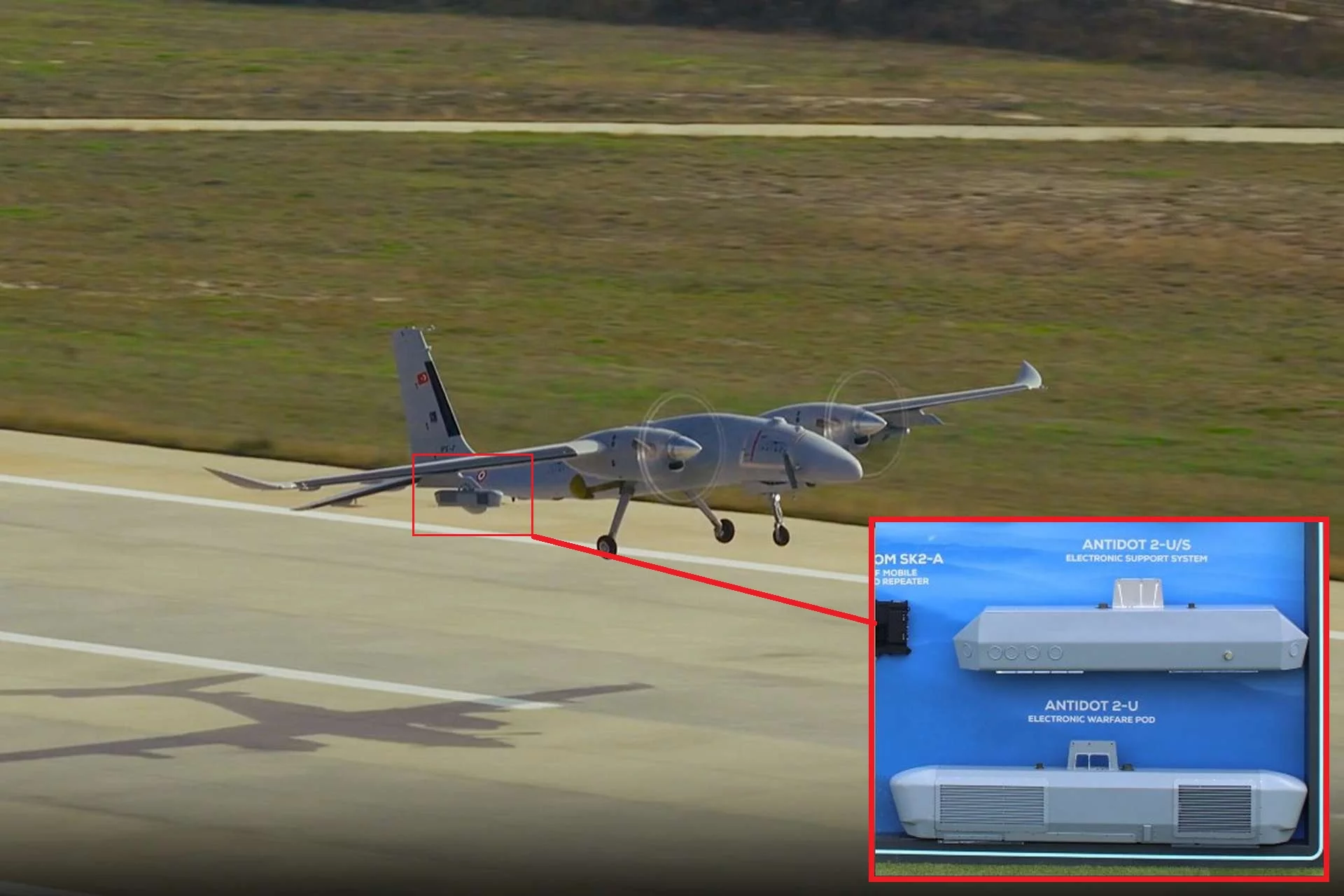
27 October 2025 – Defense / AerospacTurkey’s high-altitude, long-endurance unmanned combat aerial vehicle Bayraktar Akinci has begun operating with Aselsan’s Electronic Support (ES) and Electronic Attack (EA) pods, marking a shift from pure ISR and strike missions to active emitter detection, jamming and deception roles. Announcements from Baykar and technical details from Aselsan, supplemented by recent exercise footage, confirm the capability change.
Footage released on 24 October shows Akinci prototypes fitted with ANTIDOT 2-U/S (ES) and ANTIDOT 2-U/EA (EA) pods. The ES pod locates, classifies and geolocates hostile radar emissions and streams data to ground controllers in real time; the EA pod applies high-power jamming and deception techniques to disrupt or mislead threat radars. Together, they let a single unmanned platform both build an emitter picture and generate electronic effects that protect accompanying aircraft or munitions.
Akinci’s greater payload and electrical power compared with lighter systems such as the TB2 enable the use of higher-output ANTIDOT variants. Where TB2s can provide local protection and limited escort jamming, Akinci is positioned to perform wide-area emitter hunting, route sanitization and deception across much longer ranges.
Since entering Turkish service on 29 August 2021, Akinci has evolved into a multi-sensor node with SATCOM and AESA/SAR options and reserved growth space for SIGINT/EW payloads, making it a natural host for modular ES/EA stores. The ES/EA pairing compresses the find-fix-finish cycle: telemetry and recordings are sent live to the ground control station, operators can re-task in flight, and jamming techniques can be adapted to frequency-agile threats.
Aselsan is also developing a larger ASOJ-234U stand-off jamming pod for Akinci’s centerline station. When fielded, a centerline SOJ store would push the platform from escort roles into true stand-off suppression, allowing pre-conditioning of defended airspace ahead of strike ingress while retaining the cost and attritability advantages of an unmanned system.
Operationally and fiscally, the shift is significant. Uncrewed EW assets let planners accept tactical risk in dense threat environments, maintain persistent orbits measured in tens of hours, and re-task a single aircraft between emitter hunting and deception as the picture evolves. For nations without dedicated manned EW fleets, a HALE-class drone with modern pods offers an affordable, exportable path to SEAD/DEAD effects, escort jamming for cruise salvoes, and electromagnetic shield corridors for strike packages.
Strategically, persistent unmanned jamming changes deterrence and denial dynamics over maritime chokepoints and contested borders, forcing adversaries to expend more interceptors, reveal more emitters, and accept greater uncertainty in their radar picture. With visual confirmation from Baykar and technical disclosures from Aselsan, the Akinci’s ANTIDOT fitment signals that unmanned systems are becoming central actors in the electromagnetic battlespace rather than peripheral enablers.
