

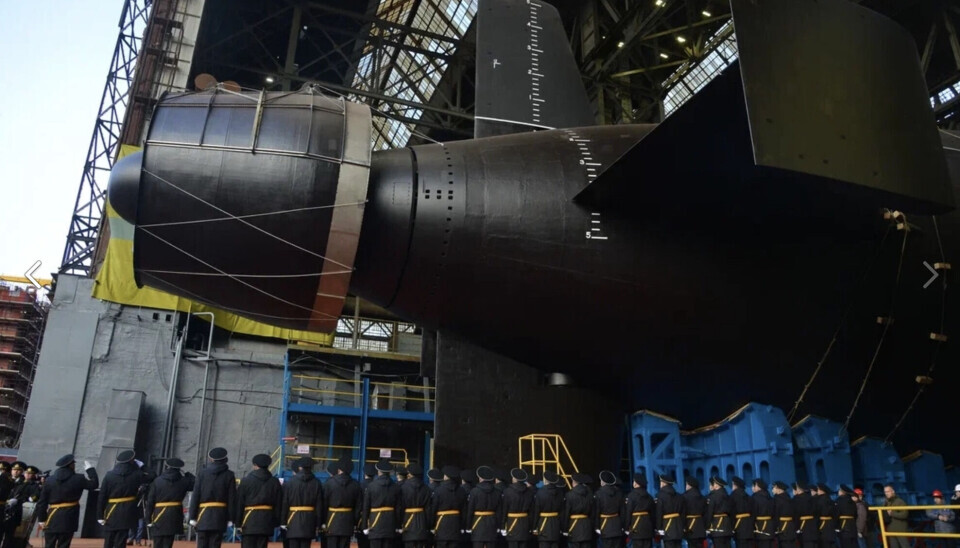
Russia has launched the Khabarovsk nuclear-powered submarine at the Sevmash shipyard in Severodvinsk. Defence Minister Andrei Belousov presided over the ceremony, with Navy Chief Admiral Aleksandr Moiseev participating. Official statements describe the submarine as carrying underwater and robotic weapons, positioning it as a carrier for long-range unmanned undersea systems that could challenge U.S. and NATO maritime defenses.
Ceremony and Unveiling
On 1 November 2025, the high-profile launch ceremony showcased Khabarovsk, a platform described by the Russian Ministry of Defence as equipped with “robotic weapon systems for various purposes.” Admiral Moiseev performed the traditional bottle-smash on the hull. While officials did not disclose the exact types of systems, the language suggests long-range unmanned underwater strike vehicles. The submarine will now proceed to harbor and sea trials before entering operational service.
Khabarovsk and the Poseidon Project
Commonly identified as Project 09851, Khabarovsk is a next-generation nuclear submarine designed to carry Poseidon nuclear-powered underwater drones capable of long-range deep-sea missions. Each submarine is believed to carry up to six Poseidon weapons. A second unit, Ulyanovsk, is under construction and is expected to join either the Northern Fleet or Pacific Fleet in the future.
Operational and Strategic Advantages
Khabarovsk offers Russia several operational benefits:
- Concentrates autonomous or semi-autonomous nuclear strike capability in a long-endurance, nuclear-powered hull.
- Complicates adversary detection through nonstandard acoustic and hydrodynamic signatures.
- Provides a flexible strategic signaling node with new underwater weapons.
Unlike traditional SSBNs, Khabarovsk functions as a “mother-ship” for unmanned undersea systems.
Regional and Global Implications
The introduction of Khabarovsk capable of deploying Poseidon nuclear UUVs has major implications for regional maritime planning and NATO anti-submarine operations. It complicates strategies in the Arctic, North Atlantic, and Pacific, driving investments in deep-water sensors and seabed monitoring networks. Diplomatic and arms-control discussions are also affected, as the combination of manned nuclear submarines and unmanned nuclear weapons raises new escalation and stability questions.
