

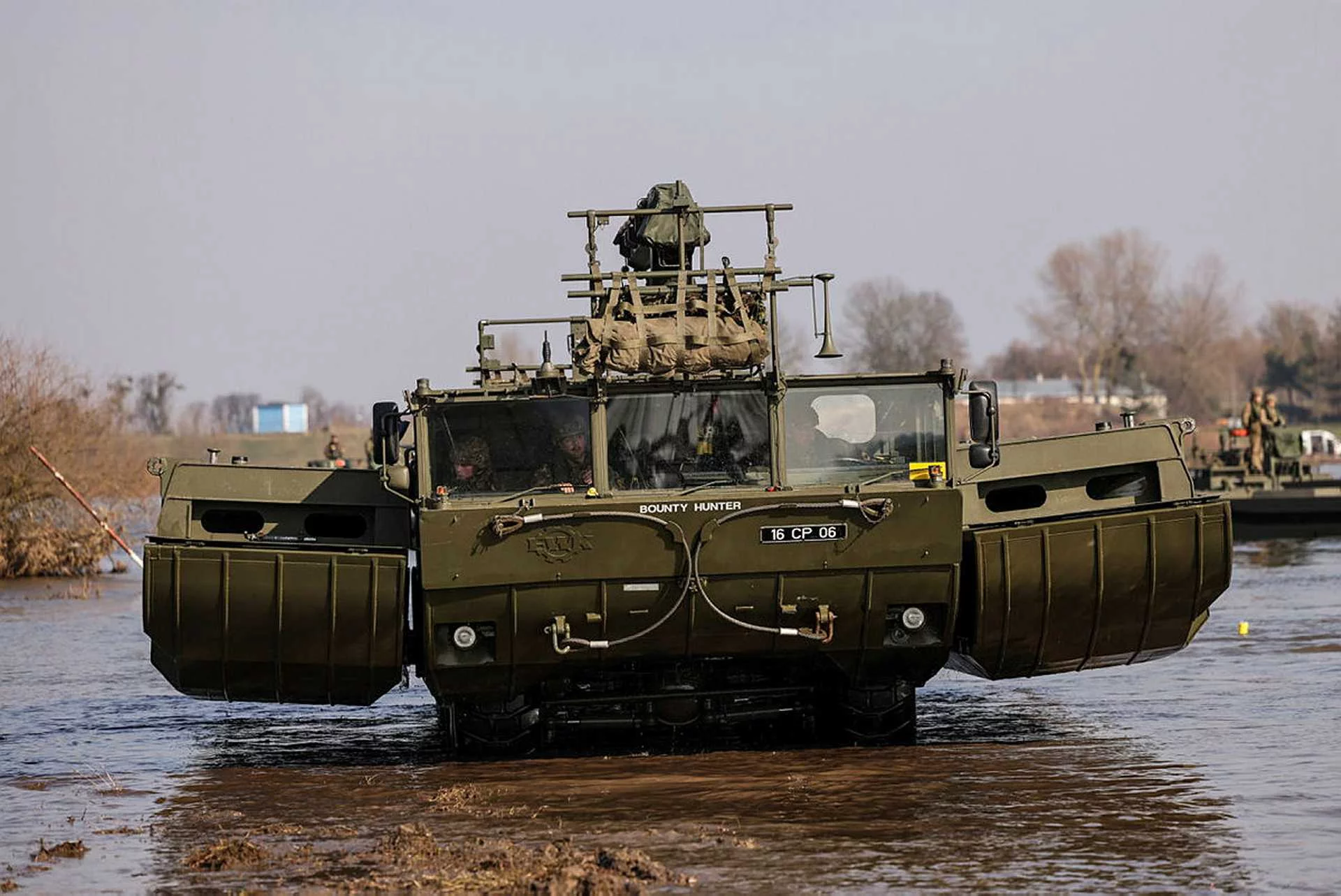
The crucial river-crossing capability for NATO’s operational agility is set for a massive defense upgrade. Germany and the United Kingdom have jointly signed a €450 million contract with General Dynamics European Land Systems (GDELS) for the procurement of next-generation M3S amphibious bridging and ferry systems. Announced on November 3, 2025, and managed via the Organization for Joint Armament Cooperation (OCCAR), this program marks the first modernization of the two key NATO members’ Wide Wet Gap Crossing (WWGC) capacity since 1999.
Strategic Importance of the Germany-UK Joint Procurement
This landmark defense agreement is more than a simple replacement of aging inventory; it aims to fundamentally enhance the capacity of forces for rapid deployment and maneuverability, particularly across the extensive river networks and challenging terrains of Eastern Europe. Modern battlefield strategy demands uninterrupted supply lines and the ability for armored units to reach the front lines quickly.
The M3S Amphibious Bridging System, central to the order confirmed by GDELS on October 30, 2025, introduces significant advancements over its predecessors in terms of digitalization, crew survivability, and cross-national interoperability.
The M3S System: Versatility and Payload Capacity
The new M3S Amphibious Bridging System represents the pinnacle of versatility in combat engineering. With its high-strength aluminum monocoque hull and advanced pump-jet propulsion, it can maneuver quickly and precisely, even in fast currents.
| M3S Operational Capabilities | Metric | Detail |
| Primary Function | Dual Role | Self-propelled ferry or bridge segment. |
| Ferry Payload | 70 Tonnes | Capable of transporting NATO Main Battle Tanks. |
| Rapid Bridge Span | 100 meters | Achievable in under 30 minutes using 8 M3S units. |
| Max Bridge Length | 150 meters | Connectable with up to 12 vehicles for heavy logistics. |
NATO Interoperability and Supply Chain Assurance
The M3S system is not just superior in its individual capabilities; it also features full compatibility with existing NATO bridging standards, including the Standard Ribbon Bridge (SRB), Improved Ribbon Bridge (IRB), and Folding Float Bridge (FFB). This feature ensures seamless joint operation among the engineering elements of various allied forces during multinational exercises and deployments.
The industrial aspect of this project is equally strategic. GDELS will produce the M3 systems at its Kaiserslautern facility in Germany. This move supports Germany’s objectives under its “Growth Strategy 24/500” to strengthen local manufacturing capabilities and secure the supply chain for high-demand NATO platforms. This agreement is a clear signal that operational mobility in Europe is no longer just a logistical requirement but a core element of deterrence and rapid decision-making capability.
