

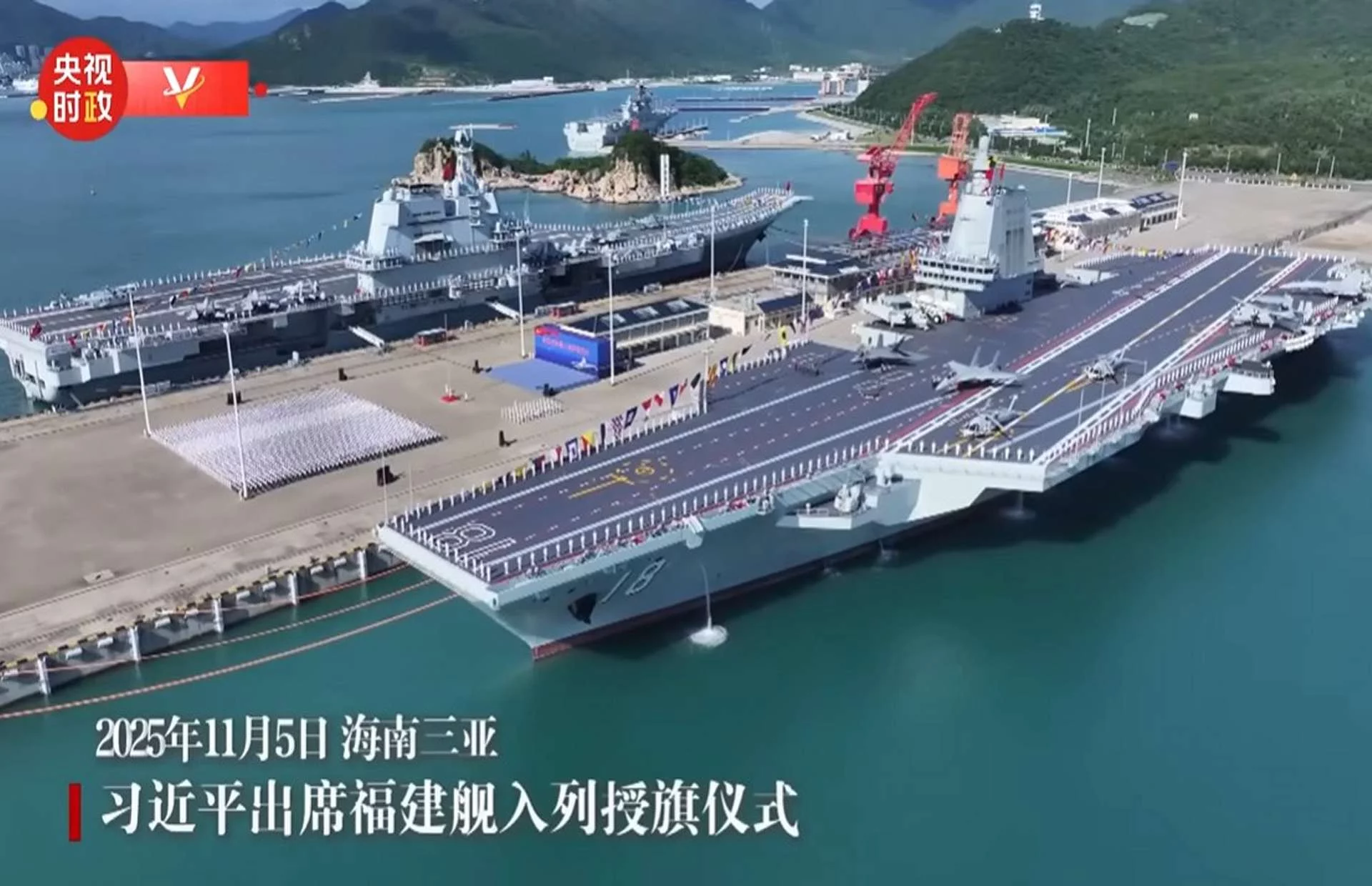
China has officially entered a new phase of naval aviation with the commissioning of its most advanced aircraft carrier, Fujian, at Shanghai’s Jiangnan shipyard. The ceremony, attended by President Xi Jinping, symbolizes Beijing’s ambition to rival U.S. naval dominance and marks the People’s Liberation Army Navy’s (PLAN) transition to true blue-water operations.
Fujian: China’s First Electromagnetic Catapult Carrier
Designated Type 003, Fujian is China’s first carrier equipped with electromagnetic catapults — a technology previously exclusive to the U.S. Navy. The system enables faster, heavier, and more efficient aircraft launches compared to the ski-jump decks of Liaoning and Shandong. During 2025 trials, the ship successfully launched stealth J-35 fighters and KJ-600 early-warning aircraft, confirming the maturity of its aviation systems.
With a displacement between 80,000 and 85,000 tons, Fujian sits between Europe’s Charles de Gaulle and America’s Ford-class supercarriers. It features three catapults, two aircraft elevators, and an angled flight deck capable of supporting over 60 aircraft.
A Major Leap in Combat Capability
The introduction of electromagnetic launch systems unlocks full-spectrum carrier operations — from fixed-wing early warning missions to high-load fighter sorties. The KJ-600 airborne early warning aircraft extends radar coverage far beyond helicopter-based systems, allowing a Fujian-led strike group to maintain a broader and more accurate operational picture.
The air wing will eventually include stealth J-35s for air superiority and strike roles, J-15T multirole fighters, KJ-600 AEW aircraft, and ASW/SAR helicopters. Together, these assets provide China with sustained air patrol, maritime strike, and sea-denial capabilities across the South China Sea and Western Pacific.
Strategic Implications for the Pacific
The commissioning of Fujian marks a milestone in China’s “Far Seas Protection” strategy, expanding the PLAN’s operational reach well beyond coastal defense. The carrier will form the core of a new strike group with Type 055 cruisers, Type 052D destroyers, and Type 901 support vessels — allowing long-duration deployments deep into the Philippine Sea.
In a Taiwan or South China Sea crisis, Fujian could provide layered air cover and precision strike options, complicating U.S. and allied operations. Dual-carrier drills conducted in 2024–2025 demonstrate that Beijing is preparing to maintain a continuous two-carrier presence while a third undergoes maintenance — ensuring uninterrupted naval air power projection.
Narrowing the Gap with the U.S. Navy
While Fujian still trails behind the nuclear-powered Ford class in sortie rates and endurance, its commissioning significantly closes the technological gap. China now stands as the only navy besides the United States to operate electromagnetic catapults at sea. Analysts note that Fujian’s success will depend on its crew training, deck-cycle efficiency, and integration with long-range strike and cyber-space assets.
Even with conventional propulsion, the combination of J-35 stealth fighters and KJ-600 early-warning platforms establishes Fujian as a credible combat system — one capable of challenging U.S. dominance in the Indo-Pacific naval balance.
