

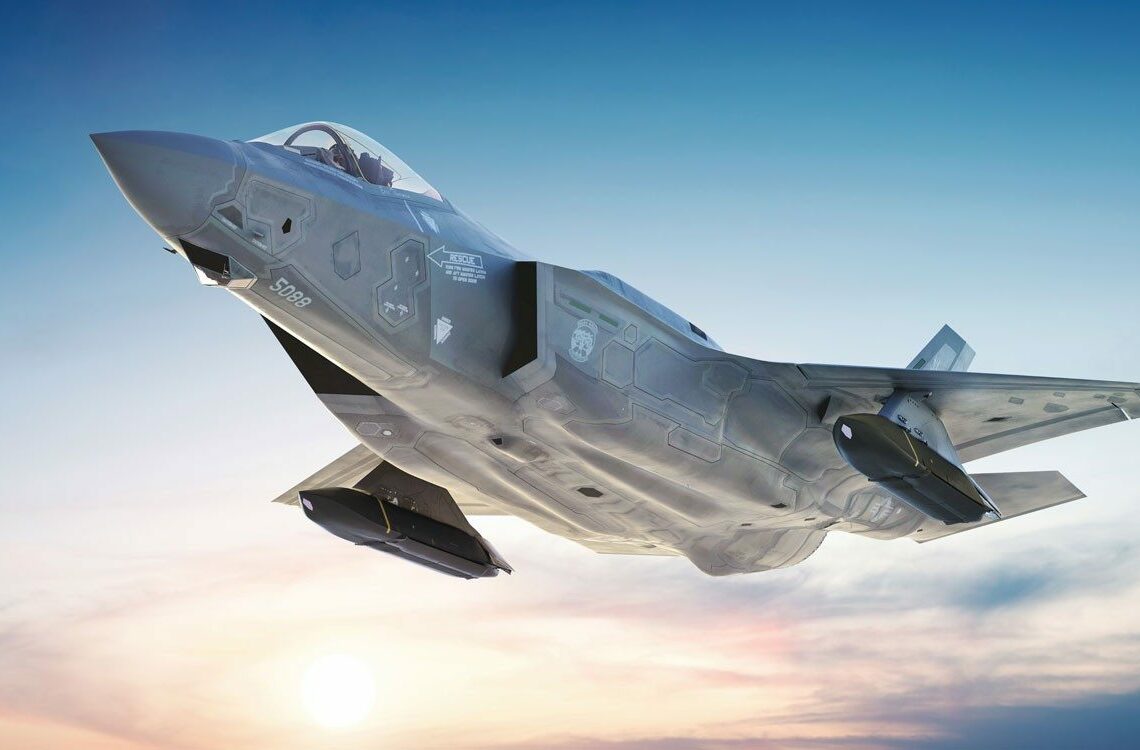
Greece has formally renewed its request for U.S. approval to acquire AIM-120D Advanced Medium-Range Air-to-Air Missiles (AMRAAMs) for its incoming F-35A fighters, aiming to counterbalance Türkiye’s planned Meteor missile integration on its Eurofighter Typhoon fleet.
According to Kathimerini on November 10, Greece’s Ministry of National Defense resubmitted its export request to Washington, emphasizing the AIM-120D’s importance for maintaining the airpower balance over the Aegean Sea. U.S. officials have yet to issue a final decision, with the proposal currently under review as part of broader regional arms transfer assessments.
Greek defense sources noted that if the request is denied, Athens may turn to the European Meteor missile instead — a move that could shift procurement priorities toward European defense suppliers and reduce dependence on U.S. systems.
For the Hellenic Air Force, the AIM-120D provides a critical beyond-visual-range engagement capability exceeding 150 kilometers. The missile features a two-way datalink, GPS-assisted inertial navigation, and improved electronic resistance for high-threat environments. Measuring 3.66 meters in length and weighing around 160 kilograms, it reaches speeds close to Mach 4 and enables “fire-and-forget” engagements against multiple targets.
Greece is also expressing interest in the AIM-260 Joint Advanced Tactical Missile (JATM), developed by Lockheed Martin as the AMRAAM’s next-generation successor. With a projected range of over 200 kilometers and speeds approaching Mach 5, the JATM would align Greek capabilities with future NATO standards once approved for export.
The country’s €3.47 billion F-35A acquisition contract, signed in July 2024, includes twenty aircraft, spare engines, simulators, training, and four years of logistical support. Deliveries are scheduled to begin in 2028, with operational deployment expected in the early 2030s at Andravida Air Base.
Currently, the Hellenic Air Force operates 24 Rafale F3R fighters armed with Meteor, MICA, SCALP, and Exocet missiles, alongside 83 upgraded F-16 Vipers, forming the backbone of its fleet. The modernization of 38 F-16 Block 50s is ongoing domestically at Hellenic Aerospace Industry facilities.
In parallel, Athens is exploring cooperation with the United States on Collaborative Combat Aircraft (CCA) programs that pair crewed fighters with autonomous drones for reconnaissance, strike, and electronic warfare roles — signaling Greece’s intent to join the shift toward manned–unmanned teaming.
Analysts view Greece’s AIM-120D request not merely as an arms deal, but as a strategic effort to sustain deterrence and air superiority across the Aegean amid evolving regional dynamics.
