

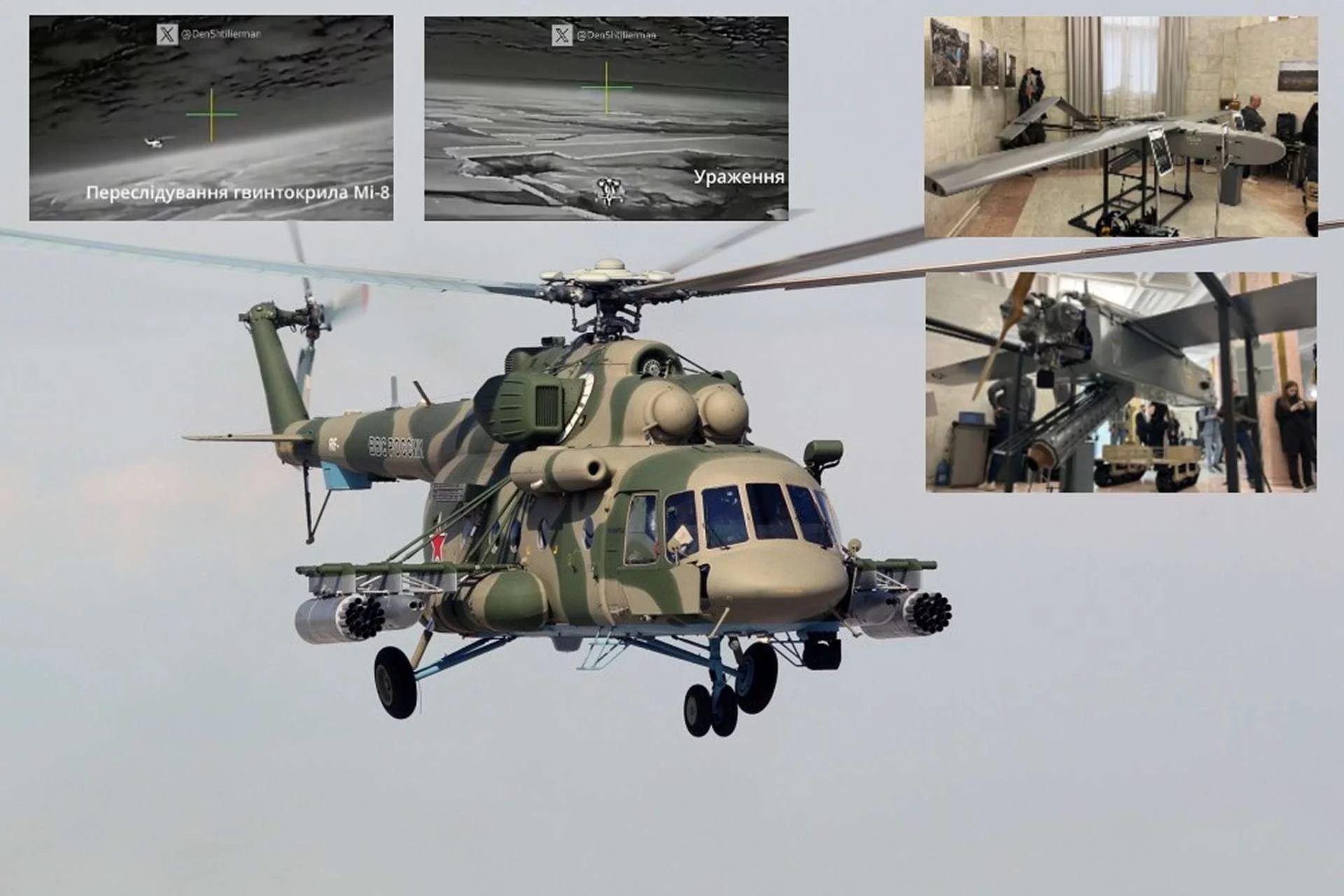
Ukraine’s Special Operations Forces claim that an FP-1 long-range deep-strike drone has brought down a Russian Mi-8 helicopter in midair over Russia’s Rostov region, roughly 180–190 kilometers from the front line. If confirmed, the engagement would represent a significant evolution in drone warfare — one in which long-range unmanned aircraft begin actively hunting airborne targets deep inside enemy territory.
According to the statement released on 22 November, the incident occurred near Kuteynykove and marks the first time a Ukrainian-made FP-1 has intercepted a helicopter in flight. Previously known for reaching targets far inside Russia — striking fuel depots, ammunition facilities, and infrastructure sites — the FP-1 was allegedly used in this case to pursue a helicopter assigned to intercept Ukrainian drones. The claim has not yet been independently verified, and Russia’s Ministry of Defence has not issued a response, but military analysts already note that such an event could alter Russia’s risk calculus in its rear-area air operations.
FP-1: Capabilities and Tactical Adaptation
Developed by Ukraine’s Fire Point company, the FP-1 is a single-use attack drone with a range approaching 1,600 kilometers, a modular 60–120 kg warhead, and guidance designed to withstand electronic warfare. Until now, FP-1 drones were primarily associated with long-range strikes on stationary targets, including coordinated raids intended to saturate air defenses. The reported interception over Rostov suggests a new application of the system: using endurance, guidance precision, and operator coordination to attack maneuvering aircraft.
Broader Trends in Ukraine’s Deep-Strike Campaign
Since Kyiv began systematic long-range drone operations in 2023–2024, its strategy has evolved toward integrated offensive campaigns. A notable example was the strike on the Kirovske airfield in occupied Crimea, where multiple helicopters — including Mi-8, Mi-26, and Mi-28 models — along with a Pantsir-S1 system were reportedly destroyed. In this context, using a deep-strike drone to shoot down a helicopter appears as a logical extension of a doctrine aimed at undermining Russian airpower both on the ground and in the air.
Compared with earlier drone models — including Iran-supplied Shahed systems used by Russia — the FP-1 offers greater modularity, improved jamming resistance, and mass-production scalability. These qualities create an opportunity for Ukraine to conduct more dynamic operations, including tracking mobile assets that previously faced threats only from missiles or fighter aircraft.
Strategic Implications
Should the downing of the Mi-8 be confirmed, Russia may be forced to reevaluate the security of its air operations across the operational depth. Helicopters that once flew with relative freedom over rear areas may now face the risk of low-observable, expendable drones capable of operating far beyond the front.
The incident underscores Ukraine’s broader shift toward unmanned-centered warfare. Through its messaging and published footage, Ukraine’s Special Operations Forces signal to Moscow that every helicopter sortie, every concentration of aircraft, and every critical rear-area facility may now fall within reach of Ukrainian drones as the war enters a more distributed, multi-dimensional phase.
