

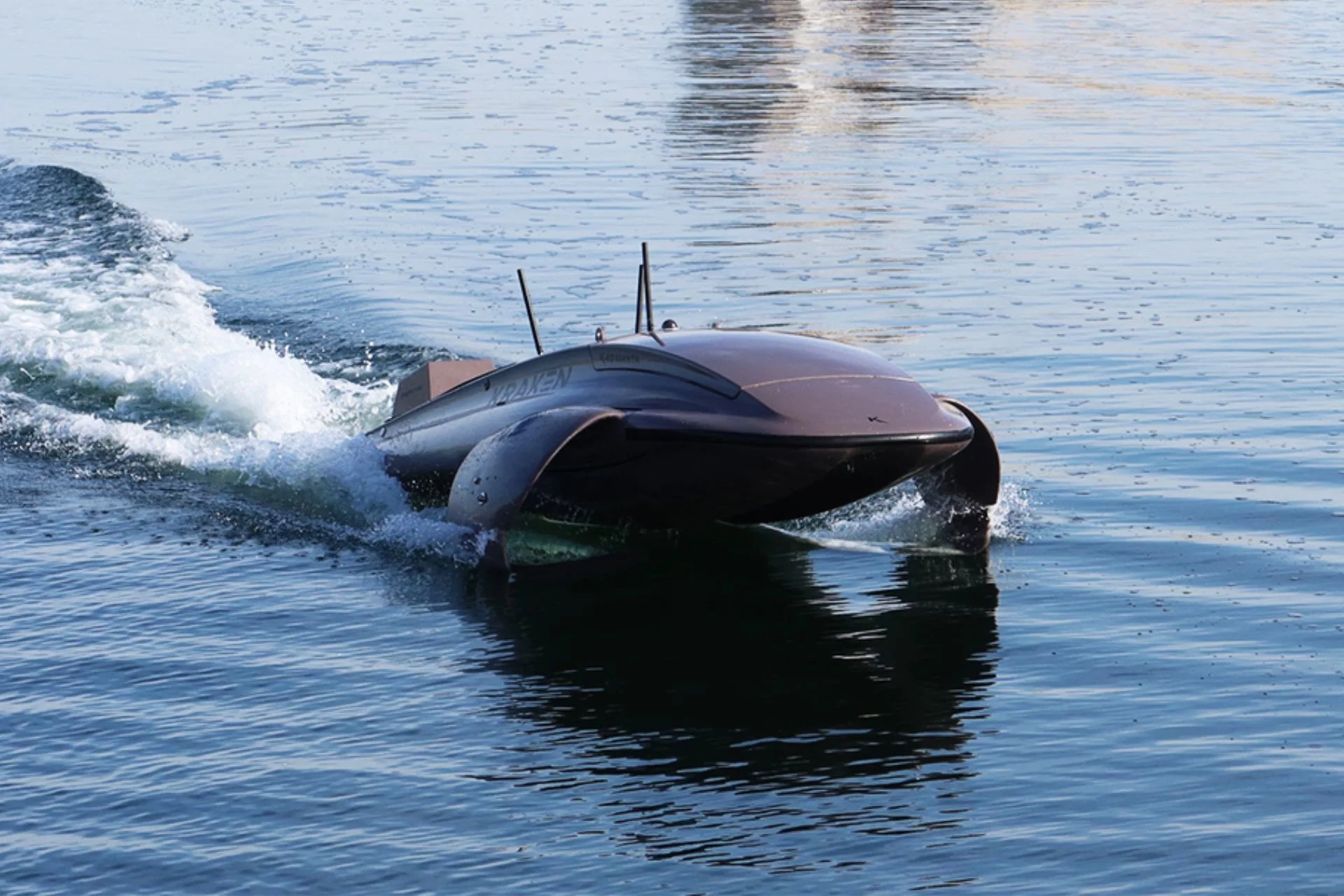
The United States Special Operations Command (USSOCOM) has chosen Kraken Technology Group of the United Kingdom to lead a major new push into autonomous maritime systems. The British company has won an Other Transaction Authority (OTA) agreement capped at $49 million to develop and prototype low-observable unmanned surface and subsurface vessels designed for high-risk special operations missions.
A New Era of Low-Observable Maritime Drones
The multi-year program will accelerate the transition of Kraken’s platforms from experimentation to operational deployment. The systems will leverage:
- Advanced composite materials
- Stealth-optimized hull forms
- Modular payload bays for rapid mission reconfiguration
These features allow a single drone family to conduct ISR, discreet logistics, and direct-action support in heavily monitored littoral environments.
Key Platforms: K3 Scout and K4 Manta
Two Kraken platforms already tested by U.S. special operations forces illustrate the capabilities USSOCOM seeks.
K3 Scout – Compact ISR Surface Drone
Designed for affordable multi-mission use, the K3 Scout offers:
- Low-signature composite hull
- Quiet propulsion for covert approaches
- Modular ISR payload options including EO/IR and ELINT sensors
- Coastal surveillance, route scouting, and infrastructure protection roles
K4 Manta – Hybrid Surface/Subsurface Stealth Vessel
The K4 Manta aligns directly with the OTA’s objectives:
- Capable of both surface transit and submerged operation
- Carbon-fiber foil architecture minimizing radar, acoustic, thermal, and optical signatures
- Payload capacity up to 5,000 kg and endurance of up to 10 days
- Deployable mast for ISR and communications
- Ideal for covert infiltration, reconnaissance, and discreet logistics
This hybrid design enables missions that would be too risky—or impossible—for crewed vessels in sensor-dense coastal zones.
Operational Advantages for Special Operations Forces
Together, Kraken’s systems deliver a broad tactical toolkit:
- Autonomous penetration of monitored waterways
- Persistent ISR coverage for several days
- Covert insertion of sensors, equipment, or mission preparation elements
- Distributed logistics with minimal personnel risk
These capabilities align with the increasing need for maneuver freedom in heavily surveilled straits, archipelagos, and coastal infrastructure zones.
European Momentum Behind Kraken’s Global Expansion
Kraken’s rapid growth is supported by major NATO programs, including Task Force X, funding from the NATO Innovation Fund, and integration into U.K. Ministry of Defence programs. The company now aims to convert this momentum into wider global adoption across allied navies.
Strategic Implications: The Future of Naval Competition
The USSOCOM contract highlights a strategic convergence between U.S. and European maritime innovation. As littoral regions become more contested, autonomous, low-observable vessels are emerging as essential tools in naval competition. The partnership signals that future sea power will depend not only on crewed warships, but also on distributed networks of stealthy maritime drones integrated into allied command architectures.
