

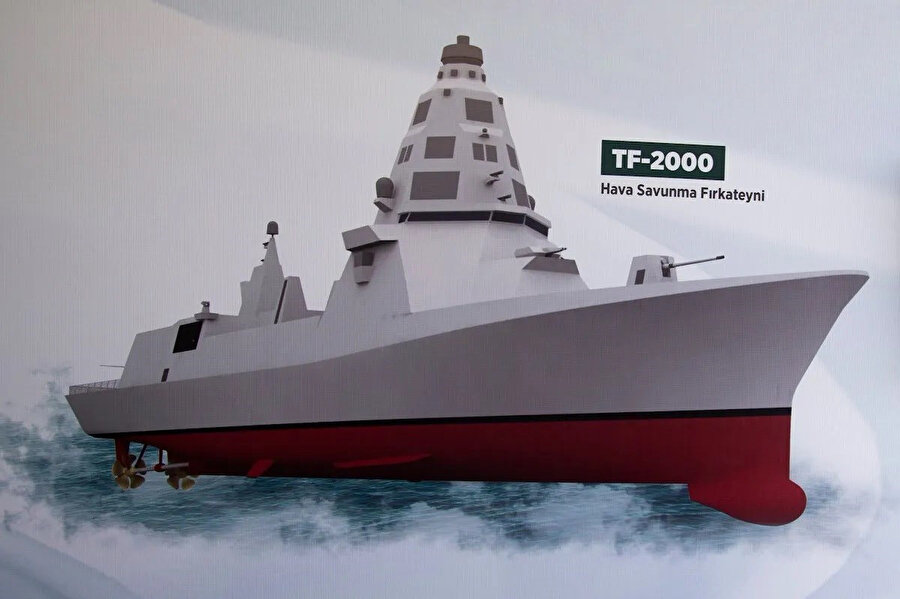
Türkiye has officially begun building its first TF-2000 air-defense destroyer at the Istanbul Naval Shipyard Command, marking a pivotal advancement in the country’s expanding “Steel Dome” architecture—a national initiative aimed at establishing a fully indigenous, layered air and missile defense network.
The Ministry of National Defence announced on 27 November 2025 that the first block of the TF-2000’s hull is now under construction, transforming a programme that has been in design maturation for years into a fully realized warship. The milestone follows a series of high-value contracts—worth approximately $6.5 billion—recently awarded to ASELSAN, Roketsan and HAVELSAN to transition the Steel Dome from development into serial production, reinforcing Türkiye’s push for greater self-reliance in advanced defense technologies.
A Next-Generation Destroyer for a New Naval Doctrine
Designed by the Naval Forces Design Project Office as the third major pillar of the MILGEM lineage, the TF-2000 will be the largest and most capable surface combatant ever produced by Türkiye. The destroyer, displacing around 8,300 tonnes and stretching 149 meters in length, will use a CODOG propulsion layout enabling speeds beyond 26 knots and provide accommodation for around 180–210 personnel.
The platform is engineered to support a fully modern air, surface, and subsurface warfare suite, featuring:
- A dual-bay hangar for 10-ton naval helicopters
- A strengthened flight deck rated for aircraft up to 15 tonnes
- Dedicated areas for unmanned surface vehicles, vertical-lift drones and mini-UAV launchers
- A national combat system integrating phased-array radars derived from ASELSAN’s ÇAFRAD family
- Indigenous sonars, electro-optical sensors, and advanced electronic warfare units
Its primary firepower will come from the domestically developed MİDLAS vertical launch system—expected to host SİPER, HİSAR-D, SAPAN and future long-range interceptors—alongside ATMACA anti-ship missiles and GEZGİN cruise missiles. Additional armaments include a new-generation 127 mm main gun, the GÖKDENİZ close-in defense system, 25 mm remote-controlled turrets and lightweight torpedo tubes.
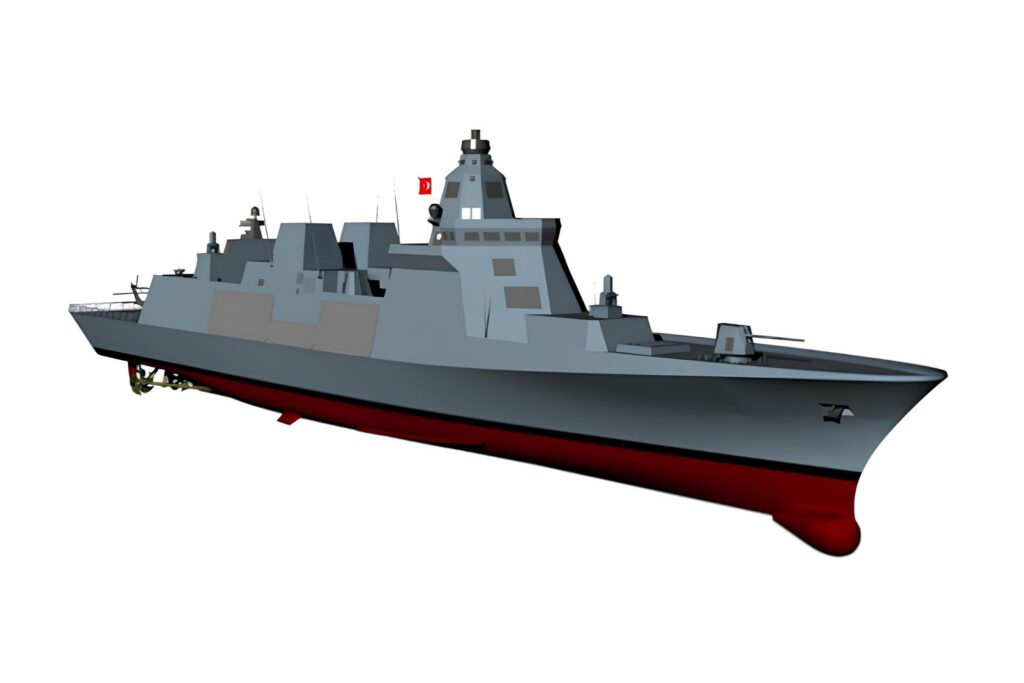
From Concept to Construction: A Long Road to the Shipyard
Approved in 2007, the TF-2000 programme has undergone extensive refinement, particularly following the detailed design phase launched in 2019. Updates implemented over the past year include:
- A fully integrated mast
- Revised vertical-launch deck architecture
- Infrared-suppressed exhaust systems
- A low-observable hull optimized for reduced radar and thermal signatures
The current build process is divided into two phases. Phase 1 covers detailed design and critical subsystem production, while Phase 2 involves full prototype integration. Türkiye aims to launch the first ship in 2028, with operational service expected by the decade’s end.
Backbone of a Layered Naval Shield
With a capacity of up to 96 vertical launch cells, the TF-2000 is designed to fill major gaps in Türkiye’s fleet-level air and missile defense. The destroyer will extend high-altitude protection for future carrier groups—including TCG Anadolu and the planned MUGEM aircraft carrier—and will operate within the ADVENT combat management system, fusing data from land radars, airborne early-warning assets and allied naval platforms.
The destroyer will also connect seamlessly to Türkiye’s national C4ISR backbone, integrating:
- HAKIM command-and-control
- RAD radar management
- TURAN/T-LINK data networks
Combined with AI-assisted decision tools, the architecture enables rapid threat detection and optimized missile allocation across the Steel Dome’s land and naval layers.
A Cornerstone of the Steel Dome’s Sea Extension
The TF-2000’s construction represents more than the arrival of a new class of destroyer—it embodies Türkiye’s shift toward a fully national maritime defense ecosystem. The Steel Dome system now entering serial production includes:
- ALP-series ground radars
- HİSAR and SİPER air defense missiles
- GÜRZ multi-role units
- Korkut air-defense guns
- EW/ECM suites and advanced counter-drone technologies
All components are designed for NATO interoperability while maintaining predominantly domestic origin, strengthening both Türkiye’s alliance commitments and its strategic autonomy.
A New Strategic Era for the Turkish Navy
The move from design to steel represents nearly two decades of institutional investment and doctrinal evolution. As Türkiye prepares for future expeditionary operations and carrier-led task groups, the TF-2000 will define the Navy’s capability profile well into the 2050s. The destroyer stands as a core enabler of a resilient maritime shield stretching across the Eastern Mediterranean, Aegean, and Black Sea—forming the seaborne extension of Türkiye’s expanding national air and missile defense network.
