

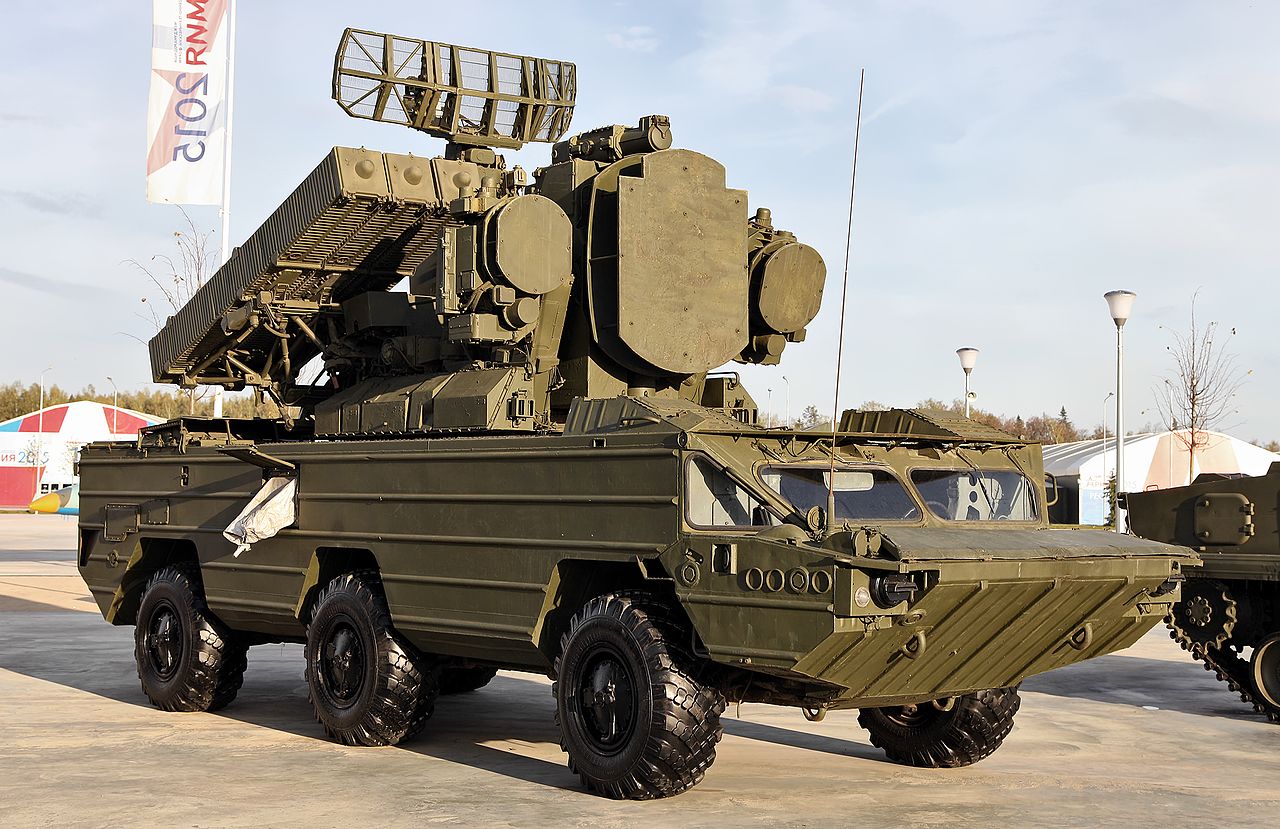
Newly released footage from Ukraine’s 413th “Raid” Regiment shows an FPV drone destroying a Russian Osa-AKM short-range air defense system on the frontline, further illustrating how inexpensive unmanned platforms continue to penetrate Soviet-designed systems that once formed Russia’s primary low-altitude protection.
Published on 27 November 2025 via the unit’s official channels and Ukrainian defense outlet Militarnyi, the video captures the FPV drone calmly maneuvering toward the radar assembly of the Osa-AKM before striking it directly. Analysts note that the event is part of a growing pattern in which legacy air defense systems are repeatedly neutralized by low-cost drones, revealing a widening disconnect between Russia’s advertised layered air defense doctrine and its operational realities in the field.
The targeted system, the 9K33 Osa-AKM, was originally intended to defend maneuver units against aircraft, helicopters, and cruise-missile-type threats. Equipped with both surveillance and engagement radar on a single amphibious chassis and armed with six ready-to-fire missiles, the platform should theoretically provide substantial protection within a 1.5–10 km envelope. However, FPV drones—with their extremely small radar signatures, terrain-hugging profiles, and low speeds—represent a type of threat the Osa-AKM was never designed to counter.
Throughout the ongoing war, Ukrainian forces have documented multiple instances of Osa systems being destroyed by FPV strikes or targeted through reconnaissance UAVs, with the 413th Regiment previously credited for similar eliminations. The latest incident reinforces a key trend: Soviet-era systems optimized for high-speed aircraft are increasingly ineffective against swarms of cheap, manually piloted FPV drones.
From a tactical perspective, FPV operators exploit dead ground, foliage and urban cover to approach from blind spots or from areas where the Osa’s radar is either switched off or unable to detect small targets. Even when active, the system struggles to track low-RCS drones inside the engagement conditions for which it was engineered. Upon visual acquisition, the operator can precisely target sensitive elements—radars, antennas, tracking sensors or missile canisters—achieving a high probability of disabling the system with a very low-cost munition. The cost-exchange ratio heavily favors Ukraine, while each destroyed or damaged launcher creates temporary holes in Russia’s local air defense grid.
The vulnerability of older Soviet systems to modern drones highlights a larger structural issue: Russia’s claimed multilayered air defense network often fails against massed FPV and reconnaissance drones due to limited radar sensitivity, slow engagement cycles, and inadequate short-range counter-UAS capabilities. This mismatch between doctrine and battlefield performance has resulted in repeated Ukrainian drone successes across multiple sectors.
Although destroying a single Osa-AKM may appear insignificant in isolation, it symbolizes a broader strategic shift. Low-cost FPV drones operated by specialized Ukrainian units are consistently breaching Russia’s frontline defenses, opening corridors for follow-on strikes by heavier UAVs, guided artillery, and missile systems. Without effective counter-FPV and counter-UAS integration, legacy air defenses face diminishing survivability on the increasingly drone-dominated modern battlefield.
