

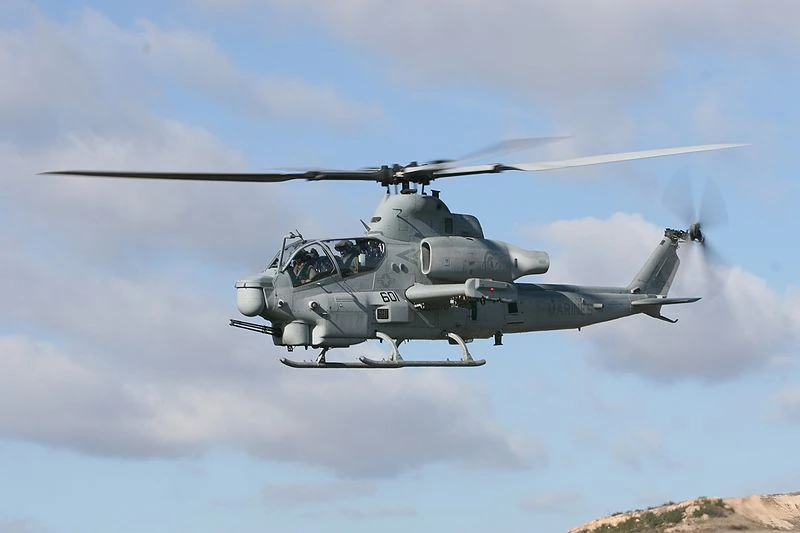
A U.S. Marine Corps AH-1Z Viper attack helicopter successfully launched an AIM-9 Sidewinder missile during a controlled live-fire drill over the Caribbean Sea on November 25, according to a December 3 update by U.S. Southern Command. The launch formed part of Operation Southern Spear, an ongoing regional mission aimed at disrupting drug trafficking networks across the Caribbean corridor.
The AH-1Z, assigned to the 22nd Marine Expeditionary Unit (MEU), fired the missile at a simulated airborne threat during maritime operations in late November. Officials described the test as a planned demonstration to validate the unit’s ability to counter increasingly agile and armed criminal groups operating in littoral and low-altitude environments.
The event underscores a shift in how the Marine Corps employs its rotary-wing aircraft. Traditionally used for close air support and anti-armor roles, the AH-1Z’s integration of the AIM-9 Sidewinder expands its mission profile into air-to-air engagements. This capability allows the Viper to counter hostile drones, low-flying aircraft, or unconventional aerial platforms often used by illicit trafficking networks.
Nicknamed the “Zulu Cobra,” the AH-1Z Viper is the Marine Corps’ most advanced attack helicopter, built for expeditionary and maritime operations. Its modernized avionics, composite rotor system, and versatile weapons configurations—including a 20 mm cannon, Hydra rockets, Hellfire missiles, and now the Sidewinder—give it significant flexibility across multi-domain threat environments.
For the 22nd MEU, currently operating with a full aviation combat element, the Viper provides overwatch and rapid strike capability during maritime interdiction missions. Its presence in Operation Southern Spear highlights an expanding integration between Marine Corps aviation and joint task force operations—an effort aimed at improving real-time surveillance and response to criminal activity in the region.
Defense officials note that the deployment of high-end aviation assets such as the AH-1Z reflects growing concerns about the sophistication of transnational criminal organizations in the Caribbean. By adding a credible air-to-air engagement capability, the United States is signaling readiness to confront both traditional and emerging aerial threats tied to illicit trafficking routes.
