

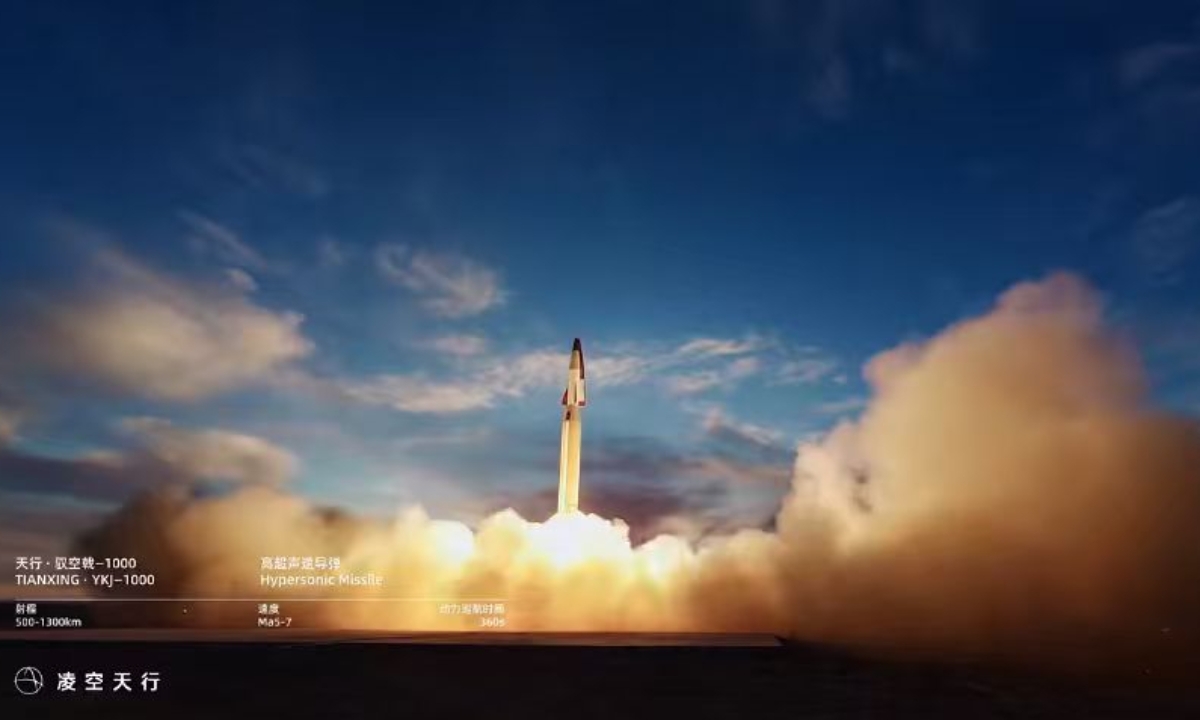
A development that could reshape global hypersonic weapons competition has emerged from Chinese aerospace firm Lingkong Tianxing. The company announced that its new hypersonic missile, the YKJ-1000, can be produced for just $99,000 per unit—a figure dramatically lower than Western systems priced in the millions.
Dubbed the “cement missile” by Chinese social media users, the YKJ-1000 reaches speeds of Mach 7 and offers a 1,300-kilometer engagement range. What makes the missile remarkable is not only its performance, but also the unconventional materials used in its construction. Instead of advanced aerospace alloys, the missile reportedly incorporates foam-cement-based thermal cladding and cast structural components. Off-the-shelf camera modules, BeiDou navigation chips, and mass-produced separation mechanisms further reduce costs.
Lingkong Tianxing states that the missile has completed operational testing and entered serial production. A visit to the Chengdu production facility by Chinese Vice Premier Zhang Guoqing earlier this year is seen as an indicator of official support for the program.
While many Western analysts remain skeptical that a fully functional hypersonic missile can truly be produced for under $100,000, others note that China has recently introduced similarly unconventional but effective low-cost defense technologies, suggesting the claim may not be entirely implausible.
If the cost figure is accurate, the strategic implications are profound. By comparison, a U.S. SM-6 interceptor costs around $4.1 million, THAAD missiles run between $12–15 million, and Patriot PAC-3 units range from $3.7 to $4.2 million. The stark price gap fuels an ongoing debate: Can high-priced defensive systems remain viable against increasingly cheap precision-strike weapons?
Analysts warn that affordable hypersonic or quasi-ballistic missiles could enable even lower-budget countries to threaten advanced naval assets such as carrier strike groups. Some experts even argue that nations like Venezuela could theoretically challenge U.S. ships if they acquired the YKJ-1000 in significant numbers.
Moreover, when paired with China’s more advanced systems—such as the DF-17—the YKJ-1000 could serve as a complementary tool, saturating defenses and increasing the likelihood of penetrating even sophisticated air-defense networks.
