

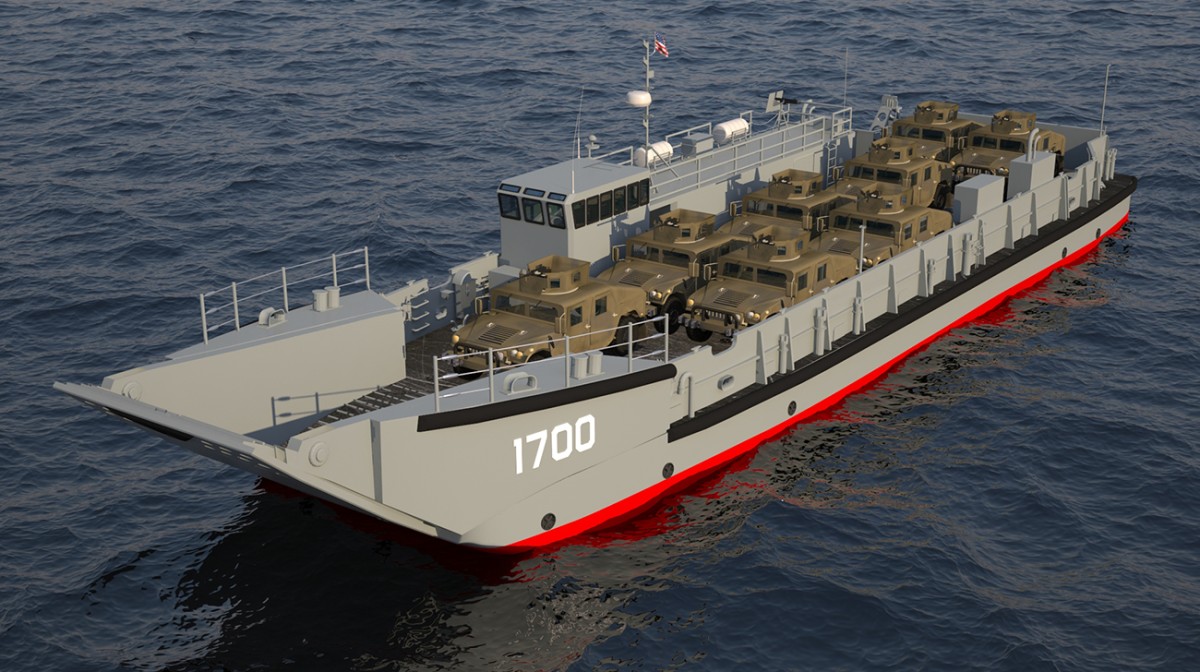
August 29, 2025 – Austal USA announced that it launched the first U.S. Navy LCU-1710 landing craft on August 22 at its shipyard in Mobile, Alabama. The vessel is the lead platform of the new LCU-1700 class, built under a contract signed in September 2023.
The initial contract, worth $91.5 million, covers the construction of three vessels. With options, the program could expand to 12 ships, with a total potential value of around $380 million. In August 2024, two additional ships were ordered, bringing the total to five, while Austal USA continues construction on three vessels.
Next-Generation Design
The LCU-1700 program was developed to replace the long-serving LCU-1650 fleet. These 139-foot steel-hulled craft are equipped with roll-on/roll-off bow and stern ramps, enabling rapid loading and unloading of vehicles and cargo. Multiple LCUs can also be connected to form temporary piers, enhancing operational flexibility under challenging conditions.
LCU 1710 can carry up to 170 short tons, equivalent to two M1A1 Abrams tanks, 350 troops, or similar logistical loads. With a top speed of 11 knots and a range of 1,200 nautical miles, it is designed to support extended coastal operations.
Strategic Importance
LCUs play a critical role in maintaining the continuity of amphibious landing and resupply missions, particularly in the Indo-Pacific region where port infrastructure may be at risk. The U.S. Navy and Marine Corps rely on these vessels to sustain basing, resupply, and forward deployment capabilities.
Austal USA President Michelle Kruger highlighted that the launch of LCU 1710 reflects the company’s progress in steel ship construction. In addition to LCUs, Austal USA also builds Navajo-class towing, salvage, and rescue ships for the Navy and Heritage-class offshore patrol cutters for the Coast Guard.
Roadmap
Construction of LCU 1710 began in 2024 when the vessel was laid down. Austal plans to deliver the first three ships (1710–1712) by July 2026. If options are exercised, deliveries could extend through 2029. Initial operational capability for the class is expected in late 2025 or early 2026.
Beyond combat operations, the program also supports humanitarian aid and disaster relief missions, strengthening both the U.S. military’s deterrence and its global humanitarian response capabilities.
