

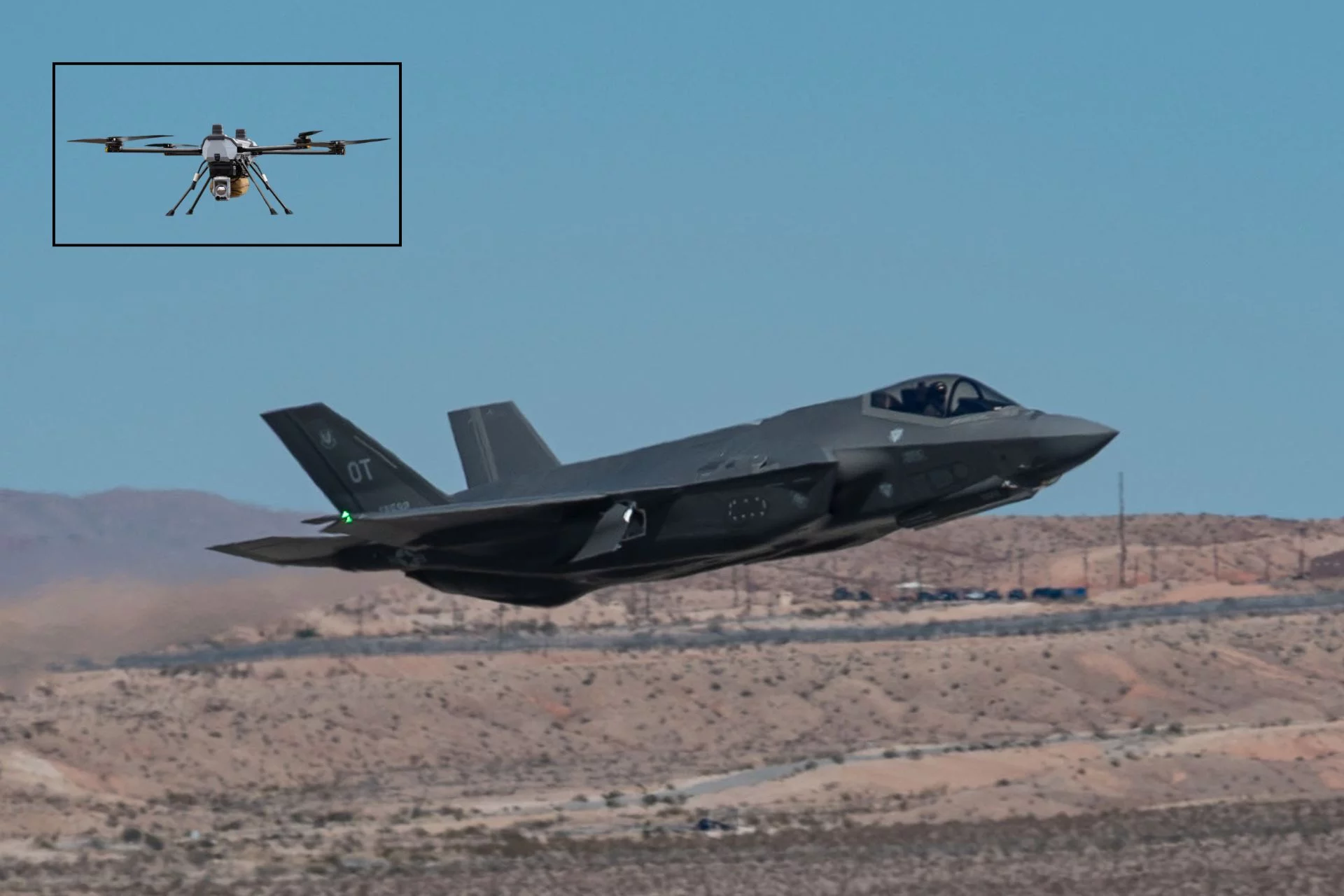
On July 23, 2025, Performance Drone Works (PDW), a U.S. company specializing in AI and unmanned aerial systems, confirmed a successful demonstration with the U.S. Air Force using its C100 drone to support an F-35A Lightning II strike. During the test, the quadcopter illuminated ground targets with a Leonardo STAG5 laser designator, allowing the stealth fighter to release and guide four inert GBU-12 Paveway II bombs with precision.
The drone designated targets at distances of 1,000, 1,500, and 2,000 meters while capturing the impact of each bomb. Though the F-35A is not shown in all footage, the demonstration confirmed that all munitions hit their intended targets. PDW highlighted that this method enables Joint Terminal Attack Controllers (JTAC) to identify targets from a safe distance, reducing the need for low-altitude flights by manned aircraft.
Significance of the Test
Using tactical drones for target designation represents a shift in air operations. By allowing autonomous systems to guide strikes, forces can leverage stealth aircraft effectively while minimizing risk to personnel. The C100’s low cost combined with the F-35’s advanced capabilities demonstrates the future of air combat, where layered technologies operate in concert to enhance both firepower and operational flexibility.
Unlike previous operations—such as the June 2024 U.S.-Philippine exercise using F-35Bs and drones to strike floating targets—the C100 loitered for 35 minutes up to three kilometers from its operator, autonomously designating targets. The GBU-12 bombs used are 500-pound Mk 82 munitions fitted with Paveway II laser guidance, with a range exceeding 14 kilometers.
C100 Capabilities and Adoption
Classified as a Group 2 drone, the C100 has already been adopted by the U.S. Army. On August 3, 2025, the 173rd Airborne Brigade announced acquisition of four units alongside custom FPV drones. Soldiers have developed and repaired components with 3D printing and designed payloads for tactical resupply missions. The drone also demonstrated modular capabilities during the Agile Spirit 25 exercise in Georgia, supporting medical supply and ammunition delivery. Its endurance is 74 minutes, with a 10-kilometer operational range, enabling reconnaissance and resupply beyond line of sight.
Designed for portability and deployment from light tactical vehicles, the C100 features a foldable quad-rotor design and can carry EO sensors, small explosive payloads, or act as a mothership for smaller drones. PDW calls it an “organic fires platform”, enabling laser designation for artillery, aviation, or naval systems. The July 2025 test validated its role in remote target designation, reducing JTAC exposure and supporting F-35 stealth strikes.
Challenges and Considerations
While drones extend operational reach, reliance on data links and onboard sensors makes them vulnerable to electronic warfare and cyberattacks. Effective use in contested environments requires networked systems with redundancy to maintain targeting reliability. The collaboration between the C100 and F-35A represents an important step toward a more interconnected battlefield, where autonomous and manned platforms work together.
The C100-F-35A demonstration highlights how compact, modular drones can enhance strike flexibility, improve precision, and reduce operator risk. It exemplifies the evolution of joint warfare, where unmanned systems increasingly take on roles once limited to manned aircraft, creating a more dynamic and layered combat environment.
