

According to a Reuters report on August 20, 2025, China is accelerating the modernization and expansion of its nuclear arsenal, closely linked to President Xi Jinping’s directive that the People’s Liberation Army be ready for a Taiwan contingency by 2027. U.S. Strategic Command and global arms control experts warn that Beijing’s nuclear ambitions now extend beyond deterrence, evolving into a force designed to challenge U.S. dominance across the full nuclear triad: land-based missiles, submarine-launched ballistic missiles, and long-range bombers.
While Beijing reaffirmed its “no first use” pledge in a 2023 defense white paper, the Pentagon cautions that China’s doctrine is becoming more ambiguous. U.S. assessments suggest Beijing might consider a first strike if the Communist Party’s survival or the credibility of its deterrent appeared at risk. This doctrinal shift raises concerns that escalation thresholds in a Taiwan conflict could prove dangerously unpredictable.
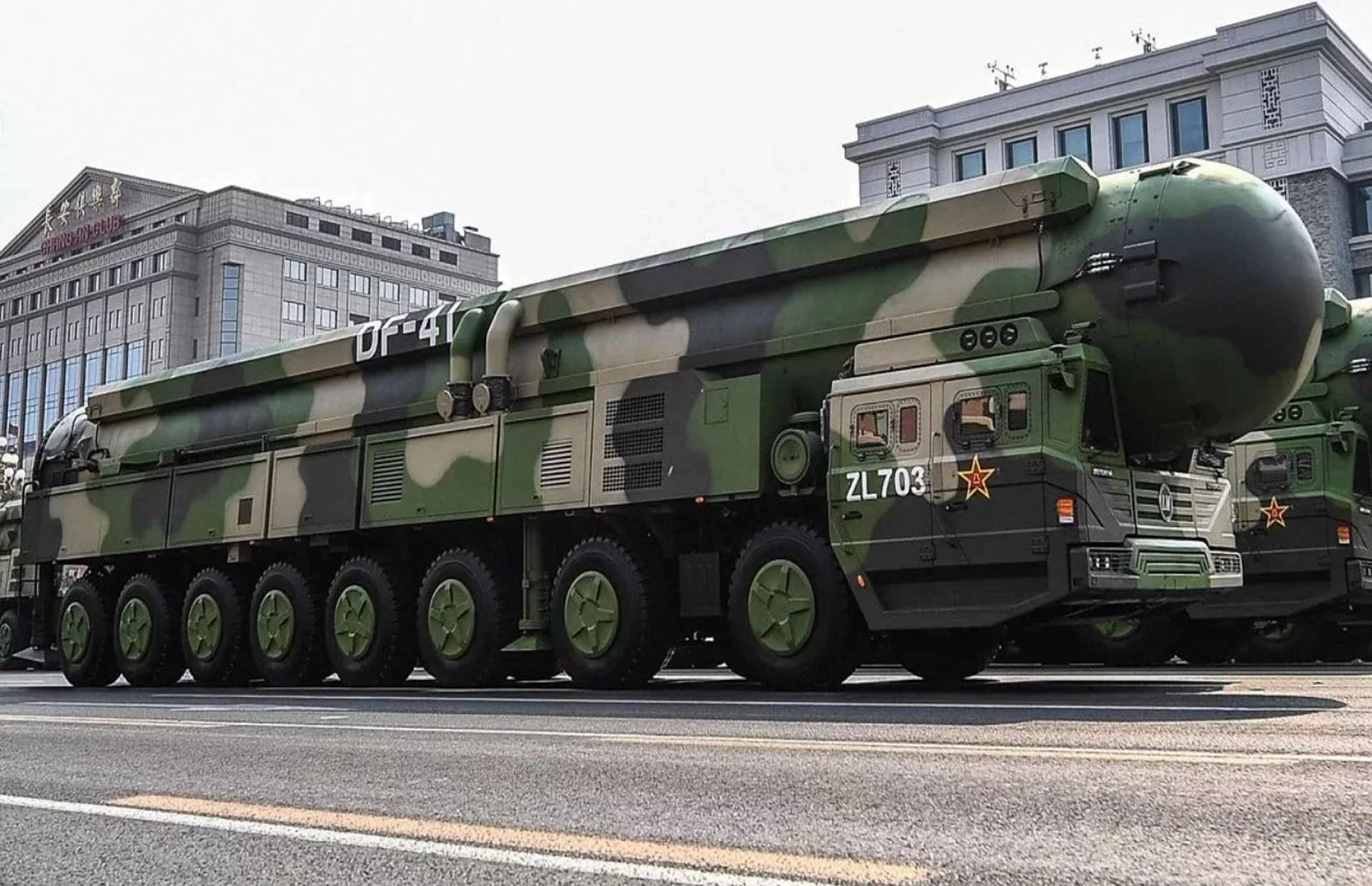
On land, China’s nuclear missile forces are undergoing their largest expansion in history. The DF-41 ICBM, with a 12,000 km range and up to ten MIRVs, provides a survivable, road-mobile strike capability. The DF-31AG and the heavy, silo-based DF-5C further enhance intercontinental reach. At the theater level, the dual-capable DF-26 “Guam Killer” offers both nuclear and conventional strike options at ranges up to 4,000 km.
At sea, China’s Type 094A Jin-class submarines carry JL-2 SLBMs capable of striking U.S. bases in Guam and Hawaii. Development of the JL-3 and deployment on next-generation Type 096 submarines will extend reach to the continental U.S., significantly boosting second-strike survivability.
In the air domain, China has introduced the H-6N bomber, capable of aerial refueling and carrying nuclear-capable cruise missiles. The upcoming H-20 stealth bomber is expected to deliver both nuclear and conventional payloads with a radius over 8,000 km, putting much of the Pacific within range. Meanwhile, systems like the DF-17 hypersonic glide vehicle add tactical nuclear options and complicate U.S. missile defense planning.
Officially, Beijing insists its buildup remains defensive, portraying its arsenal as a “minimum deterrent.” Yet the pace, scale, and diversity of its modernization efforts point to ambitions beyond minimum sufficiency, aiming instead at strategic parity with Washington. This shift is reshaping Indo-Pacific security dynamics and sparking debates in Japan, South Korea, and Australia about nuclear-sharing and indigenous deterrent options. For the U.S., the challenge has shifted from tracking China’s growth to preparing for an era where Beijing fields a peer-level nuclear arsenal.
