

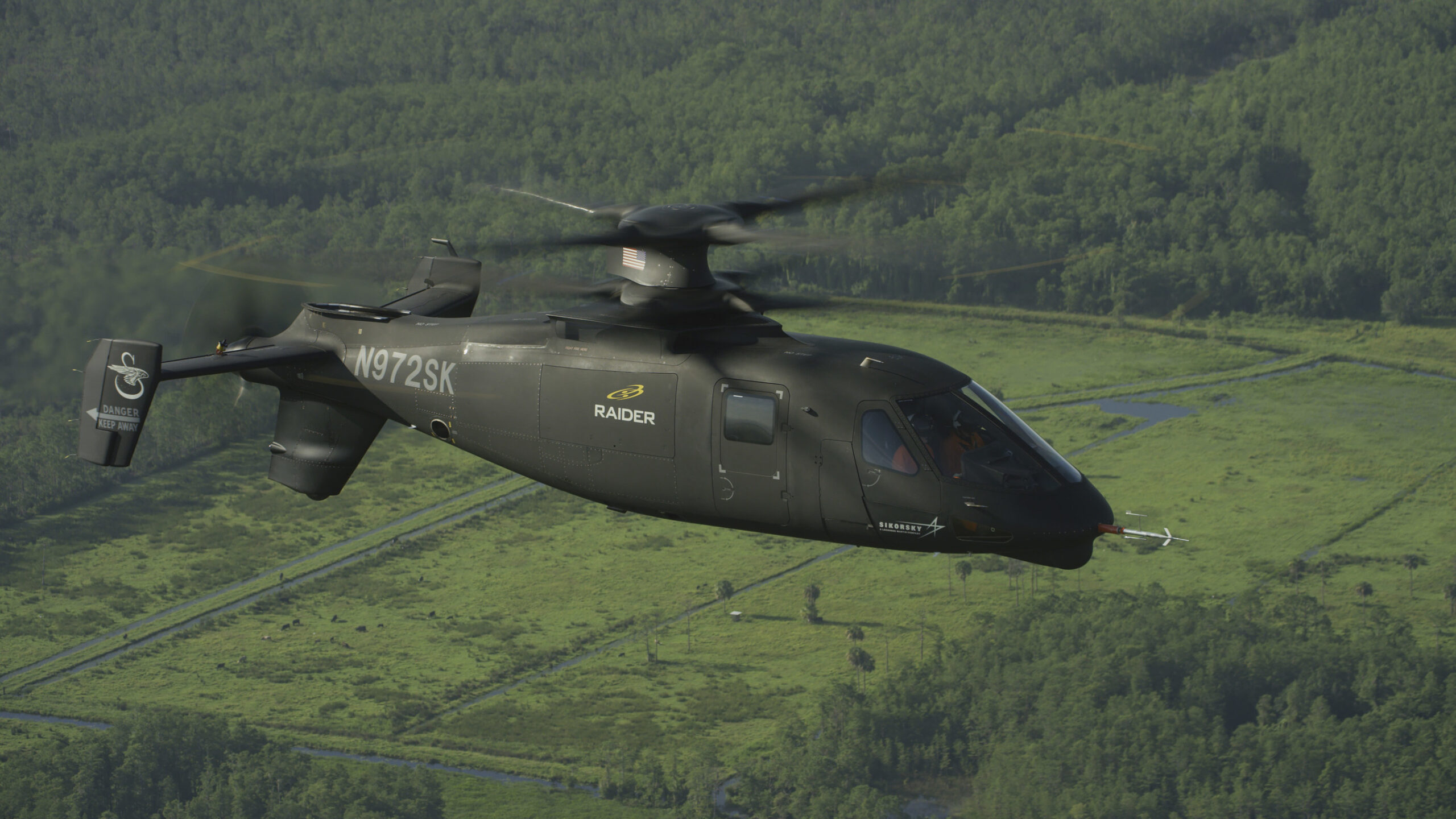
Fresh footage shared on Chinese social media platform Weibo on August 21, 2025, revealed a prototype helicopter that bears a striking resemblance to the U.S. Sikorsky S-97 Raider. Featuring a coaxial rotor system paired with a tail-mounted pusher propeller, the rotorcraft reflects Beijing’s growing ambitions in high-speed helicopter development—an arena long dominated by American innovation.
Dubbed informally as China’s “Future High-Speed Helicopter,” the prototype employs a counter-rotating coaxial rotor for lift efficiency and a pusher propeller to boost forward thrust. Its streamlined fuselage, tandem seating, and narrow frame suggest intended roles in reconnaissance and light strike operations. However, compared with Sikorsky’s Raider, the Chinese design still shows signs of immaturity: fixed landing gear, a heavier tail assembly, and simpler structural features. Additionally, its engine exhausts are positioned on either side of the fuselage—contrasting with the Raider’s optimized rear-facing configuration—raising questions about aerodynamic performance and infrared signature management.
The U.S. S-97 Raider has already proven advanced performance under the Future Vertical Lift program, reaching speeds near 400 km/h. By contrast, the Chinese prototype has only entered preliminary testing, highlighting a developmental gap. Still, adopting the coaxial rotor and pusher system could eventually give China a rotorcraft more agile and survivable than conventional models like the Z-20, provided Beijing overcomes long-standing hurdles in engines, avionics, and flight controls.
Strategically, the prototype illustrates China’s determination to advance indigenous aviation technologies and reduce reliance on foreign models. If matured, such a platform could transform regional dynamics, giving the People’s Liberation Army enhanced mobility for reconnaissance, rapid troop deployments, or special operations. For Washington and its allies, the move reinforces concerns over China’s replication of U.S. defense technologies and the potential impact on Indo-Pacific security.
Though far from operational maturity, the helicopter’s emergence sends a clear signal: China aims to challenge American dominance in next-generation rotorcraft, a development with the potential to alter the balance of military power in the region.
