

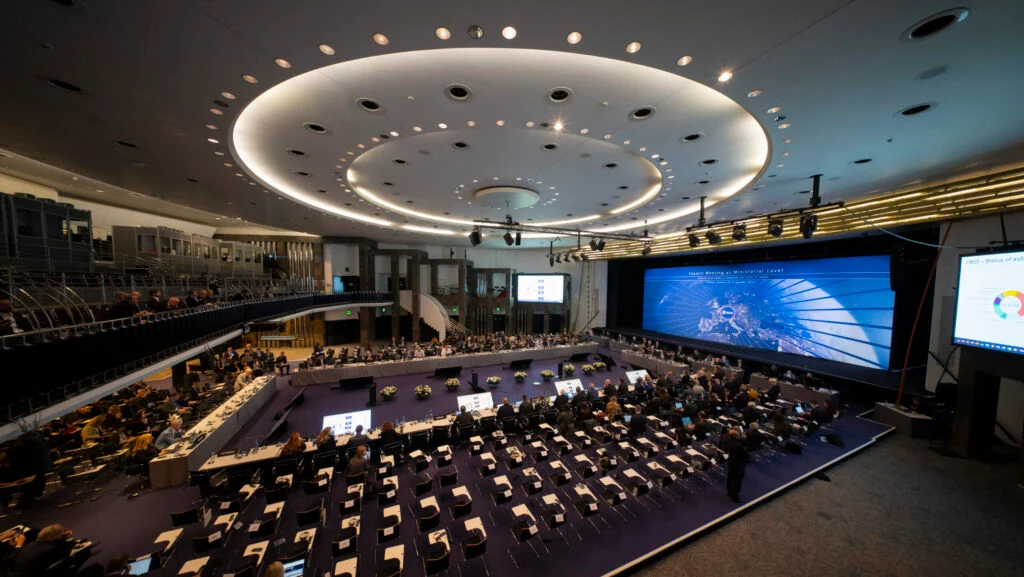
The European Space Agency (ESA) has approved a three-year, €1.35 billion ($1.6 billion) funding package dedicated to a new initiative supporting non-aggressive space security efforts across its 23 member states. The decision is part of a broader €22 billion ($27 billion) budget endorsed by the ESA Council of Ministers — a 32% increase over the previous three-year period.
“This clear mandate to use space applications for non-aggressive defense purposes marks a historic shift for ESA,” the agency said in a statement following the Nov. 27 vote in Bremen. “Technological independence and guaranteed access to space are central to Europe’s ambitions.”
For half a century, ESA positioned itself strictly as a civilian counterpart to NASA, distancing its activities from military space programs. But growing concerns about Russian hostile actions in orbit and Europe’s dependence on increasingly uncertain U.S. military space capabilities have pushed member governments to rethink that stance.
At the center of the new budget is the European Resilience from Space (ERS) program. In its initial phase, ERS will focus on dual-use technologies that support the European Commission’s proposed Earth Observation Governmental Service as well as new low-Earth-orbit satellite navigation services. The program may later expand into broader space security missions, depending on member-state decisions expected over the next year.
ESA operates separately from the 27-member European Union, with partially overlapping memberships. Its programs rely on both mandatory GDP-based state contributions and voluntary national funding.
The ERS allocation represents only a fraction of ESA’s €22 billion budget for 2025–2027, slightly below the figure proposed by ESA Director Josef Aschbacher but still a major expansion compared to 2022 levels when adjusting for inflation. “This is amazing,” Aschbacher told reporters on Nov. 28.
Space transportation remains the largest component of ESA’s spending. The new budget assigns €4.4 billion ($5.1 billion) for the Ariane 6 and Vega-C launch vehicle programs, as well as the European Launcher Challenge, an initiative aimed at developing a competitive marketplace of European commercial launch providers.
European leaders have long expressed frustration with SpaceX’s dominance in the global launch sector and have pushed for greater investment in domestic alternatives, including reusable rocket systems. Ariane 6 is produced by the Franco-German ArianeGroup, while Vega-C is manufactured by Italy’s Avio.
Earlier this year, ESA selected five companies — Isar Aerospace and Rocket Factory Augsburg of Germany, Spain’s PLD Space, MaiaSpace of France’s ArianeGroup, and the UK’s Orbex — to take part in the Launcher Challenge. Flight demonstrations are expected in 2027.
