

Executing accurate shots from moving aircraft is highly challenging due to vibration, turbulence, and instability. However, some missions demand this skill—such as in 2018’s Operation Thalathine, when a marine commando sniper aboard a Panther helicopter disabled a vehicle used by Somali hostage-takers, aiding in the recovery of ransom money and several arrests.
To enhance such capabilities, the French defense firm COSE developed the STRIKE system (Stabilisateur de Tir Réglable d’Intervention Kinésique et Équilibré), a stabilized shooting arm that reduces weapon weight load and absorbs in-flight vibration. It can also be fitted with a telephoto camera for aerial reconnaissance.
Previously deployed on Gazelle, Cougar, and Fennec helicopters, STRIKE underwent evaluation in February by the Army’s Aeromobility Group (GAMSTAT) with 1er RPIMa sharpshooters. Tests aboard an AS532 Cougar confirmed system effectiveness, followed by trials on the NH90. Configurations tested included the FN Herstal M3M (12.7 mm), HK 417 rifle, PGM Hecate II sniper rifle, and a long-range camera.
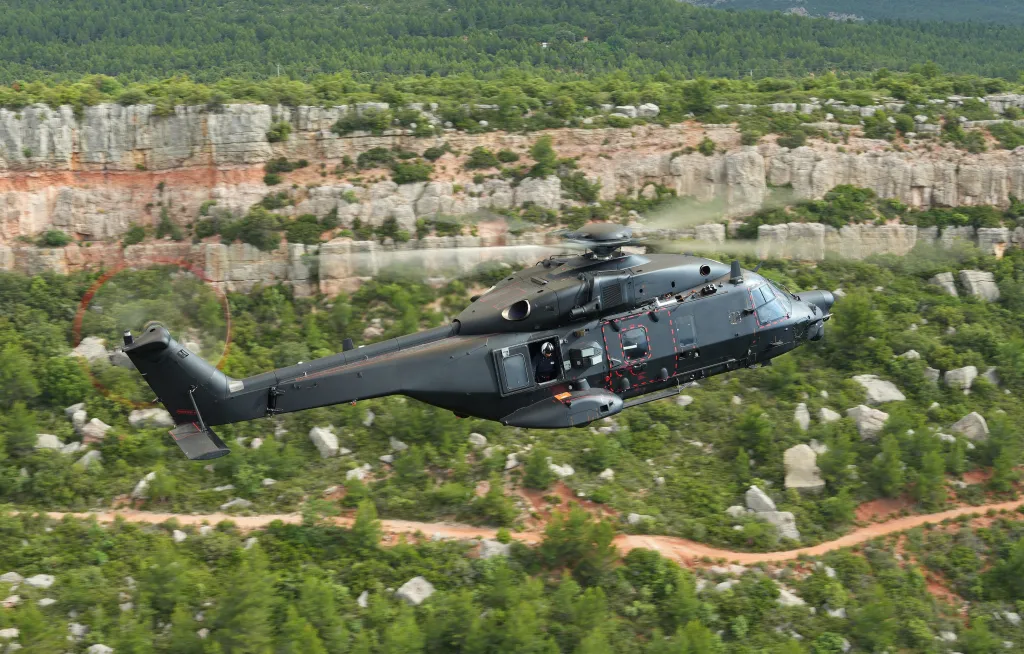
These tests align with the modernization of France’s helicopter fleet, including the upcoming NH90 Caïman Standard 2, unveiled in April 2025 at SOFINS. Tailored for special ops, it features twin 2,400 hp engines, a top speed of 300 km/h, and a 1,600 km range. It supports 4,200 kg external loads and can carry 20 troops or 10 stretchers internally. Key features include a Safran EOS410 IR camera with laser designator, AI-assisted mission systems, drone interfaces, and enhanced weapon mountings such as the Mag 58.
Eighteen Standard 2 NH90s have been ordered for the 4th Special Forces Helicopter Regiment, with deliveries expected between 2026 and 2029.
The STRIKE system will now undergo final operational testing on NH90s to validate its field deployment. Together with the NH90’s upgrades, STRIKE will boost helicopter-based special operations, enhancing long-range engagement, situational awareness, and operational flexibility.
