

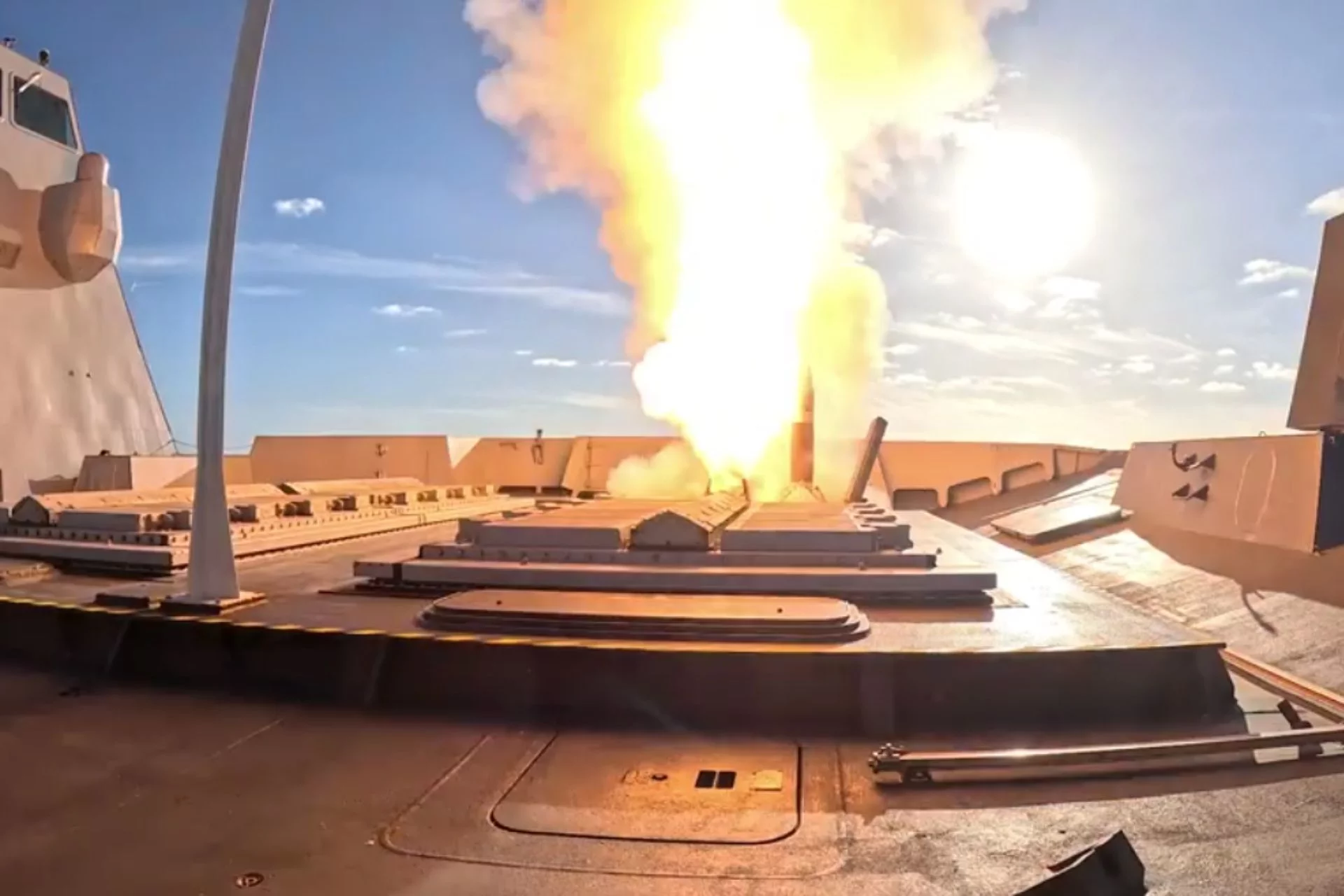
The French Navy’s air-defense FREMM Alsace (D656) successfully launched an Aster 30 missile on October 7, 2025, intercepting a supersonic sea-skimming target during a high-intensity live-fire exercise conducted under the supervision of the French Defense Procurement Agency (DGA) off the country’s Atlantic coast. The event highlights Alsace’s role as the fleet’s air-defense shield and showcases Europe’s progress in integrated, layered air and missile defense — closely watched by NATO and U.S. partners.
During the drill, a Rafale Marine fighter released a low-flying target simulating a modern anti-ship missile. Alsace’s Héraklès multifunction radar detected, tracked, and cued the engagement through the SYLVER A50 vertical launch system, firing an Aster 30 interceptor that destroyed the target within seconds. The exercise follows the frigate’s previous operational combat use of the Aster family during Red Sea missions in 2024, validating its effectiveness against complex, low-altitude, high-speed threats.
Commissioned in 2021, the 6,000-ton Alsace measures 142 meters in length and can reach speeds of up to 27 knots thanks to its CODLOG propulsion system. It features an advanced sensor suite — including the Héraklès AESA radar, Thales STIR EO Mk 2, CAPTAS-4 towed sonar, and UMS 4110 CL hull sonar — allowing it to maintain robust anti-submarine capabilities while serving primarily as an air-defense frigate.
The ship’s armament includes a 76 mm Super Rapid gun, three 20 mm Narwhal mounts, 32 SYLVER A50 cells for Aster 15/30, eight Exocet MM40 Block 3 anti-ship missiles, and MU90 torpedoes.
The Aster 30 interceptor, measuring 4.9 meters and weighing about 450 kg, uses an advanced PIF-PAF control system that combines aerodynamic and lateral thrusters to achieve high-energy maneuvers at speeds approaching Mach 4. Its active radar seeker and proximity-fused fragmentation warhead enable it to defeat even low-altitude, sea-skimming targets.
For France and its allies, the successful intercept demonstrates the FREMM DA’s capability to protect carrier groups and convoys against evolving aerial and missile threats. Within NATO’s broader framework, it contributes to the alliance’s integrated air and missile defense architecture, ensuring seamless coverage from coastal waters to open seas.
