

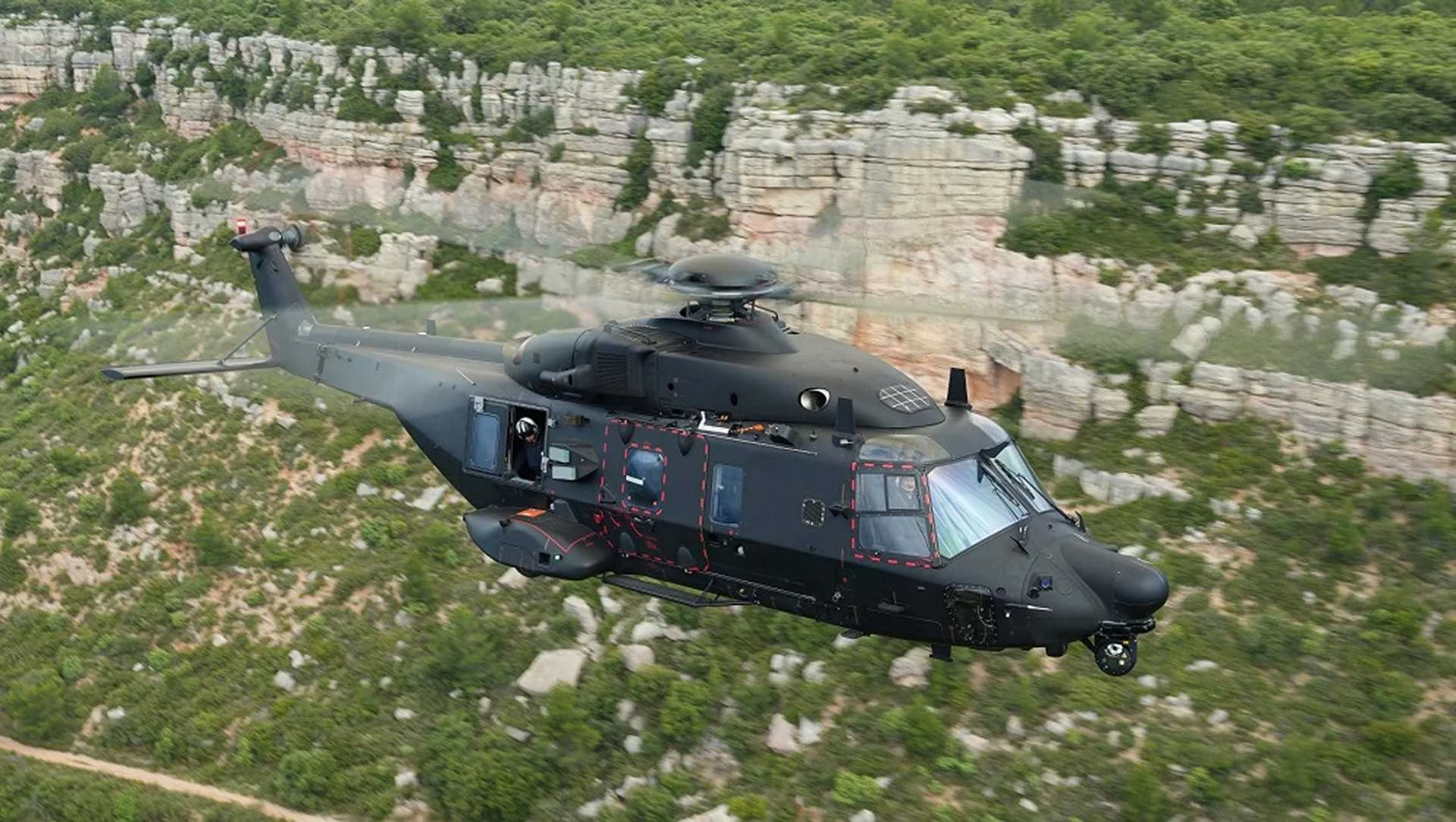
The French Army Aviation (ALAT) is set to receive its first NH90 TTH TFRA Standard 2 “Caïman” helicopters beginning in June 2026, following the delivery of the 63rd and final Standard 1 aircraft earlier in 2025. The upgraded model is designed specifically for French Special Forces, introducing advanced sensors, new cabin layouts, and improved mission capabilities under the Commandement des Opérations Spéciales (COS).
According to reports following an October 21, 2025 visit to Airbus Helicopters’ Marignane facility, the program — managed by NHIndustries under NATO’s NAHEMA — includes 18 helicopters configured for special operations. The TFRA Standard 2 adds enhancements such as upgraded electro-optical systems, expanded fuel capacity, fast-rope insertion beams, and provisions for next-generation situational awareness suites.
A New Phase In France’s NH90 Program
The introduction of the TFRA Standard 2 marks the second stage of France’s NH90 program, transitioning from a general-purpose fleet to a dual-standard structure: Standard 1 for tactical transport and Standard 2 for special operations. The project originated on October 12, 2020, when NHIndustries signed a development and production contract with France’s DGA procurement agency. Initially covering the last ten NH90s in France’s order, the deal expanded in December 2023 to include eight additional airframes, bringing the total to eighteen.
The first five helicopters from the initial batch are expected in 2025, the remaining five in 2026, and the final eight later in the decade. The 4e Régiment d’Hélicoptères des Forces Spéciales (4e RHFS) in Pau will be the primary operator, focusing on infiltration, extraction, and fire support missions for the special forces command.
Upgraded Design And Capabilities
The NH90 Caïman Standard 2 introduces several key upgrades over the original Standard 1 model:
- EuroFLIR 410 electro-optical system by Safran Electronics & Defense, providing advanced day/night imaging for pilots and crew.
- A new 3D digital mapping system for terrain awareness during low-altitude flight.
- Quick-removable rear doors, a roof-mounted fast-rope beam, foldable boarding steps, and ceiling-mounted rope anchor points for rapid troop insertion and extraction.
- M3M 12.7 mm machine guns on side doors for lateral defense.
- External 500 kg fuel tanks increasing range and endurance.
The model also integrates provisions for a Distributed Aperture System (DAS) — a network of fixed infrared sensors linked to a helmet-mounted sight and digital display (HMSD-DD) under development by Thales. This system will enhance flight safety and targeting in low-visibility environments such as dust or fog.
Technical Specifications
The NH90 TTH is a twin-engine, medium tactical transport helicopter developed by NHIndustries, a consortium of Airbus Helicopters, Leonardo, and GKN Fokker Aerostructures. Built primarily from composite materials, it features full fly-by-wire controls.
- Length: 19.56 m
- Rotor diameter: 16.30 m
- Height: 5.44 m
- Maximum take-off weight: 10,600–11,400 kg
- Troop capacity: Up to 20 soldiers or 12 stretchers
- External load: Up to 4,000 kg
Powered by either Rolls-Royce Turbomeca RTM322 or GE T700-T6E engines, the NH90 reaches speeds up to 300 km/h, with a cruise speed of 260 km/h and a range of 800 km (1,260 km with external tanks). The Standard 2 retains these figures but optimizes avionics and cabin configuration for covert or contested missions.
Strategic Significance
The NH90 Caïman Standard 2 provides France’s special forces with a dedicated platform for demanding operations requiring stealth, precision, and rapid deployment. With its modular upgrades, it remains logistically compatible with the existing NH90 fleet, ensuring unified maintenance under the NH90 Operational Support (NOS) contract.
By the end of the decade, France’s NH90 inventory will reach 81 aircraft, including 18 Standard 2 variants. The new configuration strengthens France’s special operations aviation capabilities and ensures continued modernization of the ALAT fleet through digital, sensor-driven, and network-ready systems.
