

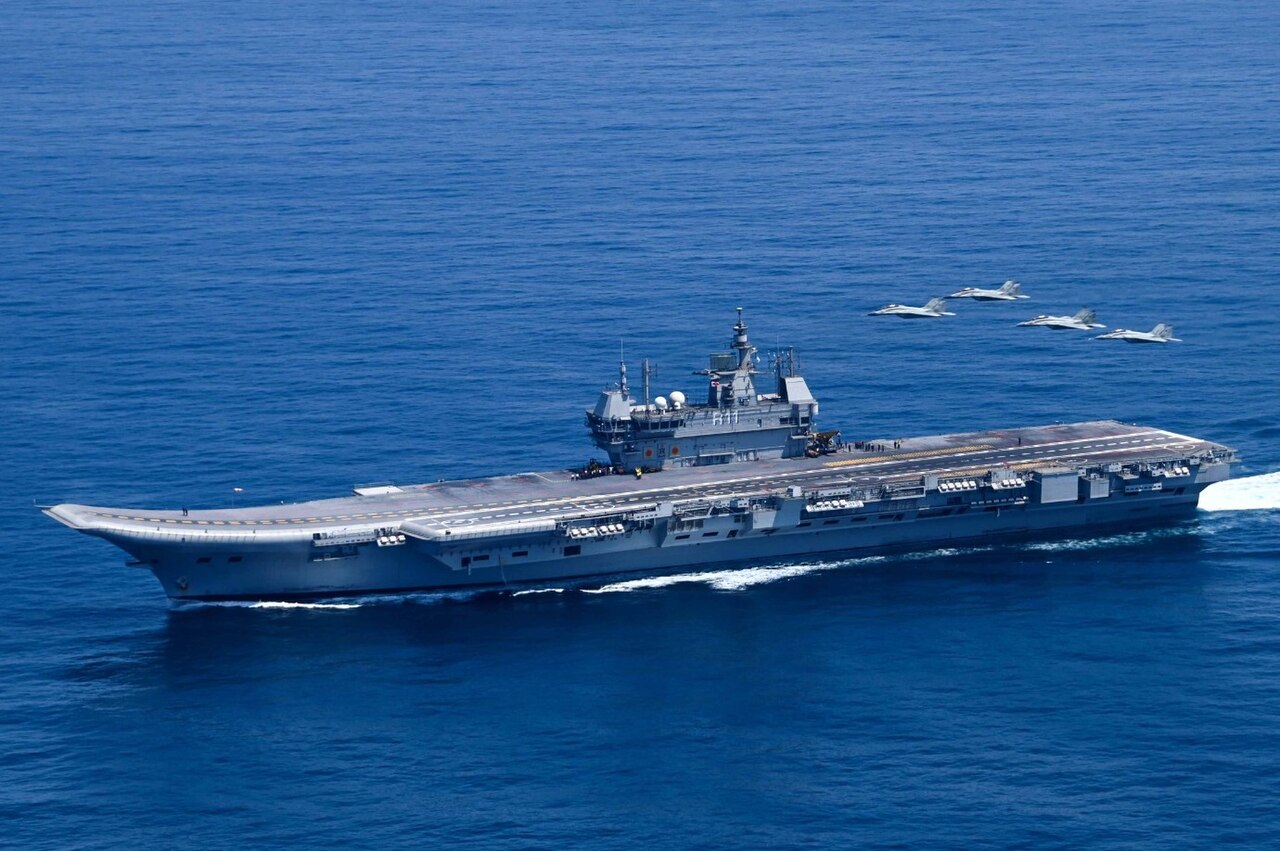
The INS Vikrant is a landmark achievement for the Indian Navy and a powerful symbol of India’s growing defense and shipbuilding capabilities. As the country’s first indigenous aircraft carrier (IAC-1), Vikrant represents decades of planning, technological innovation, and industrial collaboration. Its construction began in 2009 at Cochin Shipyard Limited (CSL), marking the start of a new era for India’s naval modernization. Originally expected to begin sea trials in 2014, delays pushed the program back, but by 2022 the carrier was officially commissioned, solidifying India’s position among the select nations capable of designing and building carriers domestically.
Design and Dimensions
INS Vikrant is the lead ship of the Vikrant-class aircraft carriers and is designed for maximum versatility in the Indian Ocean Region (IOR). The vessel measures 262 meters in length, with a beam of 62 meters and a displacement of approximately 40,000 tonnes. The flight deck can operate up to 40 aircraft, while the ship’s crew complement stands at around 1,645 personnel. With a draught of 8.4 meters, Vikrant is built to handle sustained blue-water operations, enabling India to project power far beyond its shores.
Propulsion and Endurance
The carrier is powered by a conventional propulsion system with two shafts driving the vessel at a top speed of 28 knots. It has an operational range of 8,600 nautical miles, giving it significant endurance for long deployments and regional security missions.
Weapon Systems and Defense
INS Vikrant comes equipped with a robust mix of defensive weapon systems designed to counter aerial, surface, and missile threats. Its primary armament includes:
- 4 × Otobreda 76mm dual-purpose naval guns
- AK-630 Close-In Weapon Systems (CIWS) for last-line defense
- Barak-1 and Barak-8 surface-to-air missile systems, housed in two 32-cell vertical launch systems (VLS)
This layered defense system ensures that the carrier can operate safely within contested environments, supported by escort ships as part of a carrier battle group (CBG).
Sensors and Radars
The carrier features some of the most advanced naval radar systems in service today. The Selex RAN-40L long-range AESA radar provides early warning and airspace surveillance, while the Elta EL/M-2248 MF-STAR multifunction AESA radar delivers advanced tracking, fire control, and guidance capabilities. Together, these systems give the INS Vikrant superior situational awareness.
Air Wing
INS Vikrant is designed to carry up to 40 aircraft, including MiG-29K fighter jets, Kamov Ka-31 airborne early warning helicopters, and the indigenously developed HAL Dhruv and MH-60R Seahawks. This air group provides strike capability, anti-submarine warfare, and fleet defense, allowing the Indian Navy to operate effectively across multiple mission profiles.
Strategic Importance
The commissioning of INS Vikrant marks India’s transition into the elite group of nations capable of designing, constructing, and operating aircraft carriers. As the largest warship ever built in India, Vikrant enhances the Navy’s ability to safeguard sea lanes, respond to regional crises, and project maritime power. It significantly strengthens India’s role in the Indo-Pacific, aligning with its vision of self-reliance under the “Atmanirbhar Bharat” initiative.
The INS Vikrant aircraft carrier is more than a warship—it is a strategic asset that represents India’s technological maturity and defense independence. With advanced weapon systems, cutting-edge radars, and a formidable air wing, Vikrant stands as the centerpiece of India’s naval power and a cornerstone of its maritime security strategy.
