

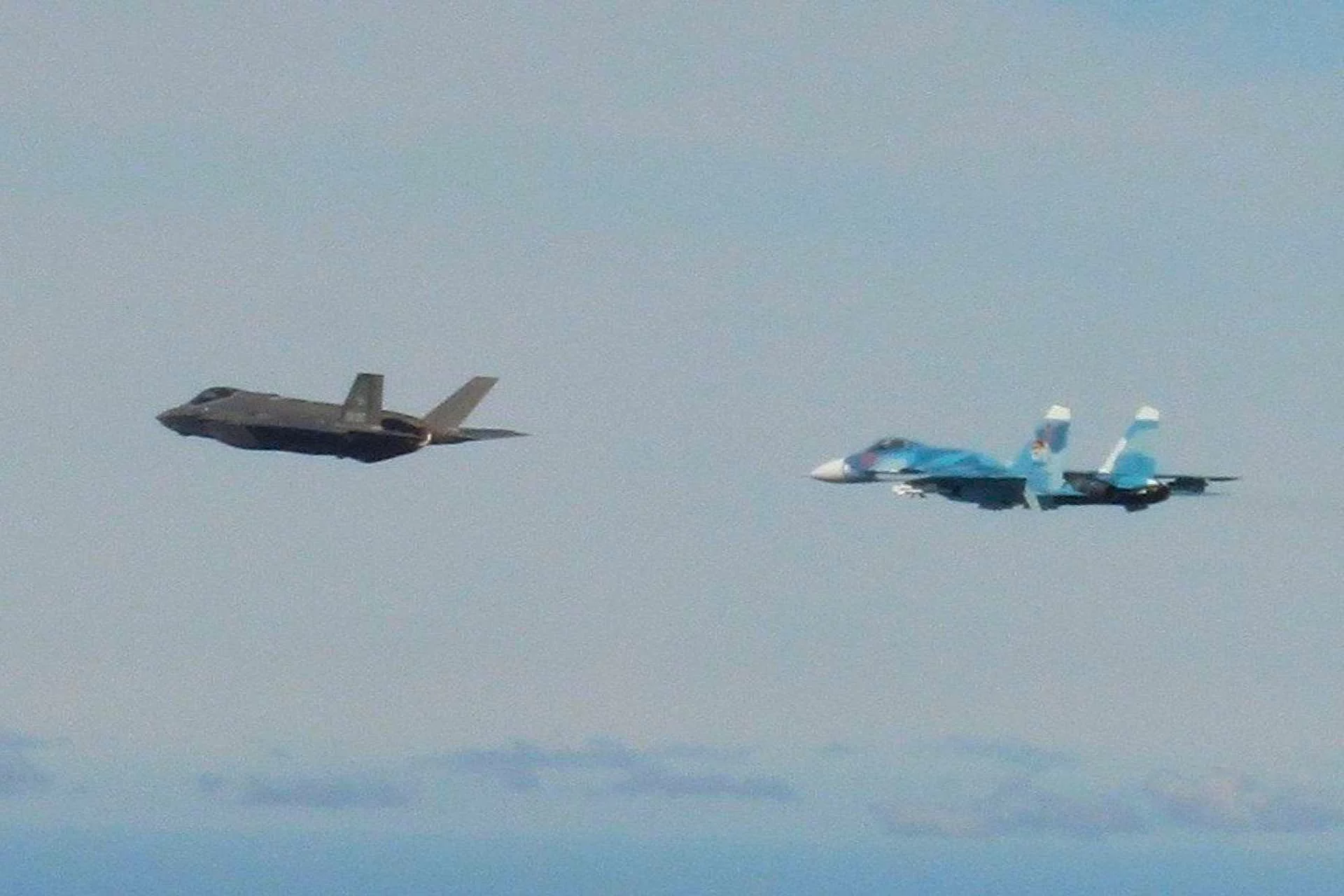
On August 13, 2025, two Italian Air Force F-35 Lightning II fighters took off from Ämari Air Base in Estonia under NATO’s Air Policing mission to intercept Russian aircraft operating close to Alliance airspace. According to NATO Air Command, this marked the first time Italy’s fifth-generation fighters were deployed for such a mission in the Baltic region—an operational milestone. The intercept took place just days after Hungarian Gripen jets carried out a similar mission, underscoring a surge in Russian aerial activity in the area and the rising risk of miscalculation.
The Italian detachment at Ämari, drawn from the 32nd Wing, maintains a constant Quick Reaction Alert (QRA) posture to protect NATO airspace. During the August 13 intercept, a Sukhoi Su-24 “Fencer” and a Sukhoi Su-27 “Flanker” were detected flying without flight plans or active transponders. NATO has long linked this tactic to attempts to probe Alliance defenses and gather intelligence. The twin-engine, variable-geometry Su-24 is designed for low-level penetration and precision strike missions, capable of carrying a wide range of ordnance—its presence near Alliance borders may indicate a simulated attack or reconnaissance operation.
The Su-27, a long-range, highly maneuverable air superiority fighter, typically escorts and protects strike aircraft. Visual inspection revealed “Kaliningrad” markings on its tail along with insignia of the 689th Guards Fighter Aviation Regiment, based at Chkalovsk Air Base—an outfit known for rapid-response duties in the Baltic. The aircraft’s proximity to NATO airspace enables swift deployment to test Alliance reactions. The Su-27 was observed carrying a standard QRA loadout of medium- and short-range air-to-air missiles, reinforcing the likelihood it was acting in an escort role.
Facing them, the Italian F-35s brought a clear generational edge. With stealth characteristics, advanced radar and electro-optical sensors, and networked data-sharing capability, they can detect, identify, and track multiple threats—often without the adversary realizing it. This advantage not only boosts NATO’s deterrence but also delivers real-time intelligence on enemy flight patterns, radar emissions, and tactical behavior. While NATO F-35s have participated in air policing over Eastern Europe before, this was the first known intercept by Italian F-35s in the Baltic, signaling both operational maturity and a political commitment to collective defense.
The mission came just a day after Hungarian JAS-39 Gripens intercepted Russian aircraft under similar circumstances. The back-to-back scrambles highlight a notable uptick in Russian flights conducted without identification or communication. Such repeated encounters suggest Moscow is running a sustained pressure campaign—testing NATO’s reaction times, allied coordination, and the performance of different aircraft types. The involvement of a Kaliningrad-based Su-27 further supports assessments that these flights are deliberate elements of a regional coercion strategy, not random incidents.
Beyond the tactical dimension, the intercept carries strategic weight. Geopolitically, such missions test NATO’s cohesion and readiness, potentially exposing hesitation or inconsistency that Moscow could exploit. From a geostrategic perspective, they allow Russia to map NATO’s forward-base responses. Militarily, they impose a continuous operational burden on NATO’s quick-reaction forces while revealing reaction patterns that could be leveraged in a crisis. For NATO, the deployment of Italian F-35s from a forward position in Estonia sends a clear message of resolve—meeting provocations with the Alliance’s most advanced capabilities.
This Baltic Sea intercept was far more than a routine policing sortie. It demonstrated NATO’s readiness to respond decisively to increased Russian air activity, through rapid, coordinated, multinational action leveraging cutting-edge technology. The successive involvement of Hungarian and Italian fighters showcased the operational tempo required to safeguard the Alliance’s eastern flank—while the use of fifth-generation aircraft confirmed NATO’s preparedness at both tactical and strategic levels.
