

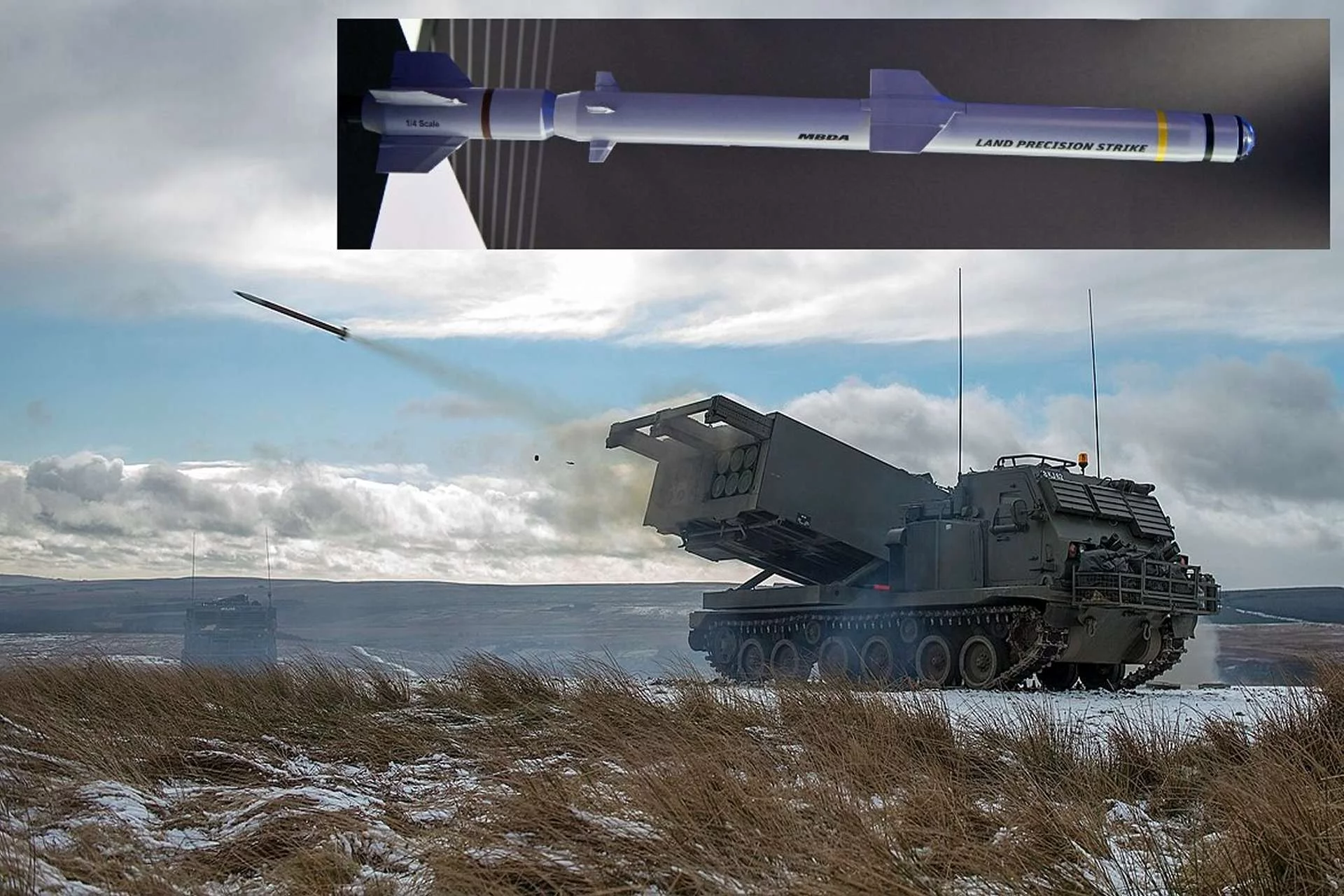
MBDA’s Land Precision Strike (LPS) is a compact, surface-launched precision munition pitched as a practical way to help the British Army expand its long-range strike options without over-reliance on air or naval platforms. Designed for launch from MLRS rocket pods or Mk 41 vertical launch cells, LPS pairs a multi-mode AI seeker with INS/GPS navigation, turbojet propulsion, a multi-effect warhead and a bi-directional datalink for in-flight updates and retasking.
Smaller and lighter than conventional cruise missiles (MBDA cites a mass under ~140 kg and length below 3.5 m), LPS is built to operate from existing rocket and VLS infrastructure. Its seeker suite uses AI-assisted automatic target recognition and multi-object mapping to engage fleeting or mobile high-value targets, while turbojet sustainment and onboard power support advanced sensors and maneuverability during flight. Selectable fuzing and a multi-effect warhead let commanders tune terminal effects to mission needs, from precise kinetic hits to lower-collateral or non-kinetic options.
A core operational feature is the two-way datalink: in-flight retargeting, mission abort, status reporting and even missile-to-missile cooperation are envisaged, enabling both fire-and-forget employment via onboard ATR and operator-assisted shoots using semi-active laser designation when human verification or collateral control is required. These capabilities are aimed at contested or degraded electromagnetic environments where persistent, adaptable surface-launched effects offer an alternative to exposing aircraft or warships.
LPS’s launcher-agnostic design and multi-domain potential—land MLRS and naval Mk 41 integration among them—allow planners to distribute strike assets across domains, increasing resiliency in anti-access/area-denial scenarios and complicating enemy targeting calculus. Yet fielding LPS at scale would demand upgrades to C2, sensor networks and tactical datalinks, plus training on dynamic retasking and ATR limitations. Legal and doctrinal frameworks for AI-assisted targeting and human-in-the-loop requirements would also need clarification.
Industrial adoption likewise goes beyond the missile: integration kits for launchers, sustainment for turbojet munitions, secure datalink ecosystems, and interoperability with allied architectures are necessary procurement considerations. MBDA positions LPS as a complement—not a replacement—to existing air and artillery strike options: a retargetable, sensor-rich, surface-launched tool that promises persistent engagement and reduced platform exposure. Its real operational value will hinge on successful technical integration, doctrinal evolution and robust C2 and legal structures to govern AI-enabled targeting in contested battlefields.
