

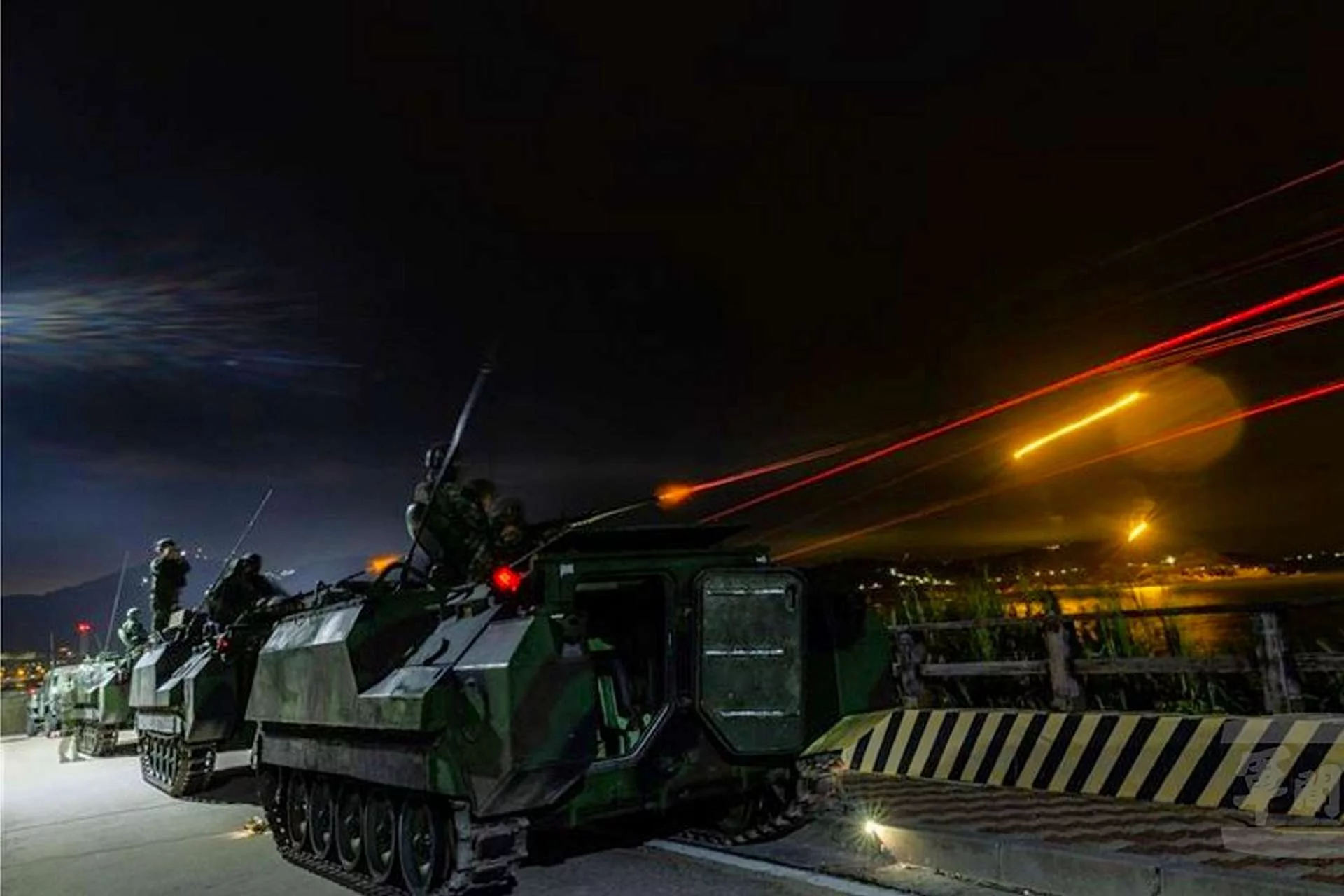
On 4 November 2025, the Matsu Defense Command staged a nighttime live exercise on Nangan Island that linked drone reconnaissance, mechanized maneuvers and layered fires. Conducted as part of the fourth-quarter Yuntai exercise, the drill reflected a shift toward combat-oriented, scenario-based training on the outlying islands closest to the Fujian coast. The sequence and objectives were disclosed via Taiwan’s Military News Agency.
Drones, Armored Units and Focused Fires in Concert
The exercise began with small unmanned aerial systems scanning approaches and cueing maneuver units. Mechanized infantry in CM-21/CM-23 variants raced to firing positions under blackout discipline and prepared munitions. Illumination rounds from 105 mm howitzers and 81 mm mortars temporarily turned the littoral into daylight, stripping concealment from simulated infiltrators. The finale concentrated short, intense fires from 20 mm guns and .50-caliber machine guns at sea and air threats — emphasizing rapid detection, decisive positioning and brief, lethal engagements over prolonged fire demonstrations.
Legacy Platforms and Organic Firepower
The platforms used reflect a pragmatic “island fight” toolkit. The CM-21 family, descended from the M113 lineage, favors simplicity, amphibious capability and maintainability; the CM-23 mortar carrier adds organic indirect fires to small units. In narrow, road-scarce terrain, these light, mobile vehicles trade heavy armor for agility and quick dismounts. Paired with illumination fires, they deny attackers the cover they would need at the critical moment of landing.
Why This Matters for Gray-Zone Contests
The scenarios are grounded in reality: recent drone intrusions around Nangan have disrupted civil aviation, underlining that coercion can start below the threshold of open conflict. Yuntai’s focus on night reconnaissance, rapid occupation of firing positions and concentrated short-duration fires is a direct operational response: locate first, expose the intruder with light and steel, and force dilemmas before any foothold forms. Lessons from larger Lu Sheng force-on-force events — decentralized command, small-unit initiative and real-time data sharing — are being applied at the exact coves, airstrips and approaches that matter most.
Strategic Effect: Deterrence at the Edge
Exercises like this complicate calculations that the outlying islands are “easy wins.” They telegraph resolve to defend populated terrain close to the mainland while avoiding escalatory massed displays. Compressing the sensor-to-shooter loop and pushing decisions to platoon level raises the cost and risk for gray-zone probes. Combined with drones and seasoned tracked carriers, illumination-led fires turn geographic constraints into timing advantages.
Detect Sooner, Decide Faster, Strike Immediately
The Nangan night drill sent a clear signal: frontline defenses will detect first, make faster decisions and strike under flares to prevent incursions from taking hold. By marrying unmanned sensing to veteran tracked platforms and disciplined short-burst fires, the Matsu Defense Command refined a local playbook that strengthens deterrence and raises the bar for any adversary contemplating sudden, deniable actions.
