

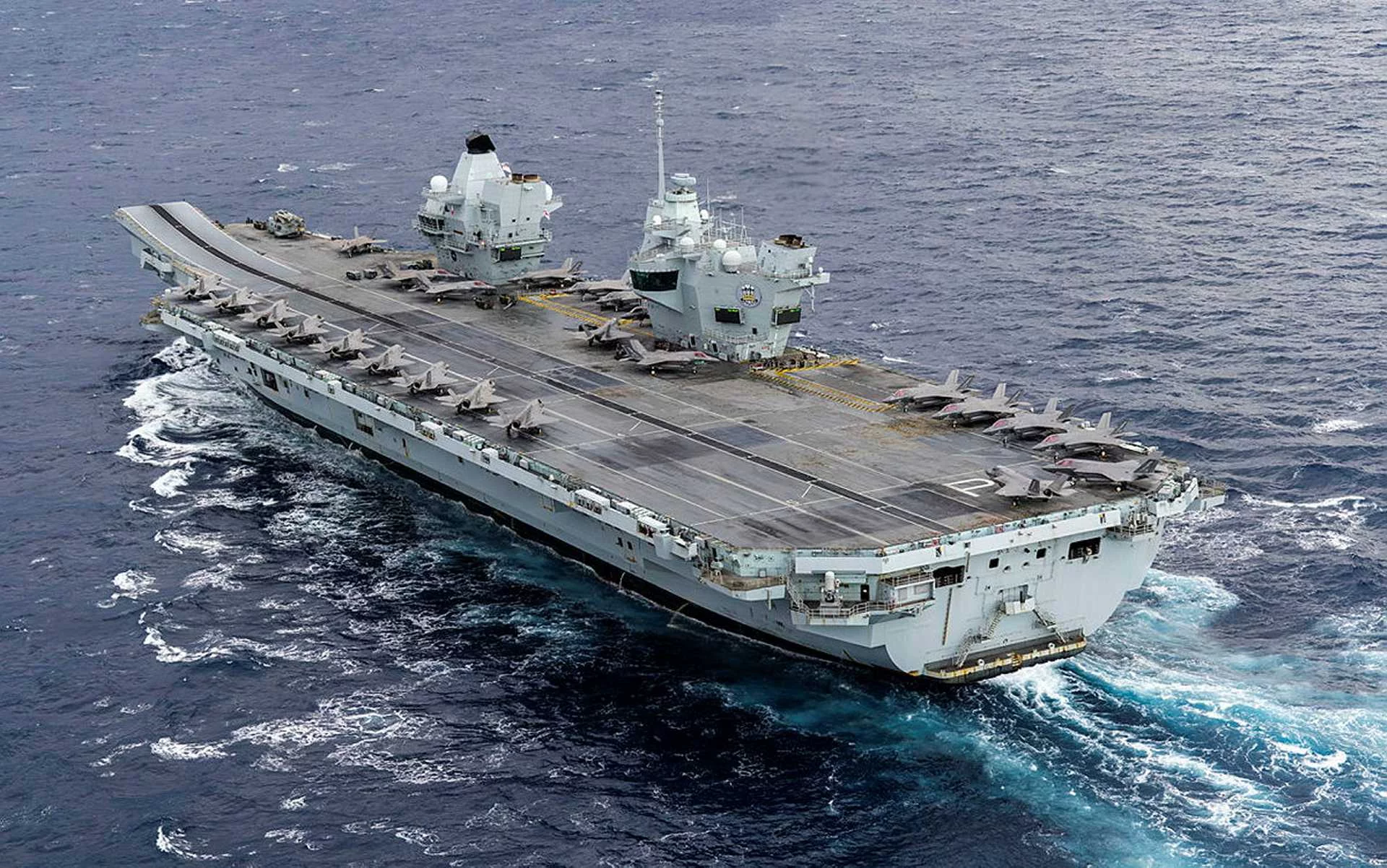
NATO has completed its most ambitious maritime aviation exercise to date, bringing together two European aircraft carriers—the UK’s HMS Prince of Wales and Italy’s ITS Cavour—under a single command structure during Exercise Neptune Strike 25-4, held from 16 to 26 November 2025.
The operation represents a major milestone in Europe’s evolving carrier strike capabilities, signaling a clear shift toward joint, high-end naval aviation led by European allies.
A New Era of European-Led Power Projection
According to NATO officials, both carrier strike groups operated simultaneously under alliance tasking, supported by a broad array of air, surface, and subsurface assets. The integration demonstrated NATO’s ability to synchronize complex, multi-domain maritime operations—a capability European navies have been developing since the first Neptune exercises earlier in the decade.
HMS Prince of Wales: NATO’s Maritime Strike Flagship for 2025
Largest Fifth-Generation Carrier Air Wing Ever Embarked in the UK
The 65,000-ton HMS Prince of Wales deployed with the largest fifth-generation air wing ever fielded by a British aircraft carrier. F-35B Lightning II jets from the RAF’s No. 617 Squadron and the Royal Navy’s 809 Naval Air Squadron executed synchronized missions throughout the training areas.
The carrier’s air group also included:
- Merlin HM2 helicopters for anti-submarine warfare
- Early-warning and airborne surveillance variants
- Platforms integrated with NATO ground command-and-control networks
UK Carrier Strike Group Composition
Supporting vessels accompanying HMS Prince of Wales included:
- HMS Diamond (Type 45 destroyer) equipped with Sea Viper air defense
- HMS Portland (Type 23 frigate) specializing in submarine tracking
- Royal Fleet Auxiliary Tide-class tanker enabling long-endurance operations
- A suspected Astute-class attack submarine, enhancing deep-sea intelligence and strike capability
ITS Cavour: Italy’s First Major NATO Deployment with F-35B Jets
Mixed Harrier and F-35B Air Wing at Sea
Italy’s 27,900-ton ITS Cavour played a central role in Neptune Strike 25-4, deploying a blended air wing of AV-8B Harrier IIs and a growing complement of F-35B Lightning II jets. This marked one of the earliest NATO maritime operations involving Italy’s fifth-generation aircraft at sea.
Cavour also carried:
- NH90 helicopters
- EH-101 multi-mission platforms for ASW, maritime utility, and SAR roles
Italian Carrier Strike Group Assets
Italy’s task group included:
- Andrea Doria-class destroyer with Aster 30 long-range air defense
- Bergamini-class FREMM frigate configured for ASW and multi-role missions
- Vulcano-class support ship for at-sea replenishment
- A probable Todaro-class submarine, providing undersea deterrence
High-Tempo Joint Operations Across NATO’s Southeastern Flank
Coordinated Air Power Over the Mediterranean and Black Sea Approaches
Throughout Neptune Strike 25-4, both carrier groups conducted synchronized missions across the Mediterranean, Adriatic, and training zones in Romania and Bulgaria. F-35Bs trained with NATO Joint Terminal Attack Controllers (JTACs), simulating precision strike missions supporting multinational ground forces.
Key alliance contributions included:
- NATO RQ-4D Phoenix ISR drones
- USAF B-52 and B-1B Bombers executing strategic deterrence sorties
- Anti-submarine and amphibious support helicopters from France, Greece, and Norway
- Allied airborne early-warning and tanker aircraft extending mission endurance
Carrier-to-Carrier Interoperability Tested for the First Time
Cross-Deck F-35B Operations Achieved
One of the most notable achievements was the successful execution of cross-deck operations, enabling British and Italian F-35Bs to land and launch from either carrier. This capability is critical for:
- Emergency recoveries
- Dynamic redistribution of aircraft
- Joint strike operations during high-intensity conflict
A Clear Strategic Message: Europe Now Fields a Scalable Carrier Strike Capability
Neptune Strike 25-4 demonstrates that NATO now possesses a maturing, European-led carrier strike force with the ability to deliver multi-domain effects without relying solely on U.S. carrier presence.
The operation strengthens the foundation for future integration with:
- France’s Charles de Gaulle,
- The upcoming PANG next-generation carrier,
- The UK’s future Global Combat Ship program,
collectively signaling that Europe is emerging as a fully capable maritime power prepared for crisis response and high-end deterrence.
