

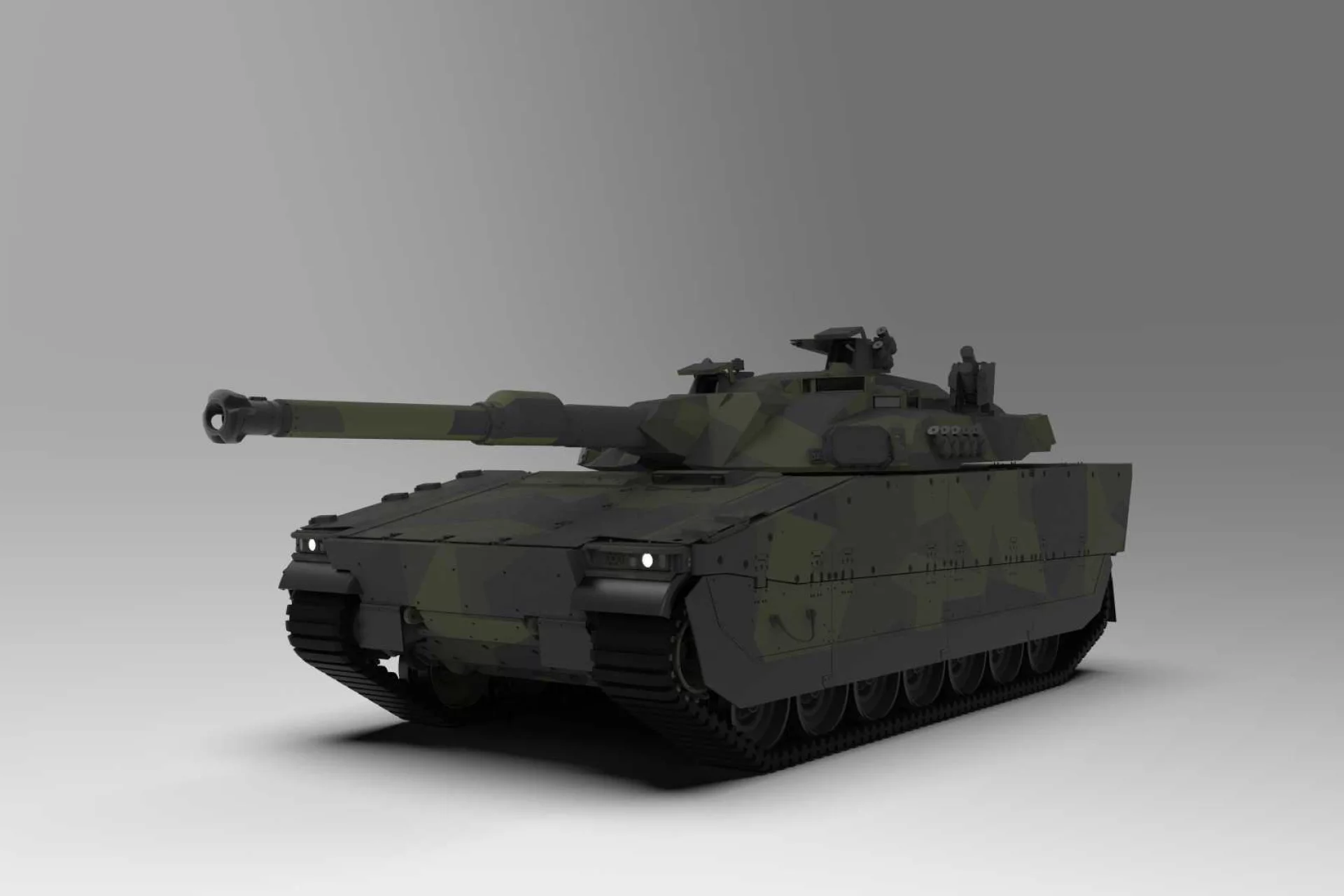
BAE Systems Hägglunds and Rheinmetall Weapon and Ammunition will evaluate a CV90120 prototype fitted with Rheinmetall’s L44A1 120 mm low-recoil (LR) gun to determine whether a lighter tracked vehicle can match main battle tank firepower while offering easier deployment and lower logistical burden.
The agreement signed on 8 October 2025 covers tests of an L44A1-equipped turret installed on the CV90 Mk IV chassis. The concept is simple: retain compatibility with standard NATO 120×570 mm ammunition but reduce structural loads and enable a 30–40 tonne class vehicle to operate with tank-grade lethality and reach.
The L/44 family is a NATO staple; the A1 variant keeps the same barrel length and chamber geometry but adds reinforced structures, upgraded steel alloys and refined recoil systems to tolerate higher chamber pressures and extended service life. That allows firing legacy rounds alongside newer high-pressure kinetic types such as the DM63A1 and DM73 while lowering impulse transmitted to the host vehicle.
The L44A1 supports a broad ammunition set — from programmable DM11 high-explosive rounds (airburst, delay, point-detonation modes; effective out to ~5,000 m) to modern kinetic penetrators capable of 2,000 m-plus engagements with penetration in excess of 600 mm RHA under optimal conditions. Cartridge weights typically range 18–29 kg and sustained firing rates depend on turret automation and stowage, roughly 6–10 rounds per minute — parameters that define the mechanical and energetic envelope any vehicle must accommodate.
Rheinmetall’s Low Recoil variant reduces peak impulse through longer recoil travel, tuned buffer assemblies and optional muzzle devices, enabling lighter turret structures to absorb firing loads without sacrificing projectile performance. The design improves barrel life beyond earlier L/44 norms and, with temperature-stable propellants, offers consistent performance across extreme environments. These engineering choices spread loads more evenly and help preserve accuracy and component alignment on lighter platforms.
To accept the L44A1, the CV90120 prototype receives chassis reinforcements, upgraded recoil mounts and a stabilized suspension to maintain rigidity and firing precision on the move and when static. Dimensions vary by fit, but the vehicle is roughly 6.6 m long, 3.3 m wide and about 2.8 m tall; combat weight is projected between 35–37 tonnes depending on armor. A Scania diesel powerplant up to 1,000 hp coupled to an automatic transmission provides road speeds up to ~70 km/h. An autoloading turret with space for some 45–50 rounds enables sustained firing profiles comparable to heavier tanks while keeping crew size to four.
The CV90 baseline brings active damping suspension, reinforced drivetrains, rubber-band tracks and a digital fire-control architecture capable of programming advanced munitions. Survivability is enhanced through modular armor, active protection systems and advanced situational-awareness sensors; secondary roof-mounted machine guns and countermeasure launchers are also supported. Together these features let the CV90120 perform direct-fire support, anti-armor and area-engagement roles at extended ranges while preserving mobility and reducing logistical footprint versus traditional MBTs.
Integrating the L44A1 Low Recoil into the CV90120 enables a lighter tracked vehicle to project main-battle-tank-level effects without the mass or heavy structural reinforcements of a true MBT. Using standard NATO 120×570 mm rounds simplifies supply chains and training for forces already operating this calibre. The approach delivers faster deployment, lower fuel and drivetrain wear, and greater tactical flexibility — distributing heavy direct-fire capability across lighter, more mobile formations while preserving interoperability with existing ammunition and sustainment networks.
