

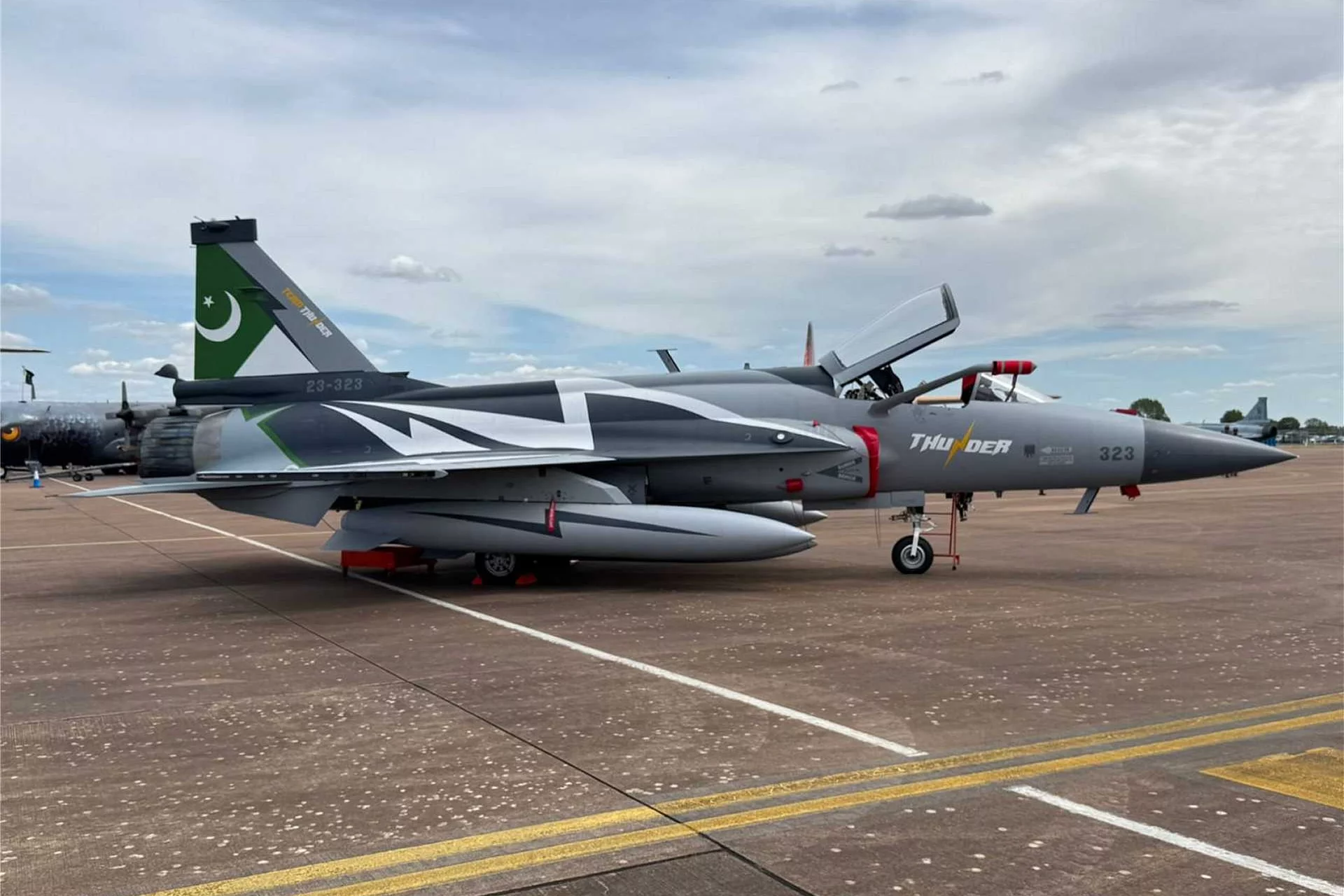
Pakistan’s cutting-edge JF-17 Block III fighter jet made its first-ever appearance in Europe at the Royal International Air Tattoo (RIAT) 2025, held at RAF Fairford in the UK. This milestone static display signaled Pakistan’s intent to position the aircraft as a competitive export option on the global stage. Two JF-17C Block III jets from the Pakistan Air Force’s No. 8 Squadron were showcased, supported by an IL-78 aerial refueling aircraft and a C-130E Hercules transport, highlighting the PAF’s expeditionary capabilities and its growing international ambitions.
The JF-17C Block III—an upgraded and export-focused version of the Thunder multirole fighter—is the most advanced model in the JF-17 series, co-developed by Pakistan Aeronautical Complex (PAC) and China’s Chengdu Aircraft Corporation. This latest variant moves the platform into the 4.5-generation category, offering a compelling alternative to legacy fighters such as the F-16 and China’s own J-10C. The Block III incorporates enhanced avionics, modular mission systems, and performance upgrades designed to appeal to both domestic and international customers.
At the core of the Block III’s improvements is the integration of the KLJ-7A Active Electronically Scanned Array (AESA) radar—marking the first time such technology has been installed on a Pakistani fighter. This radar enables superior target acquisition, electronic counter-countermeasures (ECCM), and the ability to track and engage multiple targets simultaneously. The aircraft’s cockpit features a wide-area multifunction display, full fly-by-wire control, a helmet-mounted display and sight (HMD/S), and an advanced electronic warfare (EW) suite—all designed to boost pilot effectiveness and survivability.
The jet is powered by the RD-93MA engine, offering improved thrust and efficiency compared to earlier variants. In terms of armament, the aircraft at RIAT 2025 displayed a suite of advanced Chinese weapons, including PL-10 infrared-guided short-range air-to-air missiles and PL-15E beyond-visual-range (BVR) missiles. The PL-15E, though an export variant, still offers formidable range and BVR capability, rivaling many Western systems.
Further enhancing its combat effectiveness, the JF-17C Block III supports a full array of precision-guided munitions and sensors, including infrared search and track (IRST), electronic countermeasures (ECM), and secure data link systems. The platform’s AESA radar is especially valuable for multi-target tracking in high-electronic-warfare environments, making it suitable for modern contested battlespaces.
On the international front, the Block III has already seen significant export success. Pakistan recently finalized a $4.6 billion deal with Azerbaijan for 40 units—its largest defense export contract to date. Previous JF-17 variants are already in service with countries like Myanmar, Nigeria, and Ghana, and interest in the Block III is rising across Africa, Latin America, and Southeast Asia. Its affordability, advanced features, and political flexibility make it an attractive option for countries facing budgetary or diplomatic restrictions when buying Western systems.
Pakistan’s aerospace industry has evolved significantly in the past decade. Once limited to assembly and maintenance roles, PAC Kamra now oversees a fully integrated defense aviation ecosystem—from design and production to export. The JF-17 Thunder program has played a central role in this transformation, reducing Pakistan’s dependency on Western suppliers and fostering a new generation of engineers and defense professionals. Local innovations now include avionics development, mission computing, data links, and structural components—cementing PAC’s role as a regional aerospace hub.
By showcasing the JF-17 Block III at RIAT 2025, Pakistan is making a calculated effort to expand its defense export footprint and break into markets traditionally dominated by NATO aircraft. The display not only demonstrated the fighter’s technical maturity but also served as a strategic advertisement aimed at prospective buyers looking for modern multirole capabilities at a fraction of the cost of Western fighters. Pakistan’s message was clear: the JF-17 is no longer just a low-cost option—it’s a capable and credible contender on the global stage.
